Our European Letter

3%

Pacific Press Publishing Association · Mountain View, California · Jul 11, 1911

FromSigns of the Times, Vol. 38, No. 27.

Read the full edition

Our European Letter

From Our Own Correspondent
[Mr. Jean Vuilleumier was formerly editor of Les Signes des Temps, of Bâle, Switzerland, has spent several years in the Americas as journalist, teacher, and preacher, and is now engaged in teaching. He is well informed on European and world affairs.—Ed. S. or T.]

Protestantism in Geneva

In the midst of external prosperity and the glories of nature, Geneva is passing through dark experiences. Only two years ago, we had the great Calvin Jubilee, which seemed to give a new luster to the religious reputation of this city. But this great demonstration did not heal the grievous sores of which Geneva as a religious community is suffering. On the one hand, a great influx of world-loving, either irreligious or Catholic population, is coming in from the surrounding countries. A great many of them become naturalized. Naturally they help in electing the officers of government, many of whom know nothing of the history and spirit of old Geneva. Lost in this new element, which makes out a large majority, the small nucleus of sturdy Protestants is nearly drowned, and their efforts to counteract and resist the mighty wave of evil is almost hopeless. Such has been the case in late years in the endeavor to fight the liquor traffic, legal prostitution, and gambling.
We have had in the last few days a new and bitter illustration of this. The Casino, an amusement resort, was operating a gambling establishment in defiance of a clear article of our Swiss constitution. The Geneva government remaining deaf to all complaints, the matter was carried to the federal authorities. After a careful study of the matter, the federal council has issued a decree ordering the closing of the gambling portion of the pleasure resort. Thereupon, a mass-meeting was organized by the frivolous, office-seeking party to protest against this decree. Six thousand persons were gathered in a public hall, and were harangued by half a dozen speakers, among them the president and vice-president of the city government. The religious element of the community, which is more or less responsible for the various moralizing campaigns going on in the city, was vituperated and insulted in no ordinary fashion. In this wholesale abuse were included, of course, "ultra-protestantism" and "Calvinism;" and all this in the name of liberty, honor, and the good name of Geneva! One of the speakers, the vice-president of the State Council, said that he had not witnessed such a glorious demonstration in his whole already long political career. The manifestation ended with disorder and noise through the streets and before the building in which the "Journal de Geneve" is edited.

The Morality of Geneva

The Protestant people are ashamed and disgusted and almost discouraged at the prospect which faces them. Any illusions which they might have entertained as to the real issue before them have now disappeared. Geneva, as a Protestant, religious, or even moral city, is a thing of the past. Would to God that those who claim to believe in the Christ of the Bible were consistent Bible Christians themselves. There might be some hope left. Matters in Geneva looked worse than now when Calvin took up the task of moralizing and evangelizing the city. Once he was exiled; and ever after that it took all the forbearance, all the faith in God and in the Scriptures, that animated him and his successors, to succeed in establishing a clean city and in maintaining it such for a century or more. Vergerio, bishop of Capo d'Istria, going through Geneva, about 1540, did not meet a single beggar (which was a strange thing to an Italian). Another traveler at that time marveled very much at the harmony and the order which he saw there, and declared that he would like to transfer this city to Germany.
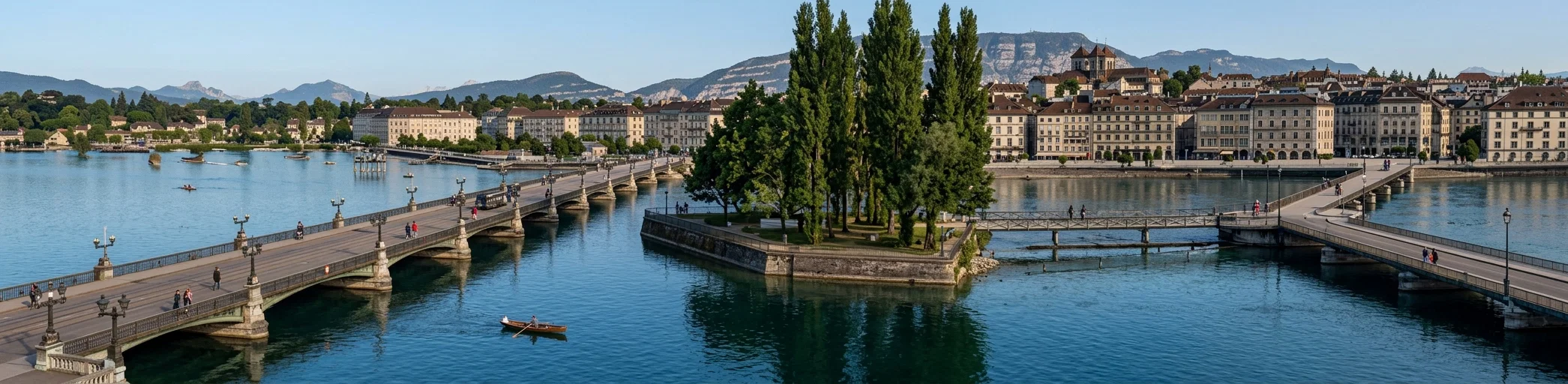
IN THE CITY OF GENEVA, SWITZERLAND, THE HOME OF CALVIN

Higher Criticism

But they held to the Bible, and to the God of the Bible, and to the Christ of the Bible; and it worked wonders, by the blessing of God. This is not the case now. Under a guise of respect, the Bible is being demolished by all the theological professors, and infidelity is thus fostered among the mass of church-going people. A few individuals here and there dare to raise their voice against this "higher criticism;" but their voice is hushed by a conspiracy of silence. No one with sufficient authority to claim attention has come out to antagonize and denounce this baneful work.
This stage of the controversy seems to have passed by in some portions of Germany, where university professors are bold enough, probably on account of general indifference, to deny publicly the existence of such a being as Jesus Christ. "Jesus of Nazareth never existed," they say: "authentical history does not know Him. All that is told about Him is pure imagination." So says Mr. Arthur Drews, professor of philosophy at Carlsruhe. This was the burden of lectures which he gave in Frankfort, Jena, Berlin, and other places of learning. He found an opponent in Professor de Soden, who thought that if the proposition were true, internal Christianity would not lose very much. At Jena Mr. Drews silenced all opposers by saying that he did not care very much whether Jesus existed or not, provided it were granted that "the Jesus of the Gospels" never existed—a proposition to which all "liberal Protestants" were ready to adhere. At Berlin, however, an enthusiastic crowd filled two large halls to listen to lectures in favor of the belief in the historic Christ. This is very well; but these people would be doing better still if they were careful to see that the Gospels upon which their faith in Christ is based are not broken to pieces by their own professors or pastors.

Mob Law in France

The recent disorder in Champagne, France, has caused the loss of thirty million francs' worth of property, most of which consisted in millions of liters of champagne poured out on the streets, and in houses devoured by fire. This shows distinctly that the spirit of anarchy is unfortunately gaining ground instead of receding. How could it be different where religion is unknown except under the form of superstition, where pleasure-seeking and money-making are the only ideals followed, and where government, instead of stepping in firmly to repress and punish violence and wanton destruction, thinks only of pandering to popular passions in view of securing the votes of Socialists at the coming elections! Socialism holds the balance of power, and has filled France with its doctrine of strike and violence. The weakness of the government fosters the idea that "nothing can be obtained without violence; through violence everything is obtainable; little is risked in using violence."
"This timorous weakness of repressive measures," says a paper, "has much to do with the repetition of troubles in all the recent disorders in France. This attitude is unaccountable and seems to us one of the ominous features of the situation."

Political Situation in Europe

But we must leave international troubles, to spend a few moments looking at the general political situation in Europe. As the daily papers have shown, the question of armaments has for several weeks focused the attention of statesmen. England, spurred by hostile movements on the part of Germany, has again sought its safety in making an enormous jump toward increasing its naval expenses. This was not an easy resolution to obtain from Parliament; but some very clever speeches by Sir Edward Grey, by Mr. Balfour and others, carried the matter successfully. The interesting feature of this parliamentary victory is the way in which satisfaction was given at once to rabid war partizans and to no less determined partizans of peace. To the former, an increased program of Dreadnoughts was presented; the latter were captured by a scathing denunciation of war expenses and by the prospect of a coming world arbitration era.
"The House might well say," said Sir Edward, "that it was a paradox that, the relations between the powers being as they were, armaments should be increasing so rapidly. Yes, but a much greater paradox is this,—that the growing enormous burden of naval and military expenditure, is coinciding not merely with the friendly relations between the powers, but with the growth of civilization as a whole." "Should this tremendous expenditure and rivalry go on much longer," he went on to say, "they would in the end break civilization down. Some people think it will lead to war, but I think it more likely that this burden will be dissipated by international revolutions; not by nations fighting against each other, but by the revolt of masses of men against taxation."
And yet the same speaker quieted all fears by waving before Parliament the olive-branch of peace. Such was the impression made by this speech, that mass-meetings were organized, mainly by pastors, to approve and extol the peace prophecies of the secretary of foreign affairs.
One of many papers says: Everything tends toward peace, but we notice that this is a peace with nations armed from head to foot, with arsenals overflowing with ammunitions, and powder kept very dry indeed; a peace, forsooth, such that no government can make a move without setting Europe ablaze. This is what can well be called dancing upon a volcano.
Another paper says: How long will this farce last? No one knows. One can feel that slowly the culmination is approaching, but wo to the nation which shall be taken unprepared.

The Fearful War Burden

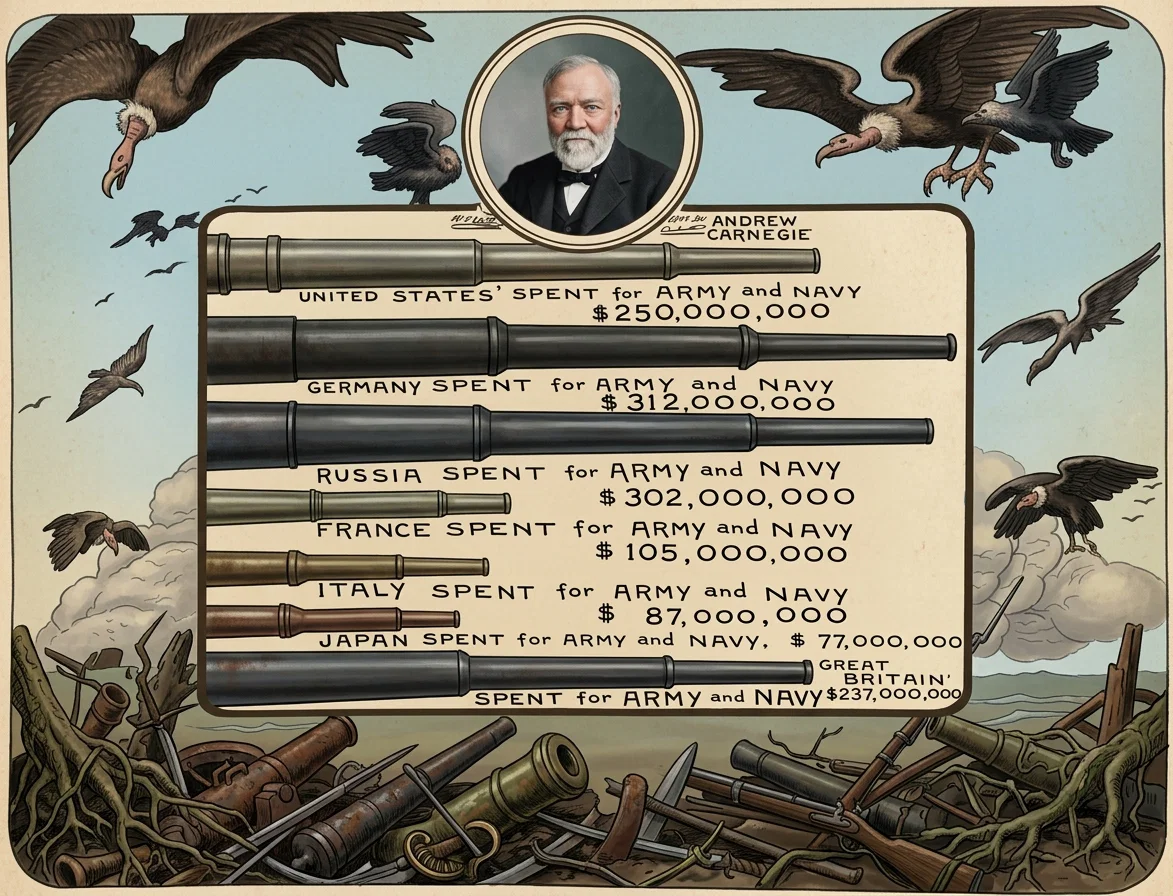
Describing the increasing war expenses, the leading editor of the "Journal de Geneve" remarks: These fantastic figures represent an effort on the part of the nations which it seems impossible for them to stand much longer. Already in England as well as in Germany, the great political crises of the last few years were caused by a question of taxes. As a result, civilized humanity is panting under moral anxiety. People may well say that these formidable armaments have maintained the peace; it is nevertheless a cause of concern to think that so much progress accomplished, that so much light thrown upon the world, have ended in this state of universal suspicion. Where are we going? No one knows. We are groping across a dark forest filled with burglars and wild beasts. . . . Never was peace so much spoken of since all nations are armed to the teeth. . . . We are running down toward destruction. How can we stop?
A French representative and ex-minister, M. Jules Roche, has made an approximate estimate of the cost, and has endeavored to describe the economical consequences, of a future war. He figures on the basis of the Franco-German War, which cost eleven francs ($2.20) a head each day. Counting that 2,860,000 men would be called out the first month of war, the daily expense would be 68,000,000 francs ($13,600,000). If the war lasted eight months, as it did in 1870-71, the total expense would be 9,810,000,000 francs ($1,962,000,000). Adding 10,700,000 men for Germany, Austria, and Italy, at ten francs a head each day (which is only about half what it would cost now), we would have 100,000,000 francs ($20,000,000) a day to add to the other sum. This leaves out the expense represented by England, the United States, Russia, etc. It also leaves out all naval expenses, which would make out nearly as much as the war on land.
The above cartoon was made from a clipping of a daily paper which was sent us. If we knew the journal from which it was taken, we would gladly give credit. It is a striking illustration of the relative standing, among the nations, of war and peace.
"These amounts," remarks M. Roche, "are much higher than the total revenue of each country. For instance, we have estimated the French war expenses at 68,000,000 francs a day; but actually the entire expenses of the French State amount only to 10,000,000 a day, of which 2,000,000 goes for war, thus leaving only a total expense of 8,000,000. In other words, a war would mean an increase of expense three and a half times that of the total budget of the State." But as M. Roche has not counted anything for naval war, and has rated the whole estimate at half the present cost, the real figures would be fourteen times the amount of the actual revenue of each government!
But this is not all. Where would this money come from? For we must consider that the economical and industrial operations—in other words, the production of wealth—would be rendered well-nigh impossible were almost the entire male population between twenty and forty-five called under arms. These fifteen to twenty million men leaving their work all at once will paralyze all large economical operations. Individual work only will be practicable; but how limited this work has now become! Social life will come to a standstill. What will come of electric and gas plants, of street-cars and other conveyances, of banks, of post and telegraph offices, of mines, of printing-presses, of flour mills, of factories of every description, and of ever so many industries, trades, and public services, which have become necessary to national life? Yes, what would become of naval traffic, without which the physical life of a nation is hardly to be conceived at the present time?
"The money crisis," concluded M. Roche, "would inevitably burst upon us with all its dreaded consequences. Everywhere, almost simultaneously, would be witnessed a crisis, an economical cyclone, such as was never seen in any nation since the world began."
Aye, and the solemn descriptions of the Holy Scriptures referring to this very state of things should be deeply meditated just now.