Editorial

7%

Pacific Press Publishing Company · Oakland, California · May 20, 1897

FromSigns of the Times, Vol. 23, No. 20.

Read the full edition

Editorial

An Important Question.

In the fourth chapter of 1 Corinthians, the seventh verse, is asked a question which not only Christians but unbelievers would do well to consider. It is this: "What hast thou that thou didst not receive?" The evident answer from the context is that we have nothing; all that we have that is of worth came from God. This all Christians profess to believe.

"Why Dost Thou Glory?"

Then if this be true, if we did receive from God all that we have, why should we glory, or boast, as tho we did not receive it, as tho it all came of ourselves? This is the question which the apostle presses home upon Christians. There is frequently much boasting one against another. Our brother's talents are decried and belittled while one's own are exalted in comparison. Emulation and strife are everywhere prevalent. Now if we have clearer knowledge, greater wisdom, or superior talents, they came from God, the Giver of all good and perfect gifts. Why should we boast of them? If our brother has less, why should we glory over him? Why not rather rejoice that God has granted us great blessings, and gratefully strive to impart them to others? Why not be grateful that our brother also has talents, and endeavor to supply his lack by our fulness? To press the question further, How do we know—by what can we judge—that our talents are superior to his? God may decide differently as he weighs their true worth in the balances of the sanctuary. Let us be meekly modest, praising God for all that he has given not only to ourselves but others, and ever remember that he gives them to us not that we may boast in ourselves but in Jesus Christ, and thus be a blessing to others. To God belongs the glory, not to thee.

To the Unbeliever.

Oftentimes unbelievers ridicule the Bible, the New Testament, the writings of Moses and the prophets, the miracles, the vicarious atonement, the lives of professed Christians, and then boast of their own morality. They tell us, while Shakespeare and Byron adorn their libraries, that they would not have the Bible read in their homes by their children; that its morals are low, etc. The lives of insincere and inconsistent Christians, as well as the sins of inconsistent characters of the Bible, are held up as reasons why the Bible should be condemned. But in themselves, their morals, their teaching, they glory.
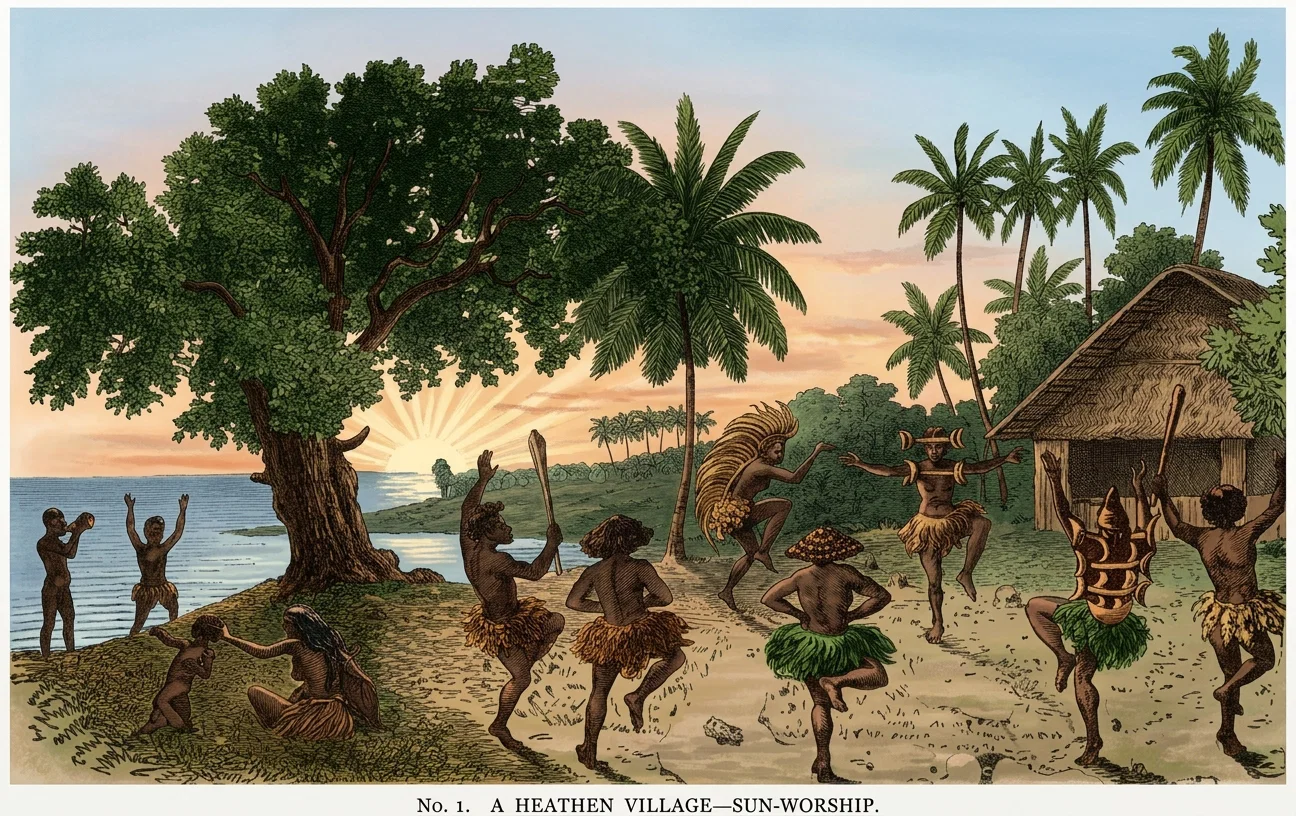
NO. 1. A HEATHEN VILLAGE—SUN-WORSHIP.
"Why Dost Thou Glory?"—The question may profitably be pressed home by each one of them to his own heart. "What hast thou that thou didst not receive?" Not many centuries ago those lands now called Christian, where these scoffing unbelievers dwell, were heathen lands. Most of the people were worshippers of nature in various forms. The most widespread and the most abominable of all these forms of worship was sun-worship. Our cut shows one of its milder and most harmless demonstrations. But every sin in the catalogcould find shelter under its broad mantle. It was noted for the most abominable licentiousness. Prostitution of female purity at its shrine was a part of its worship. Human life was frequently demanded as a part of its sacrifices. Our Anglo-Saxon ancestry were worshipers in these abominable idolatries. And had God allowed them to go on in their chosen blindness, there we would have been if we had been at all.
NO. 2. THE SAME VILLAGE UNDER CHRISTIANITY.
But Christianity, pure, fair-faced, white-winged, and clean-handed, born from above, strong in the strength of the Mighty One, with the love and pity of the Infinite, entered the dark forests of idolatry. Wherever she went, light streamed, day dawned, idol temples fell, heathen shrines crumbled, human life and virtue became sacred, and the whole face of the earth was changed. As the years passed on, while the power was sensibly diminished in its marked manifestations as seen in its earlier day, its teachings broadened and spread; and while many times the form exists without the power, even the form reveals its superiority over those of all false religions, the code of morality higher and purer. Its ethical teachings have permeated the world, and while those relating to God are abjured by many, those relating to men are accepted generally by all; and the innate force of these teachings has made the grosser sins and crimes of heathenism unpopular. The conclusion is, therefore, that all that is good and true and pure and noble and lovely in the teaching and life of the skeptic has come to him from Christianity, its source; for had it not been for Christianity, he would still be causing his son to pass through fire, and his daughters and wife would still lay down their virtue at the shrine of sun-worship. But now like an angry babe he smites the breast which gave him nourishment. He uses his God-given knowledge to curse God. He tramples on the Book, as his prototypes did its Author, which has brought him the best blessings of purity, home, and health. "What hast thou that thou did not receive?" Then "why dost thou boast?"

A Difference.

We are not defending the sins which have been committed in the name of Christianity. We are not defending the inconsistency of Christians. They have no defense. The loudest skeptics are themselves witnesses that the teachings of the Bible and the example of Christ do not justify the crime, the sin, the oppression, the persecution, the selfishness of professed Christians. It is a sad fact that the world is rapidly drifting backward, and much of professed Christianity is but heathenism disguised. What matters it whether our belief be carved in a cold, dead image, or penned in a cold, dead creed? When a matter of life or death faces us, what matters it even tho one form of worship be a little superior to another form? It is life the sick and dying world needs; and Christianity is that life. All that is good or pure or blessed or elevating or sanctifying comes from that, flows out from the ever-living, flowing Fountain to every thirsty soul who would drink.

The Supremely Sure Test.

This is the sure test, repeated in varied forms in the Book of God: "If any man will do his will, he shall know of the doctrine." This is the supreme test, the one sure proof of the truthfulness of God's word and the power of Christianity. He who thus makes proof will be satisfied. He will not boast himself. He will give all the glory to God, and God will bestow of his own glory upon him.