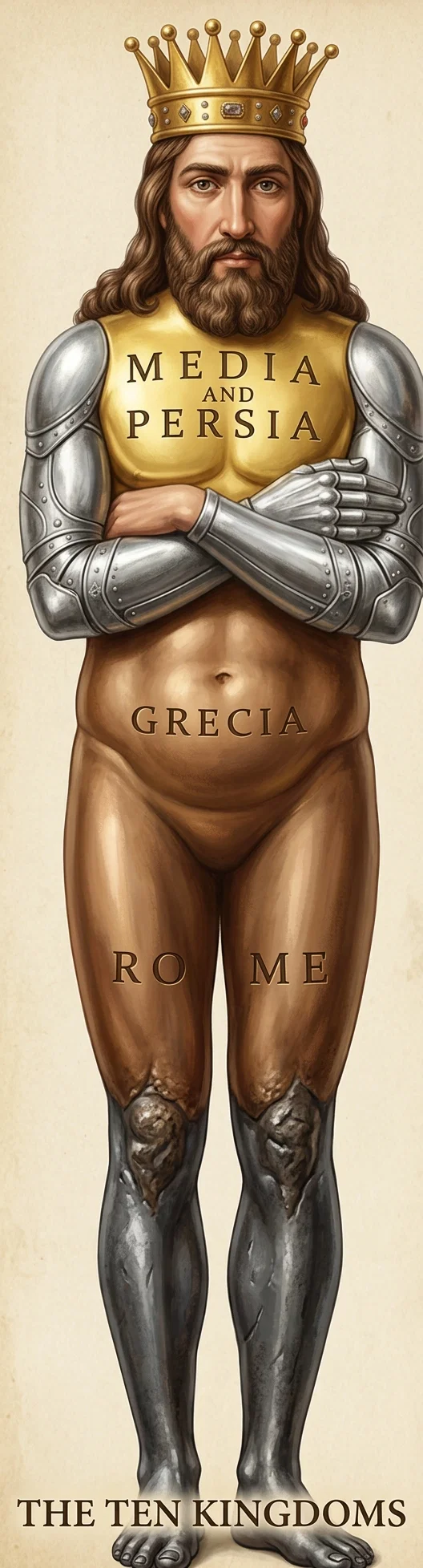
"PROPHECY" as used in the Word of God covers foretelling future events and teaching by the Spirit. In a broad sense it permeates every part of the Word of God; but in a narrower sense, the prediction of future events, it comprises, either in described symbols or words, a great part of the Bible. Not alone do we have the predictions of events to come by Moses, Isaiah, Jeremiah, Daniel, Ezekiel, and others, but every sacrifice offered, every ceremonial in feast and offering ordained of God, was a type of the Great Sacrifice and the work and coming of him whose Spirit spoke through the prophets.
For all the Word of God came through Christ, the Logos. "In the beginning was the Word. . . . Without him was not anything made that was made. In him was life; and the life was the light of men." "But to us there is but one God, the Father, of whom are all things; . . . and one Lord Jesus Christ, by whom are all things." The world was therefore created by him; the Word of God was given through him; the light and life and Spirit that are in him he has placed in his Word; for he declares, "The words that I speak unto you, they are spirit, and they are life." "Thy Word," says the psalmist, "is a lamp unto my feet, and a light unto my path." "We have also a more sure word of prophecy; whereunto ye do well that ye take heed, as unto a light that shineth in a dark place, until the day dawn, and the day-star arise in your hearts." "Of which salvation the prophets have inquired and searched diligently, who prophesied of the grace that should come unto you; searching what, or what manner of time the Spirit of Christ which was in them did signify, when it testified beforehand the sufferings2of Christ, and the glory that should follow." Many more passages of Holy Writ might be quoted to prove that all the Word of God came through Christ, the divine Logos, whose Spirit spoke through prophet and apostle. The light is his light, and to slight it, ridicule it, or reject it, is to reject its Author, the anointed Son of God.
The prophetic word of God, therefore, reveals to us Christ Jesus; and the events it foretells are those in connection with his kingdom and work. He reveals them for the benefit of his children. He warns them of danger; he points out the delusions and snares of the enemy, and he directs them to the only sure refuge, the Word of God received into the heart by faith. "Surely the Lord God will do nothing, but he revealeth his secret unto his servants the prophets." In the darkness he lightens the way. In the Babel of voices and the uncertainty of sin Jesus Christ has thus given to the world through his people faithful warning.
One of these remarkable prophecies, in which God has condensed into a few short verses the rise and fall of mighty empires, spanning the history of civilization, is found in the second chapter of Daniel. The symbol was a dream given of God six centuries before Christ to Babylon’s proudest and greatest king, Nebuchadnezzar. The dream could not be interpreted by the heathen wise men or magi, and a servant of the Most High God was brought before the monarch for the purpose of meeting the test which he had imposed upon the pretended revealers of secrets,—the dream must be told as well as the interpretation, under penalty of death. Daniel and his companions seek God, and the Lord reveals to him the dream, as follows:—
"Thou, O king, sawest, and behold a great image. This great image, whose brightness was excellent, stood before thee; and the form thereof was terrible. This image’s head was of fine gold, his breast and his arms of silver, his belly and his thighs of brass, his legs of iron, his feet part of iron and part of clay. Thou sawest till that a stone was cut out without hands, which smote the image upon his feet that were of iron and clay, and brake them to pieces. Then was the iron, the clay, the brass, the silver, and the gold, broken to pieces together, and became like the chaff of the summer threshing floors; and the wind carried them away, that no place was found for them; and the stone that smote the image became a great mountain, and filled the whole earth." Dan. 2:31-35.
This is the dream, the purpose of which, the prophet tells us, was that the king might know "what shall be in the latter days." Verse 28. It is written for us that "we through patience and comfort of the Scriptures might have hope." Rom. 15:4. After the dream, the prophet proceeds to tell to the king and the generations of the last days the meaning. He begins with the
Head of Gold,
which he applies to Nebuchadnezzar and his kingdom in the following words: "Thou, O king, art a king of kings; for the God of heaven hath given thee a kingdom, power, and strength, and glory. And wheresoever the children of men dwell, . . . hath he given into thine hand, and hath made thee ruler over them all.
"Thou art this head of gold."
This is a definite starting-point. In the shadowy past it carries us back to Nimrod, the mighty hunter of men, the leader in rebellion against God, the builder of the tower of Babel, and the founder of the kingdom of Babylon, the antitype of the great apostate powers which should afterward exist upon earth. (See Gen. 10:8-10; 11:1-9.) Nebuchadnezzar stood as the representative of the golden kingdom of the golden age of barbaric splendor and glittering pomp. The center of that kingdom was the city of Babylon, fifteen miles square, surrounded by moat and wall of gigantic proportions, containing the temple of Belus, three miles in circumference, and two royal palaces, respectively three and one-half and eight miles in circumference, the roofs to a portion of these covered with golden plates; the gates of brass, through the wall three hundred and fifty feet high, the hanging gardens luxuriant with tropical vegetation, and many other beauties we have not space to describe, made the royal city of Babylon what Inspiration has described it to be, "the Glory of Kingdoms, the Beauty of the Chaldees’ Excellency." Isa. 13:19.
But the same prophecy assures us that this city would pass away. While the principles of Babylon would remain, while the earth would become drunken by her fornication, her departure from God, her false doctrines respecting God and his government (Jer. 51:7), yet Babylon, mighty in her supposed strength and proud in her superficial glory, should pass away. "Babylon is fallen," says the weeping prophet (Jer. 51:8); "And after thee shall arise another kingdom inferior to thee," declares Daniel (chapter 2:39). To Babylon succeeded
Medo-Persia.
Isaiah predicted through whom that kingdom should fall two hundred years before it came to its doom. Before Cyrus the Persian, God would "loose the loins of kings, to open before him the two-leaved gates; . . . I will break in pieces the gates of brass, and cut in sunder the bars of iron." See Isa. 45:1-3. The last king of Babylon was the weak; bibulous, effeminate Belshazzar, who reigned conjointly with his father, Nabonidus, when the city fell. The account of the fall of the city is given in Daniel 5, Belshazzar’s doom being written before him by the hand of the angel in letters of fire on the night of his last inglorious, idolatrous, blasphemous debauch. "Mene, mene, tekel, upharzin," wrote the angel. "God hath numbered thy kingdom, and finished it; thou art weighed in the balances, and art found wanting; thy kingdom is divided, and given to the Medes and Persians," interpreted the prophet. And the sacred record continues: "In that night was Belshazzar the king of the Chaldeans slain. And Darius the Median took the kingdom." This occurred in B.C. 538, and the course of empire passed from Babylon to
Medo-Persia.
This empire is represented by the breast and arms of silver, a metal inferior to gold in value and beauty, but superior in strength. It is represented by the bear in Dan. 7:5, and by the two-horned ram in Dan. 8:3, 4. Of this dual empire Media at first was dominant, but it afterward became absorbed by Persia, the latest in point of time, but the greatest in point of power. Medo-Persian rule began in A.D. 538, and continued to B.C. 331, when the reigning king, Darius Codomannus, met his defeat at the battle of Arbela, before Alexander the Great.
It was during the existence of the Medo-Persian Empire that the people of God were released from captivity, through Cyrus the Great. Jerusalem and the temple were rebuilt and the Jewish polity to a limited extent restored under the decrees of Cyrus Darius, and Artaxerxes. The decree of the last named went forth in B.C. 457, when began the 2,300 years of Dan. 8:14.
To Medo-Persia succeeded
The Empire of Grecia,
the "third kingdom of brass, which shall bear rule over all the earth." It began its triumphant career to universal dominion under Alexander the Great, the conqueror of Darius Codomannus, B.C. 331, as before noted. In chapters 7 and 8 the same power is symbolized by a four-headed leopard and a rough goat respectively. This empire in the image extends from the breast to the knees. Tho united in the beginning, soon after the death of the greatest monarch, Alexander, it became divided, and thus weakened, until it was absorbed into the iron kingdom, represented by the legs and feet of the image.
It was during the existence of the Grecian Empire—B.C. 331 to B.C. 161—that the knowledge of God was spread through the learned world by the translation of the Scriptures into the Greek. This translation is known as the Septuagint.
The Roman Empire.
"And the fourth kingdom shall be strong as iron; forasmuch as iron breaketh in pieces and subdueth all things; and as iron that breaketh all these, shall it break in pieces and bruise." Thus declares the prophet, of the fourth kingdom. The language can apply to but one kingdom, namely, Rome; for not only did Rome succeed Grecia, but the description of the character of the power applies to the character of the Roman Kingdom. For other symbols of the same power see the description3of the prophet in chapters 7 and 8, of the fourth beast and the little horn.
Frequently, if not always, the kingdoms of earth are noted in the prophetic word when they become connected with the people of God, or in any way affect his work. A striking event in connection with the advancing empire of Rome was the conquering of Macedonia, B.C. 168. Seven years later came the Roman league with the Jews, and from that rapid progress was made to world-wide empire, completed by the conquest of Egypt, B.C. 30.
A Divided Kingdom.
"Iron" is the symbol of a strong centralized government, or imperialism. Clay, or earth, indicates that the people rule, and is a fitting symbol of democracy, division, and weakness. Of the fourth kingdom the prophet further says:—
"And whereas thou sawest the feet and toes, part of potters' clay, and part of iron, the kingdom shall be divided; but there shall be in it of the strength of iron, forasmuch as thou sawest the iron mixed with miry clay. And as the toes of the feet were part of iron, and part of clay, so the kingdom shall be partly strong, and partly broken."
Note that the division is not indicated by the natural division of the extremity of the foot into the toes; for (1) the division begins above the toes, in the feet, and (2) the Word expressly declares that it is caused by the commingling of the iron and the clay. The two will not mix, or weld, or blend. The mixture indicates a division which can not be overcome. It will exist even to the end. The strength of imperialism will mingle with the clay of division and anarchy.
The Roman Empire remained a unit until the fourth century, when its breaking up began by dissatisfaction in the central territory, in the provinces, in the leaders in these provinces, and by the incursions of barbarous and warlike tribes, like the Huns, from without. Since that time the Roman Empire has been divided between the various powers of Europe; and the prophecy declares that its division will continue to the end.
And yet many have endeavored to unite it. Charlemagne made the effort, and failed. Charles V. dreamed of a united empire, and his dream came to naught. Napoleon thought to weld together into one iron imperialism the nations of Europe, and through the power thus gained bear sway over the world, but his proud ambition was rebuked. God's providence fulfilled God's prophecy, or rather prevented puny man from making it void. The empire is divided still, and will be unto the end. "They shall mingle themselves with the seed of men," effort will be made to unite by intermarriage of royal families; "but they shall not cleave one to another, even as iron is not mixed with clay."
We are in the days of the divided kingdom still; but beyond that lies the everlasting kingdom of God, the rule of the Stone cut out of the mountains without hands. This we will consider next week. In the meantime let us consider not only the wisdom and power of God, which foreknew and foretold the history of the world, and the evanescence of earthly rule, in which there is no hope, but his goodness, that sets before us in contrast the everlasting kingdom, which is offered freely to all who will believe.