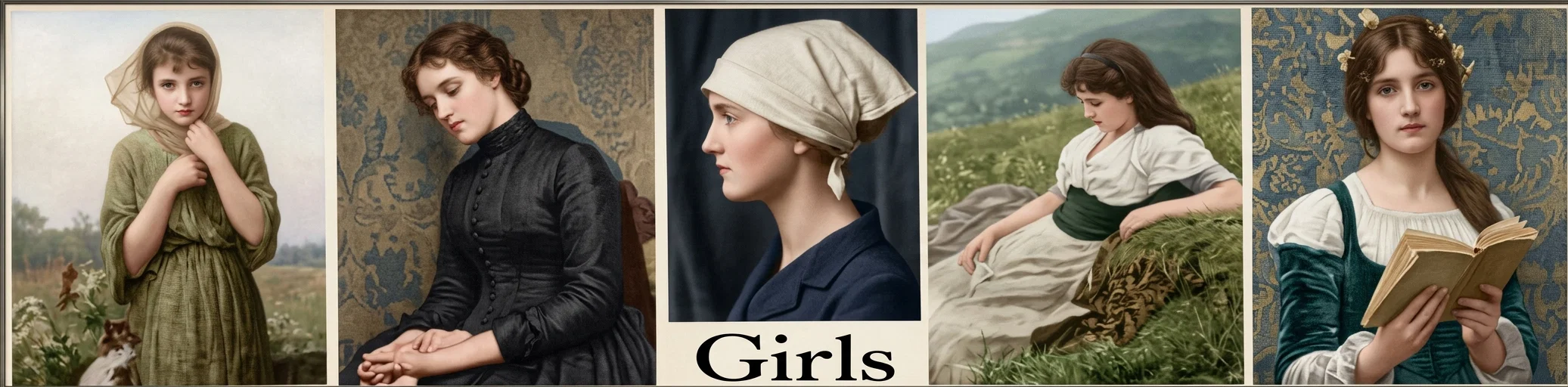
Girls

5%

Pacific Press Publishing Company · MOUNTAIN VIEW, CALIFORNIA · Sep 25, 1907

FromSigns of the Times, Vol. 33, No. 39.

Read the full edition

Girls

The Dangers That Menace Them.

By Mrs. A. J. S. Bourdeau.
(Concluded from Last Week.)
IF I could rightly picture to you the extreme loveliness of a young girl yet in her teens, who has been rightly trained in womanliness from infancy, I would be painting one of the grandest pictures possible. Occasionally we meet her—that dear young girl. See, her eyes are bright, her manner is free, and “the joy and tingle of life is ‘way down to her very toes.’” Full of life, health, vivacity, tempered with unselfishness and gentleness.
“Fifteen is the bud of what the flower will be at thirty,” and “womanhood is almost in sight at that age.” O, the possibilities for good or ill in that one fair creature!
To become a strong, noble woman, she has her daily Bible verse for meditation and for strength. She prays alone in the morning and in the evening, for sweet, tender grace to be brave, to be true, and to be great in God’s sight. The mother who has taught her child to seek this heavenly aid for herself, has most strongly fortified her against all life’s dangers.
She does not fritter away her time reading trash; for by reading trash she will not reap a noble womanhood. She reads the best books now, that she may relish the best books when she is older.
This sweet young girl has been taught to make an atmosphere of sunshine and cheerfulness about her. She gives of herself. One friend said to one of these girls: “If I had money I should always send flowers to my friends who were ill; but, of course, I can’t.”
“Well,” she replied brightly, “when my friends are ill I can’t send flowers either, but I usually sit down and write them little letters. I generally tell them something nice about themselves to cheer them; and if they’ve ever helped me, made me happy, why, I mention it, and tell them I love them, or something like that. Of course, it is not the same as a bunch of flowers, but it is better than nothing, and it costs only a two-cent stamp.” A bright, loving note would often bring more cheer to an invalid friend than costly flowers.
She is exquisitely tidy and clean in raiment, and the slovenliness of missing hooks and buttons can never be charged to her.
She believes in the dignity of work.
She is not necessarily scholarly, but she possesses a sweet disposition, which is more to be desired, because it creates an atmosphere in which others can be happy.
She is not ashamed of being honestly poor. She has grace to get along without the new hat that she can not afford. She has been taught self-denial when the purse is well-filled, as well as when it is empty.
She is not so conceited that she imagines herself an object of constant scrutiny. Her thoughts are not confined to such a narrow outlook, or “inlook,” as to how she is looking and acting, or of what others think about her.
She possesses a spirit of voluntary self-sacrifice. Her unselfishness is shown in her daily ministrations to her family and friends, the little unobtrusive courtesies that give pleasure—the comfortable chair and slippers ready for her father at night, the pillow at the opportune moment for her mother’s tired back, the bouquet for the father’s desk, the new plaything for the fretful baby, the remedy for the brother’s hurt finger, the threaded needles for grandmother. She allows her mother to pass in and out of the door before her; she gives her elders the comfortable chairs; she assists her mother into the car or carriage and carries her parcels.
As Mrs. Sangster says, “She is young and dear and sweet, and well-poised, and consecrates all she is to God.”
I have pictured what a girl should be. If good fills the heart and mind, there is no room for evil.
So, the training of our girl in all the traits of womanliness will provide for her an “invisible coat of mail” from which every danger will fall harmless to the ground, and leave her pure and unscathed.