Alway

4%

Pacific Press Publishing Association · Mountain View, California · Aug 15, 1911

FromSigns of the Times, Vol. 38, No. 32.

Read the full edition

"Alway"

By Clara Edna Rosencrans
SOMETIMES, in the weariness of partial invalidism, one is led to question many things. Why, for instance, are so many strong and capable workers, fitted by nature and attainment for the highest places in the Master's service, allowed to fall at their posts of duty, while those who can do so little to benefit humanity—who must be as it were cumberers of the ground, taking the time of those so needed for other activities, in constant wearing service for them—stay suffering on year after year? Why does the Master call our loved ones, who were so faithful, so loyal and true, and leave us almost alone? Why have others more than heart could wish, and we are so poor, and well-nigh helpless?
As often as these questions recur to the writer, she lifts her eyes to a little motto which hangs over her writing-table.
It is a dainty thing, a mass of blue forget-me-nots, and lily-bells; but it is not its delicate coloring, nor the silver letters which compose the motto, that appeals to her. The words are simple; they could hardly be more so. And yet their depth of meaning thrills my heart. "I am with you alway." Ah, the beauty and depth of meaning in the time-worn words!
The value of a promise depends on the one who makes it. If some worthless person, with neither the inclination nor power to keep his promise, had spoken these words, they would not be worth—in common parlance—"the paper on which they are written."
But—the King of the universe has said it. The Good Shepherd has said it. Our Elder Brother has said it.
Nearer and more near presses the thought, as I look at that little motto, till I am almost overwhelmed at its wonderful significance.
First, a King. What mighty power is His! All the power that lies behind the throne, the wondrous resources of a hundred worlds, with their armies of sinless beings, untouched by the weakness and infirmity of our own fallen sphere; all the wealth that lies hidden away from human eyes, besides the countless numbers of heavenly beings, who at a moment's notice stand ready to answer His call!
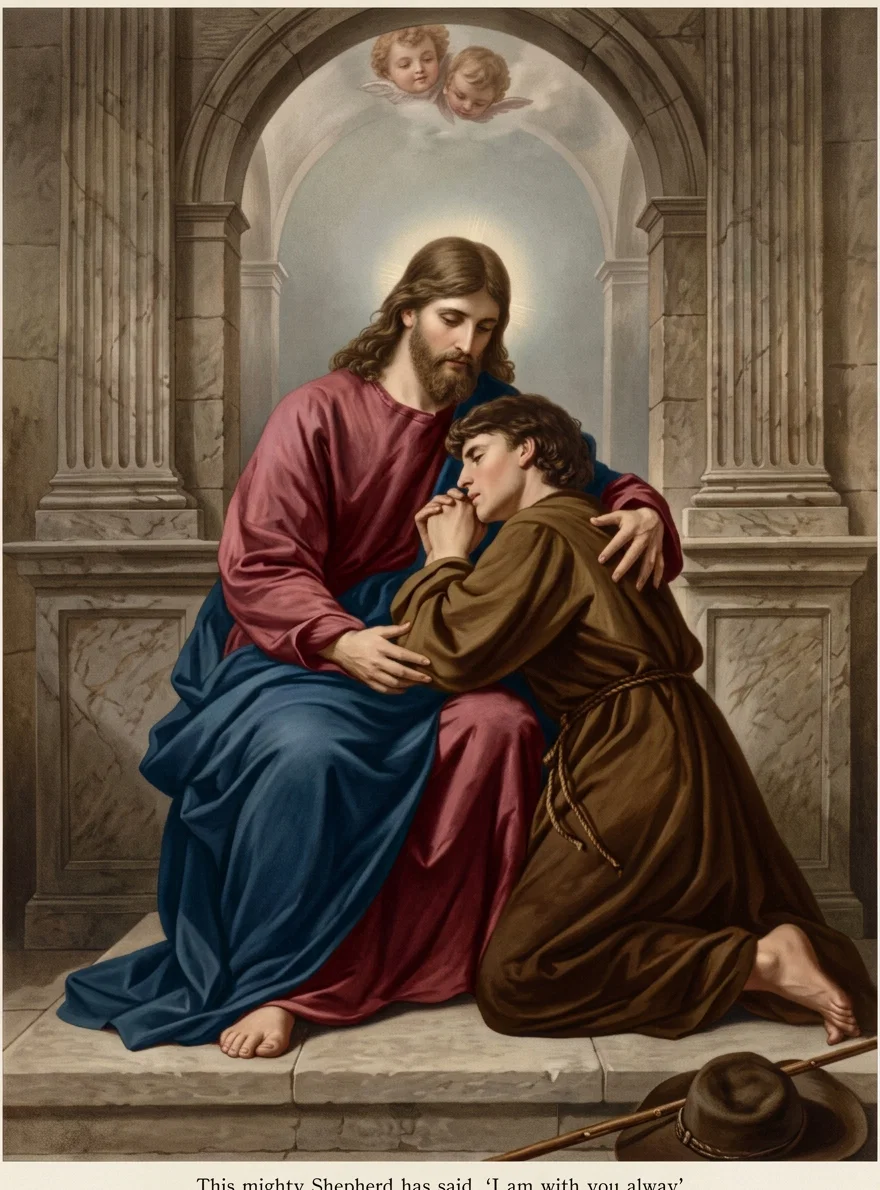
"This mighty Shepherd has said, 'I am with you alway'"
All these are waiting our need; and how can we feel desolate or alone, how can we feel poor, when this mighty Being says, "I am with you alway!"
Second, the Good Shepherd. Reader, did you ever see a flock of uncared-for sheep? Dirty their fleeces, torn with briers, roaming about on some rocky hillside trying to gain from the scanty herbage enough to sustain life. There is no water, for the brooks are dry in their stony beds, and the sheep have to walk weary miles in order to quench their thirst.
Now let me draw another picture.
It is that of a wide, sunny pasture-land. Clumps of trees here and there dot its broad expanse, forming cool, shadowy retreats beneath their ample branches. A broad, shallow brook flows quietly between green banks, where, after feeding on the sweet, cool grasses, the sheep may drink their fill, and lie down to rest.
As nightfall draws on, the shepherd comes and calls his sheep.
They lift their heads, and follow, while he leads them by a safe path. Into the quiet fold, with protecting walls, and feeling of perfect peace and security, the innocent, confiding animals are led, and lie down to a night of undisturbed and refreshing rest.
And this is the relationship that our Good Shepherd sustains to all who are His. "By Me," He says, "if any man enter in, he shall be saved, and shall go in and out, and find pasture."
The poor sheep in my first picture have no shepherd. They are left to take care of themselves. The prey of disease and hunger, in constant danger from prowling dogs, who devour the timid, helpless creatures, their condition is pitiable.With those who belong to the fold of the Good Shepherd, all is different; for He loves them no matter how far they stray away from Him; and would give His precious life for either or any of them.
How can we feel uncared for when this mighty Shepherd has said, 'I am with you alway'?
Third, our Elder Brother. The sheep in our illustration are helpless, dependent creatures, not only unable to care for themselves, but quite incapable of reciprocating the loving interest that the good shepherd takes in them.
In the case of the elder and younger brother, it is very different. Here each receives as much as he gives. There are no barriers cast up by the difference in state, no limitations to that perfect understanding and tenderness which the relation implies.
We stand upon a perfect equality, united by the ties of blood.
To know how beautiful this relationship may be, it is only necessary to visit in a family where the big boy takes almost the place of the father to the younger brothers and sisters.
Notice how tenderly he rocks the baby, while the mother prepares supper; how the tiny golden-haired girlie of three summers comes with her tale of a hurt finger, and how the little boys crowd around him for the evening game. Then when slumber has come to the younger ones, watch him draw his chair to the light and patiently help the elders on with their lessons. When sickness comes, he is the tenderest of nurses, watching with sleepless eye until the danger is past; bearing the little convalescent in strong, gentle arms that never tire of their loving task.
Into his attentive ear are poured all the confidences that mother is too tired to hear, or father too much engrossed in business to attend to.
The faithful instructor of his brothers, the watchful guardian of his sisters! Is it any wonder that Jesus has chosen this simile to convey to our minds a small part of the many-sided relationship which He bears to His own? The fatherhood of God is not more wonderful than the brotherhood of Jesus; and it is only in Him that we meet, in all its perfection, one of the tenderest and most enduring of earthly ties.
Ennobled, purified, and uplifted by His having taken upon Him its cares, burdens, and responsibilities, brotherhood will always seem more to us from His having shared it with us.
And He has said—ah, how the words should thrill our hearts!—'I am with you alway.' 'Blessed be God for His unspeakable gift.'