New Japan

6%

Pacific Press Publishing Association · Mountain View, California · Sep 12, 1911

FromSigns of the Times, Vol. 38, No. 36.

Read the full edition

New Japan

THE progress of Japan during the past half a century is the eighth wonder of the modern world. How it all happened is still a story of absorbing interest. The policy of seclusion adopted three centuries ago was followed as a means of escaping the white peril. Yet when the Westerners urged their claims at the muzzles of their cannons, Japan was forced to yield. But the treaties opening the country to foreign intercourse were so unpopular that the government of the shogun at old Yeddo was overthrown, and the emperor restored to his rightful position as the ruler of the country.
This was in 1868. The die had been cast. The dangers from foreign intercourse could no longer be avoided by excluding the foreigners from the country. The only alternative was to adopt the white man's civilization, and be able to compete with him whether in peace or in war.
And thus it was that with the beginning of the Meiji era, Japan was fairly launched for her career as a modern nation. Of course there was always a conservative element that clung tenaciously to the past; likewise an overzealous radical class who ran wild after everything foreign. The radicals had their way and their day for about a score of years. This period was characterized by the hasty, indiscriminate adoption of Western ways. When a top hat, a frock coat, and a pair of drawers, with native wooden clogs, made a full dress suit, the progressive element made themselves ridiculous in the eyes of both foreigners and the more conservative Japanese.
As a result, about the year 1888 an anti-foreign reaction set in, and continued till about the time of the war with China. Another cause of this reaction was the attitude of the treaty powers in holding Japan to the old treaties, with their extraterritorial clauses, and their practical control of Japanese tariff rates.
Then came the war with China, which some Japanese are free to admit was entered upon by Japan in order to show her military prowess to Western nations. By the close of the century all the hated treaties had been revised, and Japan had thus secured recognition as a civilized nation, with full sovereign power in her own domains. The removal of this grievance brought about a better understanding with Western nations. The reaction against foreign ways led to more careful discrimination in the adoption of Western civilization. And this was as it should be. It has been observed by some writers that Western civilization is a mere veneer in Japan. That remark may have had some truth in it a score of years ago, but is less and less true as time passes. And after all, so far as the moral and religious nature of a people is concerned, civilization alone is never anything more than a veneer, covering the natural barbarity of human nature. In this respect the Oriental kettle is no blacker than the Occidental pot.
That the white peril in the Orient was by no means an imaginary quantity, the experience of Japan in meeting the encroachments of Russia has clearly shown. With Manchuria under Russian rule, with Russian influence predominant in Korea, and a Russian naval base at Masampo on the Tsushima Straits, not only would Japan's most natural and easy means of expansion be cut off, but her very existence as a nation would be threatened. And the only course open to Japan in averting this peril was to resort to the modern means of self-protection.
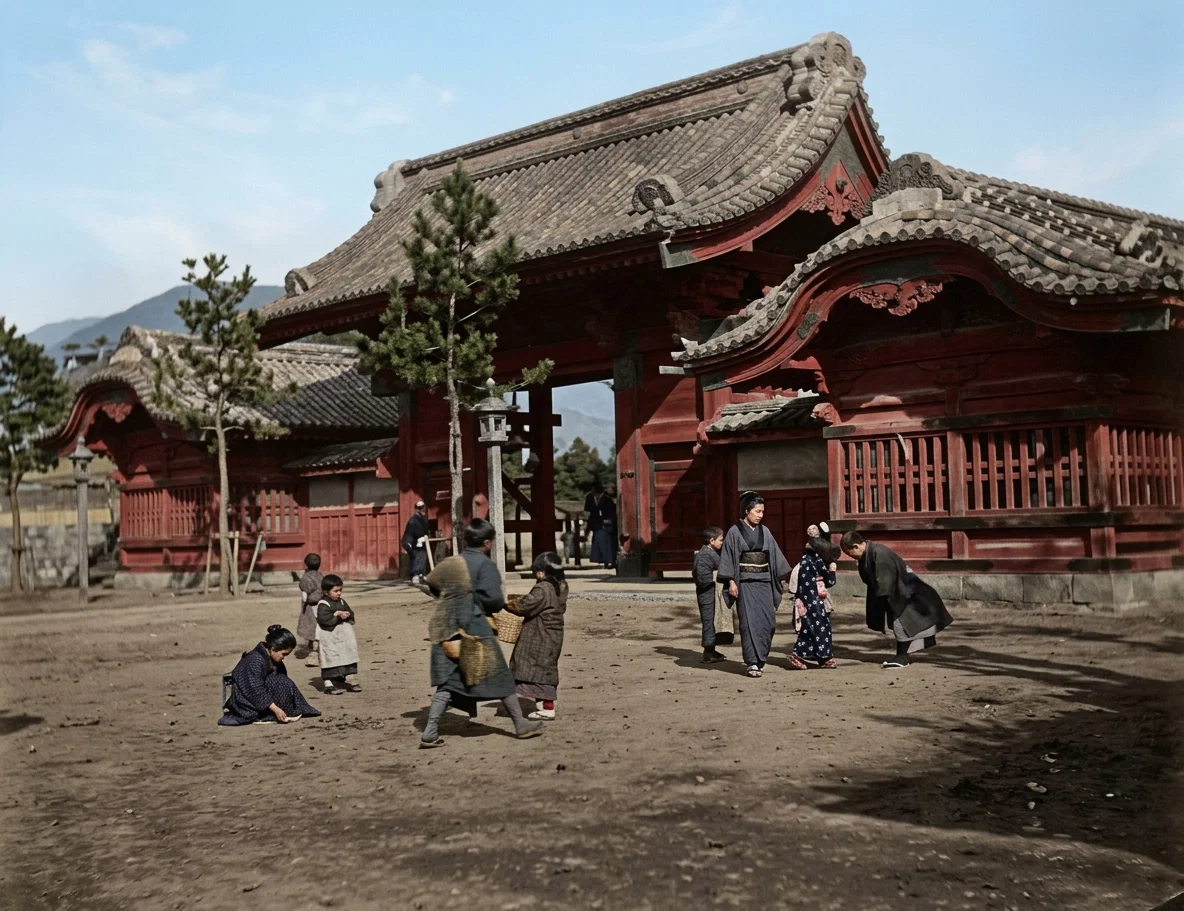
The Red Gate, a relic of Old Japan; entrance to Imperial University, Tokyo
As an immediate effect of the war with Russia, Japan was recognized by Western nations as one of the great powers. This recognition came when the United States, Great Britain, France, Germany, and finally Russia, raised the rank of their diplomatic representatives from that of minister to ambassador. During and immediately after the war, the Japanese were highly praised for their patriotism, and for their success in war. And as was very natural, a goodly number of them became much exalted in their own opinion, and greatly overestimated their power and importance as a nation. But time and experience have already done much to correct any such misconception; for as Japan, in her new role as one of the great powers, has made her influence felt all through the Far East, and has entered into keen competition with other nations in the markets of the world, inordinate praise has changed to adverse criticism, suspicion, and dislike. And this, too, is the way of the world.
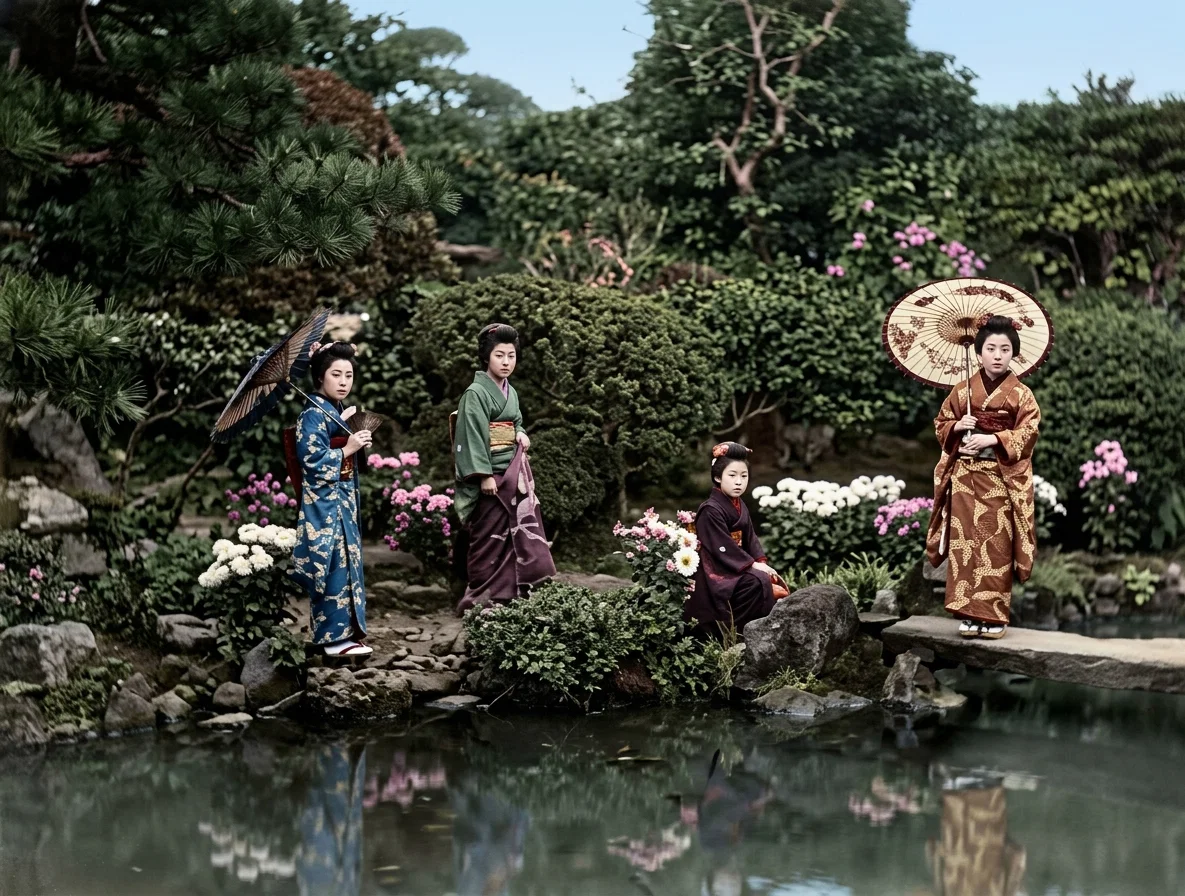
Artistic Japan, a Landscape Garden
Thus far we have considered only the political aspects of New Japan. But this consideration will be very helpful to a proper understanding of the attitude of the Japanese toward Christianity, the religion of European nations. As is well known, the first Christian missionaries to Japan, in the sixteenth century, were Roman Catholics; and it was fear of the political power of the head of the Roman Church, that led the rulers of Japan to expel the missionaries, and proscribe their religion. But now the Japanese know that they have nothing of this sort to fear from the propagation of Christianity.
During the pro-foreign period mentioned in a previous paragraph, there was a strong movement in favor of Christianity. The churches were crowded with eager listeners, and many professed the new religion. So encouraging was the prospect, that by 1888 it was freely predicted that by the close of the century Japan would rank as a Christian nation.
But very much of this work was doubtless superficial, like the hasty adoption of the top hat and the frock coat. Prominent politicians and educators recommended the adoption of Christianity as the national religion; and with the Church-and-State systems of European countries before them as models, this is not at all to be wondered at.
When the anti-foreign reaction set in, there was a great change in the attitude of the people toward Christianity. The attendance at the meetings fell off, and many who had joined the churches gave up their profession. Yet this experience was far from proving a calamity to Christian work in Japan. During this period the faith of true believers was tested, and mere nominal professors were sifted out. The adoption of Christianity as the national religion would have been a calamity indeed.
With the passing of the period of anti-foreign feeling, there was a corresponding subsidence of antichristian feeling. Various causes might be assigned for this change; but one of the most potent of these has been the ethical failure of popular education. Western education has destroyed faith in the old religious systems, and has supplied nothing in their place. As a result there is observed a marked decline in morals among the rising generation in Japan. To meet this condition, the educational leaders have been making strenuous efforts to advance moral education in the schools. But all religious instruction is strictly prohibited; and many thoughtfulJapanese are coming to see the futility of ethical instruction without a religious basis. Thus their attention is drawn to Christianity with its exalted morality and high religious sanctions; and while the obstacles to the propagation of the Gospel are by no means all removed, there will probably never be a more favorable opportunity than now for evangelical work in Japan.
F. W. FIELD.