VI. The Times of the Closing or Cleansing Work of the Gospel
And he said unto me, Unto two thousand and three hundred days; then shall the sanctuary be cleansed. Dan. 8:14.
We have already seen that the cleansing of the sanctuary includes the cleansing of God's people. In other words, it is the closing work of the Gospel in the earth.
Would God leave His chosen ones in the dark in regard to the time when the greatest of all events in the history of our world is about to take place? Did He leave Noah in the dark as to when the Flood was coming? Did He leave Lot unwarned when Sodom was about to be destroyed? "Surely the Lord God will do nothing, but He revealeth His secret unto His servants the prophets." Amos 3:7.
The words of our text are connected with a vision given to Daniel near the close of the seventy years of Jewish captivity in Babylon. It therefore becomes necessary for us to study the whole vision in order to get the connection.
A Prophetic Vision
Beginning with the second verse of chapter 8, four objects presented themselves to the prophet in succession: First, a ram, standing by a river, having two horns, one higher than the other. Second, a rough goat with a notable horn between his eyes. He dashed into the ram, broke his horns, and cast him to the ground. But suddenly the great horn was broken, and in its place four other horns sprang up. Third, out of one of those four horns a little horn appeared, which waxed exceeding great, and magnified itself even to the Prince of the host. Fourth, the prophet then heard two angels conversing. One asked the other, How long shall the sanctuary and the host be trodden underfoot? Then, addressing Daniel, the other angel made answer, "Unto two thousand and three hundred days; then shall the sanctuary be cleansed."
The Meaning of the Symbols
Daniel sought for the meaning. Soon he heard a voice saying, "Gabriel, make this man to understand the vision." Gabriel proceeded at once to give the explanation: "The ram which thou sawest having two horns are the kings of Media and Persia." Verse 20. "The rough goat is the king of Grecia: and the great horn that is between his eyes is the first king. Now that being broken, whereas four stood up for it, four kingdoms shall stand up out of the nation." Verses 21, 22.
The first king of Grecia was Alexander the Great, who overthrew the Medo-Persian kingdom in 331 B.C. Eight years after Alexander died in a drunken debauch, his kingdom was divided among his four leading generals. Gabriel did not give the name of the kingdom represented by the third symbol, but gave specifications by which the student of history could readily see its application.
It was to stand up in the latter time of the Grecian kingdom. That was the very time that Rome appeared. "He shall destroy wonderfully." All opposing powers were rudely overthrown by Rome. "And shall destroy the mighty and the holy people." The blood of more than fifty millions of martyrs testify that Rome (in its papal form) is here spoken of. "He shall also stand up against the Prince of Princes [Christ]." "The kings of the earth stood up, and the rulers were gathered together against the Lord, and against His Christ. For of a truth against Thy holy Child Jesus, whom Thou hast anointed, both Herod, and Pontius Pilate [Roman rulers], with the Gentiles, and the people of Israel, were gathered together." Acts 4:26, 27. No further proof is needed to show that Rome is the power in question.
The Time Period
The angel Gabriel has now explained three of the symbols and begins on the fourth: "And the vision of the evening and the morning which was told is true." Dan. 8:26. In verse 14, where the 2,300 days are spoken of, the margin reads "evening morning;" also the A.R.V. renders this verse as follows: "Unto two thousand and three hundred evenings and mornings; then shall the sanctuary be cleansed."
When God made the day in the beginning, He said, "The evening and the morning were the first day." Gen. 1:5. This, then, was a common way of referring to a day. Hence when the angel speaks of "the vision of the evening and the morning," he refers to the 2,300 days.
The 2,300 days, being in the midst of a symbolic prophecy, where short-lived beasts symbolize kingdoms, some of which continued for hundreds of years, must be symbolic also; and where symbols are used, God does not leave us to guess at their meaning. In Eze. 4:6, where the prophet himself was acting a symbolic part, the Lord said, "Thou shalt bear the iniquity of the house of Judah forty days: I have appointed thee each day for a year." Again, in Num. 14:34, Israel was to wander in the wilderness forty years, according to the number of days they had searched the land, "each day for a year." Let us then bear in mind that the 2,300 days represent 2,300 years.
Why did the angel tell Daniel that the vision of the 2,300 days "is true"? Was not all the vision true? Surely; but when these nations should arise and overthrow one another, all could see that that part of the vision was true; but not so when the 2,300 days should terminate. No human eye could behold the change in the ministration of Christ in the heavenly sanctuary. No one could view the scene as presented by Daniel when "the thrones were placed," "the judgment was set, and the books were opened;" but the angel assures us that if we are living at the close of the 2,300 days, and are among God's people, we shall be cleansed, never to sin again. Blessed assurance!
Gabriel was unable to proceed further with his explanation, for "Daniel fainted, and was sick certain days." Verse 27 says, "I was astonished at the vision, but none understood it." He could not have inferred that he did not understand about the ram, the he goat, and the little horn; for had not Gabriel fulfilled his commission thus far to make him understand the vision?5
He must refer to that part which was left unexplained; namely, the 2,300 days.
The Explanation of the Time
Will Daniel rest satisfied over that portion of the vision which so astonished him? Will Gabriel be so unfaithful as to leave the most important part unexplained? If not, then we may expect a further revelation. Less than a year passes, and the record of chapter 9 opens. We find Daniel studying the books of Jeremiah for light. He discovers that Jerusalem should lie desolate for seventy years. He knows that the time has about expired, and sets his heart to seek God, by prayer and fasting, for the fulfilment of His Word. Then follows the account of his wonderful prayer. In verse 17, he asks God to cause His face to shine upon His sanctuary which is desolate. He somehow seems to connect the cleansing of the sanctuary referred to in the vision, with the desolation of Jerusalem. He must now be set right; therefore while he was praying, the angel Gabriel, the one, says Daniel, "whom I had seen in the vision at the beginning," "touched me about the time of the evening oblation," and said: "I am now come forth to give thee skill and understanding. . . . Therefore understand the matter, and consider the vision." Did Daniel say, What vision? Ah, no. There were no preliminaries. Gabriel knew the thoughts of the prophet; and beginning with the twenty-fourth verse, he explained the 2,300 days of chapter 8:14.
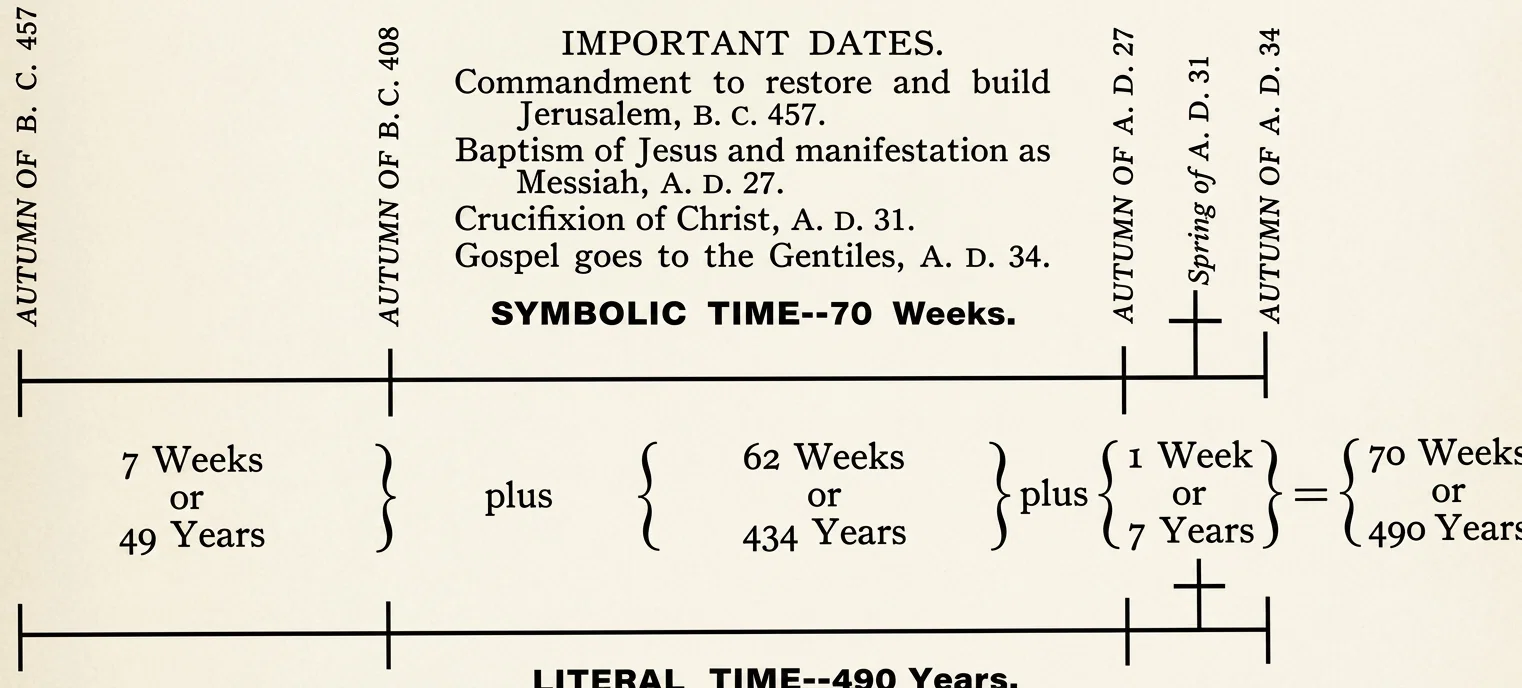
"Seventy weeks," he said, "are determined," or "cut off" (Whiting's translation, and many others), "upon thy people and upon thy holy city." If seventy weeks are cut off, they must be cut off from the first part of the 2,300 days, as no other period of time has been mentioned; hence if we can find when the seventy weeks begin, we have found when the 2,300 days begin.
The Commandment to Restore and Build
The angel proceeds at once to give the events that mark the beginning and close of that period. "Know therefore and understand, that from the going forth of the commandment to restore and to build Jerusalem unto the Messiah the Prince shall be seven weeks, and threescore and two weeks. . . . And after threescore and two weeks shall Messiah be cut off. . . . And He shall confirm the covenant with many for one week: and in the midst of the week He shall cause the sacrifice and the oblation to cease." Dan. 9:25-27.
From this testimony we learn that the going forth of the commandment to restore and build Jerusalem marks the beginning of the seventy weeks.
There were three decrees given in connection with the restoration of Jerusalem: one by Cyrus, for the rebuilding of the house of God, B.C. 536 (Ezra 1:1-4); the decree of Darius, for carrying forward the work, which had been hindered, B.C. 519 (Ezra 6:6-12); and the decree of Artaxerxes to Ezra, B.C. 457 (Ezra 7).
That it required the three decrees to constitute the commandment to restore and build Jerusalem, is evident from the words found in Ezra 6:14, "And they builded, and finished it, . . . according to the commandment [singular number] of Cyrus, and Darius, and Artaxerxes." The decree, then, was not complete until the last one had been issued. This was in the year 457 B.C., and is the time from which the seventy weeks should be reckoned. Ezra 7:12, 13, margin. Christ was anointed with the Holy Spirit (Acts 10:38 and Luke 4:18) at His baptism, which occurred in the autumn of A.D. 27. Mark 1:10, margin; Luke 3:21-23, margin.
Sixty-nine weeks, 483 years, must span the time between the going forth of the commandment and the baptism of Christ. We find that Ezra, with the children of Israel, reached Jerusalem the fifth month of 457 B.C. As part of the decree applied to the treasurers living in the vicinity of Jerusalem (Ezra 7:21, 22), and as no law or decree can go into effect until all the parties concerned are notified, and these treasurers were not informed of the decree until after Ezra reached there, therefore the decree could not be said to go forth until the fifth month. And as the Jewish year began in March or April, the fifth month would bring the going forth of the decree as late as September or October; thus more than half of the year 457 had passed, which would leave only 456½ years before A.D. 1. Christ was baptized soon after the middle of the year A.D. 27; thus only 26½ years had passed before that event. 456½ years before Christ, added to 26½ after Christ, equals 483 years, or 69 prophetic weeks, which exactly fulfils the prophecy.
The Closing Week
Of the seventy weeks, one is still left, in the midst of which Messiah was to be cut off. Christ attended four Passovers, as recorded in John 2:13; 5:1; 6:4; and 13:1. At the last of these He was crucified. This makes the duration of His ministry three years and a half, bringing us to the year 31 A.D., which was the middle of the seventeenth week. He caused the Jewish sacrifices to cease by the offering up of Himself as the great antitype of them all.
He was to confirm the new covenant with the Jews for one week, which he did personally the first half of the week, and through His disciples the remaining half. Heb. 2:3. Thus end the seventy weeks. This brings us to A.D. 34. At this time Stephen was put to death; and through the great persecution that arose, the church was scattered abroad, and went everywhere preaching the Word. Acts 8:1-5. See date in the margin, A.D. 34. Soon after, Paul, the great apostle to the Gentiles, was converted; and we hear him saying to the Jews, "It was necessary that the Word of God should first have been spoken to you: but seeing ye put it from you, and judge yourselves unworthy of everlasting life, lo, we turn to the Gentiles." Acts 13:46.
Having now reached the termination of the seventy weeks, or 490 years, 1,810 years remain. (2,300 less 490 equals 1,810.) In other words, when we reach A.D. 34, we have 1,810 years left of the 2,300, which added to 34 A.D. brings us to the autumn of 1844.
The Great Day of Atonement
As in the type the tenth day of the seventh month was called the Day of Atonement, when the earthly sanctuary was cleansed, must we not believe that on that very day, October 22, 1844 (the tenth day of the seventh month, Jewish reckoning), our great High Priest went into the most holy place of the heavenly sanctuary and began the work of judgment? Paul says that God "hath appointed a day, in the which He will judge the world." Acts 17:31. Beloved, that appointment was reached in 1844.
While the sanctuary is cleansed in heaven, there must be a corresponding work going on among God's people on earth.
A few years prior to 1844, a movement such as the world had never before witnessed took place. A warning message, based upon Rev. 14:6, 7, and many similar scriptures, was proclaimed with mighty power.
Voices everywhere were heard saying, "Fear God, and give glory to Him; for the hour of His judgment is come."
The message went to every missionary station on the globe. Treasure was poured out like water in its promulgation. Revivals followed its proclamation. God was in the movement; and Christendom was shaken from center to circumference.
It is true that a mistake was made by those giving the message, in that they thought that the earth was the sanctuary, and that its cleansing must take place by fire at the coming of Christ, and hence looked for that event in connection with the judgment; but the prophet Malachi had foreseen this, and said: "The Lord, whom ye seek, shall suddenly come to His temple. . . . And He shall sit as a refiner and purifier of silver; and He shall purify the sons of Levi, and purge them as gold and silver. . . . And I will come near to you in judgment." Mal. 3:1-6. This shows the nature of that coming, that it is to "purify" His people from sin.6
Before sin can be put away, it must be discovered. And there is no sin detector other than the law of God; for, says Paul, "I had not known sin, but by the law." Rom. 7:7. God’s law is to be the standard in the judgment. James 2:12. For this reason, when the temple of God was opened in heaven, there was seen the ark of His testament. Rev. 11:19. The ark contains the law of God. How was it seen? Through faith, by the church on earth. What further evidence can be shown that this has been fulfilled? We answer, The great movement in behalf of the law of God and the true Sabbath, now going forward all over our world. Many people have received the light on the sanctuary. They see the temple opened in heaven. They behold there the ark, and our Lord making His last offering on the mercy-seat. They see that the requirements of the law are neither relaxed nor altered. And they are going forth to vindicate its claims, and lead others to make such a preparation as will be necessary to enable them to stand with that people of whom the Lord says in His closing message to this world, "Here is the patience of the saints: here are they that keep the commandments of God, and the faith of Jesus." Rev. 14:9-12.
Every soul has now a case pending in the court of heaven. Dear reader, have you secured your Advocate?