WE have learned in past studies that the Papacy in its connection with worldly powers is only a phase of that evil system of union of church and state which began with Babylon of old; and that behind it all is Satan, the deceiver, accuser, and adversary. He has deceived the nations by making them believe that this system, in some of its forms, was necessary to salvation, to the maintenance of good order in society, to the perpetuation of civil government, to the preservation of religion in the earth. He has carried on this work of deception in every age, through the great and popular, but apostate, religious bodies. These religious bodies have always in the beginning of their history known the truth, but in departing from the truth and righteousness of God by faith have eternally united with the powers of earth, in order to enforce religious dogmas by law. Through them Satan has always accused those who protested against this great prevailing system of religion, and the accusations have always ended in persecution, unless God interposed. And through this great system, with its various phases, has he always opposed the simple, but, if received by faith, all-effectual, truth of God’s free Gospel of grace.
The System One.
We speak of "system" in the singular; for the system is one, tho the phases of that system are many. There are gods many and lords many in all these phases, but all are founded upon, and all exist by virtue of, the principle of self-salvation apart from God. It is but the repetition, in various forms, of the old Babylonian cry, "Go to, let us build us a city and a tower, whose top may reach unto heaven; and let us make us a name, lest we be scattered abroad upon the face of the whole earth." Both ideas—salvation of soul and earthly preservation—are contained in the purpose expressed; but the doers of it all are the we, the us. And so their monuments tell us, they named the city and the tower, Bab-il, "The Gate of God," or "The Gate of Heaven;" but God called it just what it truly was, is, and always shall be, "Babel," confusion. In every phase of the system, from Babylon of old to the present time, is echoed and re-echoed the ambition of Babylon’s king of her ages, Lucifer, the once day-star of God: "I will ascend into heaven; I will exalt my throne above the stars of God; . . . I will ascend above the heights of the clouds; I will be like the Most High."* (Isa. 14:13, 14.) This is the spirit of Satan and this is the spirit which has been manifest in all the phases of the great Babylonian system. Jesus Christ came as a teacher from God, assuming no power to rule, dictate, oppress, judge, or condemn those who did not agree with his teachings. He was the Master of humility and meekness, and they clothed him as garments. His ministers were not to be "lords over God’s heritage, but ensamples to the flock." They did not possess dominion over faith, but were helpers of the joy of all who believed. But in every phase of the Babylonian, or Satanic, system of religion there has been manifest in creed, in arbitrary decrees, in religious dogmas, in statute law, in a multitude of forms, the principle of religion by dictation, by law, by force.
Protestants in Every Age.
"Protestants" is doubtless too narrow a term. Not only have there been faithful servants of God in all ages who have protested against the Babylonian religion of self-salvation, of union of church and state, of force, but they have held high in their own lives the principles of righteousness and truth. In Israel’s day the prophets of God lifted true voices amid the prevailing babel of false worship. When the captivity and travail of the church began in Babylon, Daniel and the three Hebrew children were lights in the center of earth’s empire. Faithful servants of God existed in the Medo-Persian and Grecian phases of the system. During the time that Satan was using Pagan Rome John the Baptist, Jesus Christ our Lord, and the apostles lifted the clearest light3of all the centuries; its blazing beams showing the errors of all the mysteries of iniquity in past and future, and revealing clearly the only way of salvation—personal faith in God through Jesus Christ, with the Scriptures the one divine rule of faith, the true church of Christ as those who are called out according to the Gospel, obedient to every known ray of light and precept of truth.
During the reign of the fifth head, the Papacy, God had also his faithful witnesses, some with less, some with more, light in the unnaturally darker ages of superstition which followed the Gospel morning. Many of those who protested and held aloft the torch of truth confirmed their testimony with their life. The darkness increased, the light grew more dim, the darker ages grew more dark, till in the fifteenth century was born the "Morning Star of the Reformation," John of Wycliffe. Following came John Huss and Jerome of Prague. The former escaped death by martyrdom; but, to show the bitterness of the Papacy, his body was exhumed and burned after death. Huss and Jerome were burned at the stake. A century later the Protestant Reformation burst forth, based on true Gospel principles. They are thus stated by D'Aubigne:—
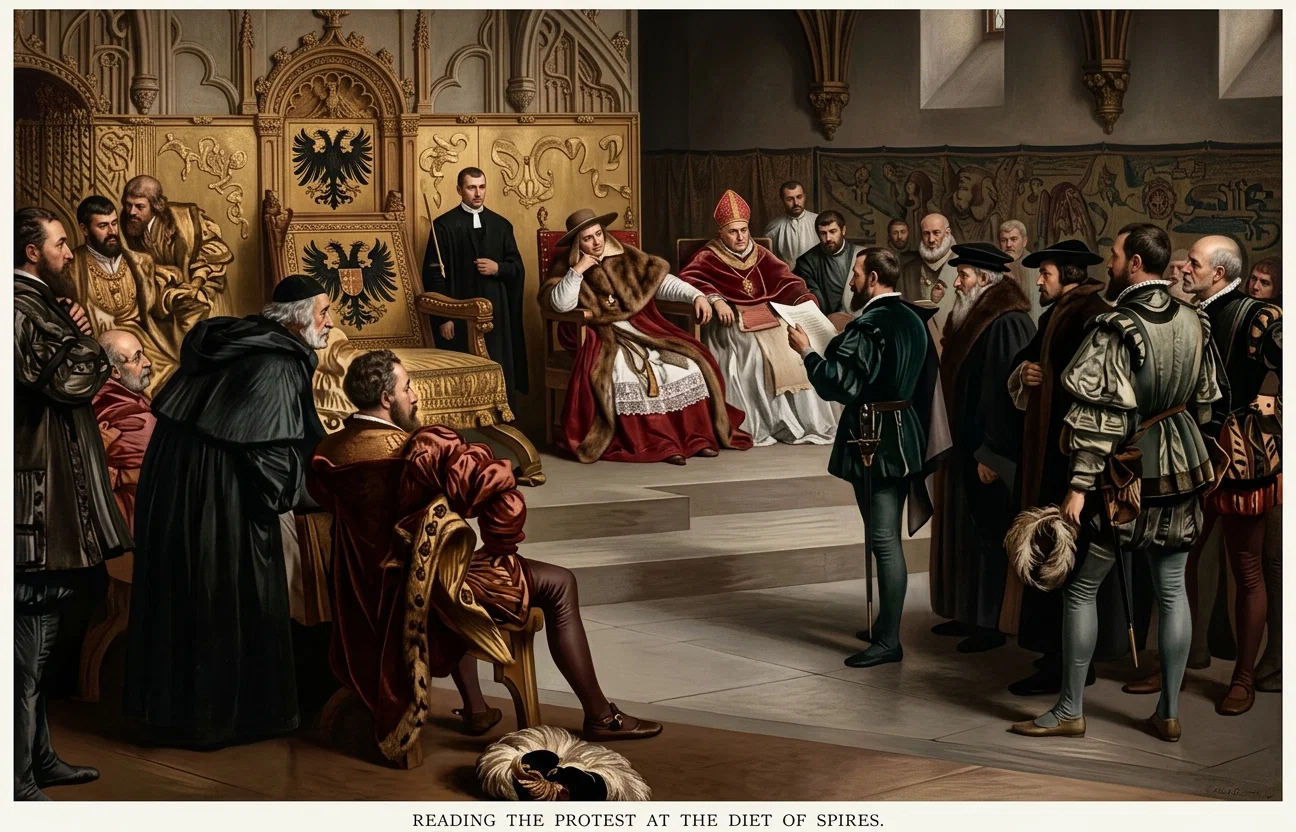
The principles contained in this celebrated protest of the 19th April, 1529, constitute the very essence of Protestantism. Now this protest opposes two abuses of man in matters of faith; the first is the intrusion of the civil magistrate, and the other is the arbitrary authority of the church. Instead of these two abuses, Protestantism sets up above the magistrate the power of conscience; and above the visible church the power of the word of God. It declines, in the first place, the civil power in divine things, and says with the apostles and prophets, We must obey God rather than man. In presence of Charles the Fifth it uplifts the crown of Jesus Christ. But it goes further; it lays down the principle that all human teaching should be subordinate to the oracles of God.*
Here was again set forth the principles of Jesus Christ: The word of God as the rule of faith, and personal, individual faith in that word the means of salvation; and that over these the civil magistrate had no control, and with them no civil ruler as such had anything to do.
Fall of the Papacy.
In 1798 the papal head of the great Babylonian system fell under the deadly wound. (Rev. 13:3, 10.) Its power to persecute, to lord it over the faith and worship of men, was taken away in the controlling kingdoms of earth. The Papacy has not since possessed that power, tho still demanding it. Her enemies declare that she will never again possess that power. She is honored, perhaps, as never before as an ecclesiastical power, but she does not control the nations nor command them under the temporal pains and penalties due to heretics. But has the beast ceased to exist?—In the papal phase, under control of the papal head, yes; but as an existing, continuing system to the end, in the light of prophecy, no. The principles as embodied in the system continue operative; the form in which they are manifest, changes. The underlying principles in Pagan and Papal Rome are the same; it is that of self-salvation, a religion of force; but the forms are widely different; hence they are denoted by different heads.
READING THE PROTEST AT THE DIET OF SPIRES.
The Sixth Head.
Satan, the originator and king of the system used his masterpiece, the Papacy, after Pagan Rome; to 1798. When the Papacy passed away another phase took its place. It no longer had one centralized head at Rome; but a phase of church and state governments, similar in form to each other, followed. In the papal system the church was dominant, the state subservient. In the phase which followed, manifest in the church and state governments of Europe, the state was dominant, a modification of the pagan idea among Christian peoples. This phase of the system is so well set forth by Bryce* that we quote:—
The principles which had led the Protestants to sever themselves from the Roman Church should have taught them to bear with the opinions of others, and warned them from the attempt to connect agreement in doctrine or manner of worship with the necessary forms of civil government. Still less ought they to have enforced that agreement by civil penalties; for faith, upon their own showing, had no value save when it was freely given. . . .
But whether it was that men only half saw what they had done, or that, finding it hard enough to unrivet priestly fetters, they welcomed all the aid a temporal prince could give; the result was that religion, or, rather, religious creeds, began to be involved with politics more closely than had ever been the case before. Through the greater part of Christendom wars of religion raged for a century or more, and down to our own days feelings of theological antipathy continue to affect the relations of the powers of Europe. In almost every country the form of doctrine which triumphed associated itself with the state, and maintained the despotic system of the Middle Ages, while it forsook the grounds on which that system had been based.
It was thus that there arose national churches, which were to be to the several Protestant countries of Europe that which the Church Catholic had been to the world at large; churches, that is to say, each of which was to be coextensive with its respective state, was to enjoy landed wealth and exclusive political privilege, and was to be armed with coercive powers against recusants. It was not altogether easy to find a set of theoretical principles on which such churches might be made to rest; for they could not, like the old church, point to the historical transmission of their doctrines; they could not claim to have in any one man, or body of men, an infallible organ of divine truth; they could not even fall back upon general councils, or the argument, whatever it may be worth, "Securus indicat orbis terrarum."
But in practice these difficulties were soon got over, for the dominant party in each state, if it was not infallible, was at any rate quite sure that it was right, and could attribute the resistance of other sects to nothing but moral obliquity. The will of the sovereign, as in England, or the will of the majority, as in Holland, Scandinavia, and Scotland, imposed upon each country a peculiar form of worship, and kept up the practices of medieval intolerance without their justification.
Not Protestant Governments.
This is the condition of the eastern world, where has existed the empire of the great beast power, from which empire has gone forth the law to the rest of the world. The sixth head of that fearful system of government is the present phase of church and state governments existing among the nations of Europe, the horns of the beast, the most influential of which profess to be Protestant. But if these governments were truly Protestant they would not persecute. No church which holds to the principle of Protestantism will in any way unite with the civil power, or solicit aid from the civil power, or permit the civil magistrate to interfere in matters of religion. Her rule will be the Bible and the Bible alone, with no mixture of tradition. Her power will be in the Spirit of God, the life of Christianity. Her means of propagating her belief will be by persuasion and teaching. All recusants and enemies she will in love commend to the mercy and wisdom of God. And when the Protestant churches or any Protestant church turns from these principles to accept of tradition and human creed she brings confusion instead of power, and becomes a part of Babylon, because molded by the principles of Babylon. Her creed may be called "The Gate of God," but God calls it Confusion. And when she unites with the state, to seek to enforce or better to maintain that creed, she commits4fornication with the kings of earth, and is a part of the Babylonian family. She is no longer Protestant. She may have true Protestants and Christians in her fold, but all such God will call out. So the Papacy has had within her fold in all ages true Christians, living up to all the light they possessed, but they were Christians not because of the papal system, but in spite of it. Germany, England, France, Denmark, Norway, and Sweden are not Protestant governments or nations in the sense of being Christian. They may be called Protestant, and Christian; there are Christians in them, but the system of government is not Christian, but Babylonian; simply another phase in the great system of which Lucifer was the inventor, Babylon was the head, and the Papacy the masterpiece.
Legitimate Earthly Government.
By this we do not refer to the legitimate rule and sphere of these governments and all civil governments; for civil government is ordained of God. But we refer to the union of church and state, or religion enforced by law, which is a characteristic of all these powers. When this church and state principle is developed into law, it always leads to persecution for conscience' sake. And this has been the case in all these countries. The persecutions under "good Queen Bess" were as truly of Satanic origin as were those under "bloody Mary." The name does not alter the fact; the character of a government determines its author. In a general way "the powers that be are ordained of God," but not to take God's place. Nebuchadnezzar, the heathen king of Babylon, God calls "my servant" (Jer. 27:5-8; Dan. 2:37); but when he aspired to take God's place, to direct and control worship, to punish those who would not worship as he decreed, God humbled him and proud Babylon with him (Daniel, chapters 3, 4). And so in all ages the dominant ruling powers of earth are God's servants to restrain evil, and prevent incivility; but not to aid religion or to coerce conscience in any way. And when the powers of Europe revolted against the tyranny of the Vatican authority, they again justified it all by perpetuating the church and state system in another form. It matters not how good the men, how mild the system at first, it logically and inevitably leads to evil. The first step means the second, and the second the third, until the last step is taken, and Jesus Christ is again mocked, maltreated, and put to death in the persons of his saints.
Thus far we have the following heads to the great Babylonian system: Babylon, Medo-Persia, Grecia, Pagan Rome, Papal Rome, Pago-Papal and Pago-Protestant governments of Europe. The future heads will be considered in our next.