Slowness of Travel—The Colonial Stage—Postal Facilities Newspapers and Books—Severe Laws and Punishments—Intemperance Common—Farm and Household Labor—Schools and Education.
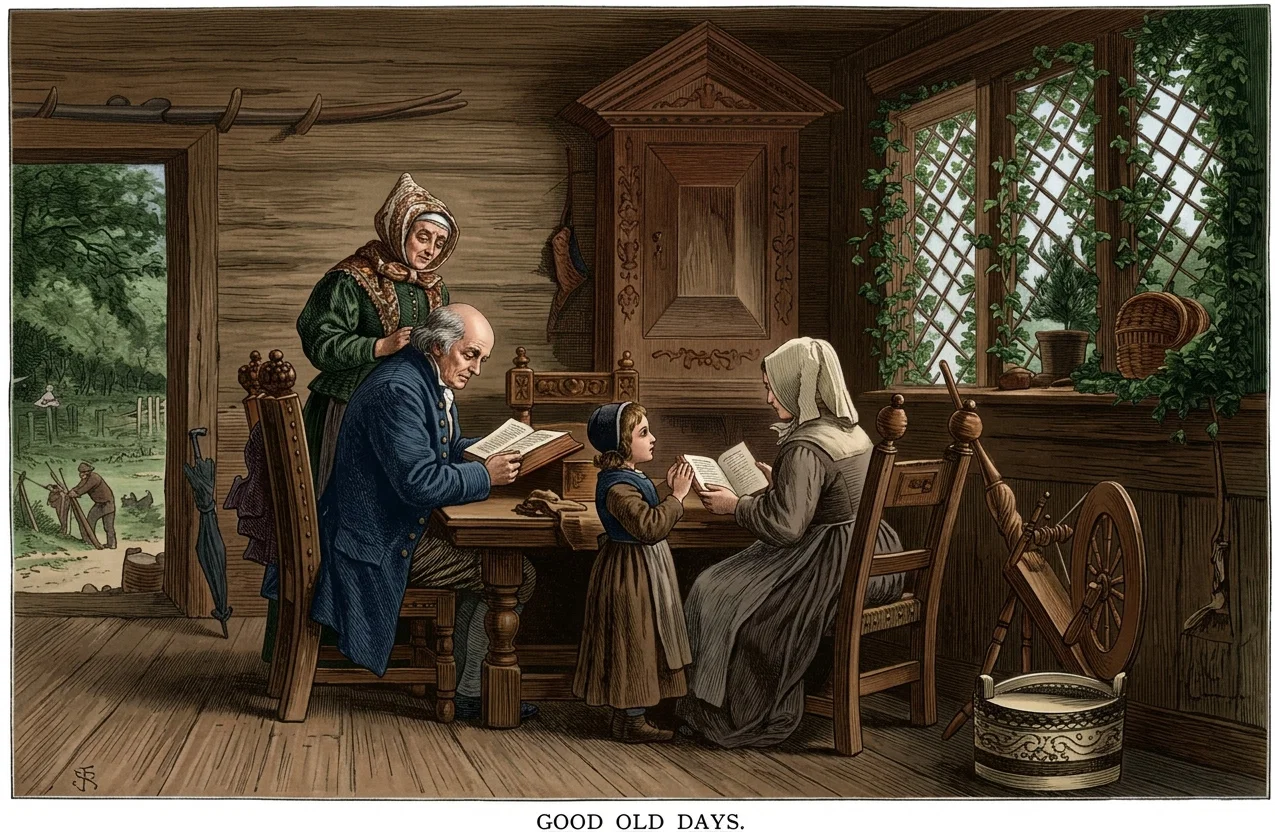
GOOD OLD DAYS.
TRAVEL in those days was an exceedingly tardy process compared with the speed with which we move through space at the present time. The boat and sailing vessel served fairly well for water travel; but on land, travelers were obliged to make their way on foot or horseback. Wheeled vehicles were little used, and the condition of the roads did not invite their rapid increase. It took three days to make a journey by vessel from New York to Philadelphia, if the wind was fair. To traverse the ninety miles overland between these two cities consumed as much time. A wagon made the trip twice a week. In 1766 stages were put on which covered this distance in the unprecedented time of two days. Their remarkable speed gained them the name of "flying machines." To-day this distance is made in two hours, and inventors are promising us still greater speed. In Pennsylvania great wagons, known as Conestoga wagons, and drawn by six or eight horses, hauled the produce of the interior to Philadelphia. At a later date it is said that there were more than ten thousand wagons used in the trade with Philadelphia.
The postal system was necessarily very tardy. Benjamin Franklin, when appointed postmaster-general, made a tour of the country in his chaise to perfect the system. It took him five months to complete the journey, but the same route could now be covered in five days. In 1672 a mail route was established between New York and Boston, the round trip being made once a month. As late as 1790 there were only five mails a week between New York and Philadelphia, and a letter was two days on the journey. Between New York and Boston mails were sent three times a week in summer and twice in winter. The mails were usually carried on horseback, a saddle-bag being sufficient to carry the small number of letters and papers sent. Even after 1789, it cost 8 cents to carry a letter 40 miles, 10 cents for 90 miles, and 25 cents for 500 miles. At that time there were 75 post-offices in the country, and 1,875 miles of post routes. There are now over 400,000 miles.
The lack of facilities for travel was paralleled by other deficiencies in colonial life. The newspaper, to us one of the first necessities of existence, was almost unknown to our forefathers. In 1750 there were only seven newspapers in the colonies. These were weeklies, the whole contents of which would not cover a single page of one of our modern sheets. And their circulation was correspondingly small. The first daily newspaper, the American Daily Advertiser, of Philadelphia, was issued in 1784. Books were as rare as newspapers. There were few American authors, and the works of these were principally upon theology. Afterwards, during the Revolutionary period, works and9pamphlets upon political subjects came into vogue. Imaginative writings were almost unknown. The only writer upon general subjects whose works are still read, was Dr. Franklin. His "Poor Richard's Almanac," with its pithy sayings and bits of homely wit and wisdom, was one of the favorite works of colonial days, and has stuff in it still worthy of perusal in this book-deluged age. Libraries had been founded in the large cities, but they were as yet far from rich in books. In truth, so far as reading matter is concerned, the life of our forefathers was as barren as in various other directions. A new book now often scarcely serves for a day's reading. It there often had to serve for a year.
The laws in colonial times were very severe. At one time in New England there were twelve crimes for which the penalty was death. In Virginia there were seventeen. Minor offenses were punished in a severe and often brutal manner. The whipping post was in frequent requisition. The stocks and pillory were employed as ordinary punishments. In the former the feet and sometimes the hands also, of the offender, were confined in holes in a sliding frame. In the latter his head and hands were similarly confined. While thus exposed to public derision, it was considered fair sport for the brutal public to pelt the helpless delinquent with mud or rotten eggs, or even with harder and more hurtful missiles. Imprisonment for debt was of every-day occurrence. The poor debtor, who perhaps had just recovered from a long illness, might be thrust in prison for the debts incurred during his sickness, and kept there among the vilest malefactors. The secrecy with which punishment is now inflicted, was then preceded by the utmost publicity. The criminal condemned to death was paraded through the streets as a public spectacle, and then hanged before a dense throng of curious spectators, who flocked to an execution as one of the choice shows of the time.
Among the prominent customs of colonial times, we can not omit that of hard drinking. Drunkenness was so common as scarcely to be noticed, wine and brandy being drunk profusely at genteel tables, while with the common people rum took its place. At every social gathering spirits formed a common beverage, and there could not be a house raising or harvesting without a heavy jug of strong liquor to comfort the laborers. Hard cider was a common drink in the eastern colonies. In the middle and southern colonies, peach brandy was abundantly consumed. In every house of any pretensions the decanter of wine or spirits was a part of the furniture of the sideboard. The jug of rum took its place in humbler mansions. Everybody drank, from laborer to minister, and, to be intoxicated in genteel society, was so common as to excite no comment. To-day, in the best circles, such a habit would lead to social ostracism; then it was viewed as a permissible weakness.
In old colony days men worked hard to produce results far below those now achieved by the same labor. Agriculture was the principal pursuit, manufacture being strangely opposed by the English Government. But the tillage of the field was performed with very rude and imperfect tools compared with those now employed. The plow in use was heavy and clumsy, being made of wood, with thin plates of iron nailed on to form the mold-board. These strips of iron were often obtained by straightening old horseshoes. The grass was cut with a scythe, the grain with a sickle. The threshing was done on the barn floor with a flail, or, in a more primitive period, the grain was trodden out by cattle. Labor-saving agricultural tools and machines were absolutely unknown.
What crude manufactures the country then possessed were mainly the result of household labor. Hats, shoes, clothes, and harness were made at home. Nails were hammered out on a rude anvil in the winter months. Every house had its spinning-wheel, and the loom was a common article of furniture. On these, flax and wool produced on the farm were carded, spun, and woven into the "homespun" cloth, from which the clothing of the day was largely made. While the men were toiling in field and barn, the women were employing the hours that could be spared from household duties in labors of this kind. Leisure from work was almost unknown in the farmhouse, and few hours in the week could be given to entertainment or mental cultivation.
Mental cultivation was, however, not quite neglected, and the colonies had schools, and from the start it was maintained in New England that it was the duty of the state to educate its children. But the schools were few and poor, the text-books crude and imperfect, and the education to be obtained very narrow. Boys were taught to read, write, and "cast accounts." Girls were taught even less. Many were not educated at all, and to read and write were far from universal accomplishments.
Writing-books were usually home-made from foolscap, and ruled by the pupil himself. He also had to whittle out his own slate pencil, while the making of quill pens took up no small part of the teacher's time. Another large fraction was occupied in the use of the switch, then deemed an indispensable aid to education.
This brief epitome of colonial conditions will serve in a measure to show how our forefathers lived in the days before the railroad and labor-saving machinery. It is, indeed, almost impossible to put ourselves in their place, and conceive what a slow and dull process life must have been with none of those conveniences which seem almost a part of the constitution of the universe to us.