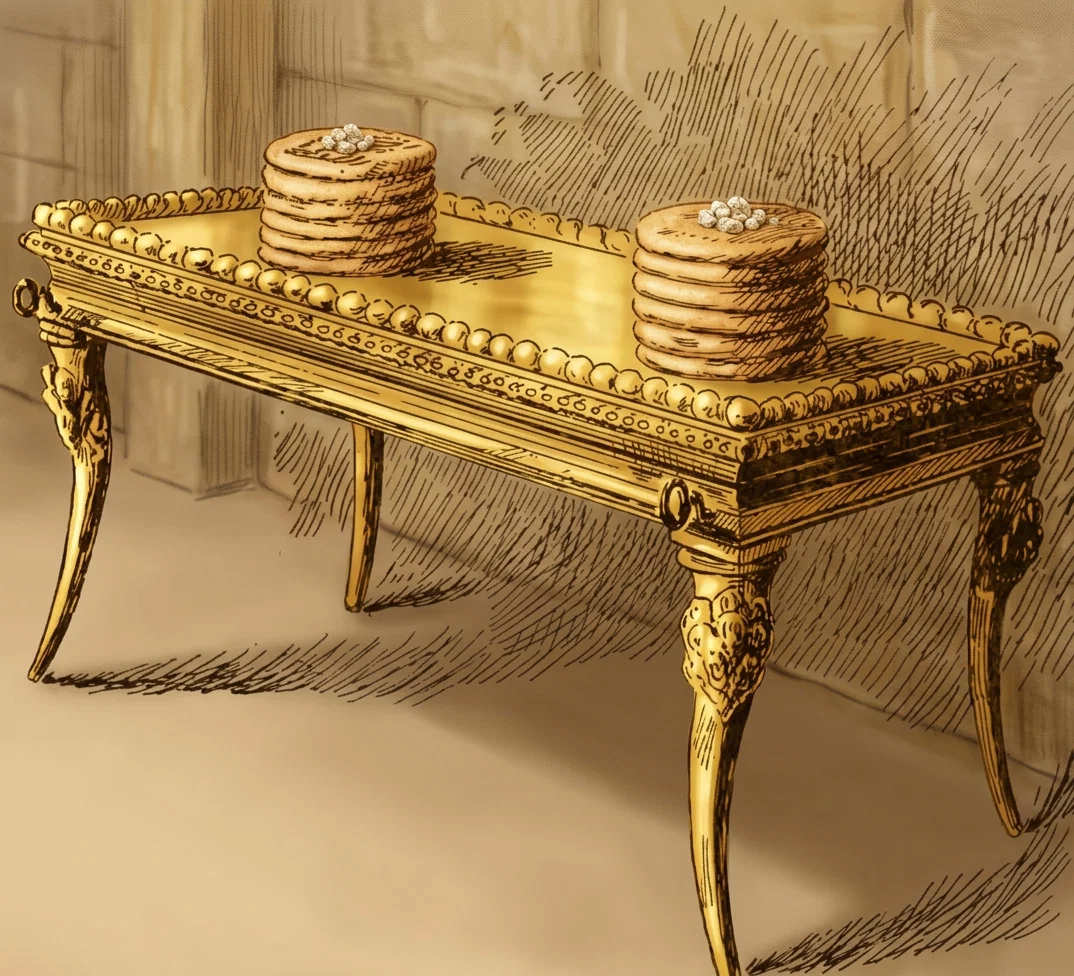
THE third and last article of furniture in the holy place which has not been mentioned is the table of showbread. The word showbread is literally "bread of the presence." This is the meaning of the Hebrew Lechem-Haponim. The reason for this meaning will be noticed later.
The directions for making the table, with all its furnishings, are found in Ex. 25:23-29; and the use of the table was to have bread thereon always before the Lord. Verse 30. When it was finished and ready to be set in its place, the Lord directed Moses to place it on the north side of the tabernacle, opposite the golden candlestick.
Even the making of the bread was not left for man to direct; but, as in all other things connected with the sanctuary, the Lord himself gave orders how it should be made, and who should bake it:—
"And thou shalt take fine flour, and bake twelve cakes thereof; two tenth deals shall be in one cake. And thou shalt set them in two rows, six on a row, upon the pure table before the Lord. And thou shalt put pure frankincense upon each row, that it may be on the bread for a memorial, even an offering made by fire unto the Lord. Every Sabbath he shall set it in order before the Lord continually, being taken from the children of Israel by an everlasting covenant. And it shall be Aaron's and his sons'; and they shall eat it in the holy place; for it is most holy unto him of the offerings of the Lord made by fire by a perpetual statute." Lev. 24:5-9.
"And other of their brethren, of the sons of the Kohathites, were over the showbread, to prepare it every Sabbath." 1 Chron. 9:32.
Thus we learn that it was the Levites who made the bread, and the priests received it from them, and took care of it in the sanctuary. The bread was renewed every Sabbath day; the old was to be given to the priests to eat. And, too, it was to be eaten in the holy place, and none but the priests were allowed to eat it.
As has been noticed in preceding articles, the Lord gave particular instruction that everything that was made in connection with the sanctuary was to be done after the pattern showed Moses in the mount. From this it is evident that God had the original sanctuary in heaven, the pattern of which he showed Moses. This is plainly stated in Hebrews 9. We learn elsewhere that John saw the golden candlestick, and also the golden altar in heaven, at which the angels of God were ministering with the golden censer. Rev. 1:12, 13, 20; 4:5; 8:3. But nowhere is it recorded that any one saw the table of showbread in heaven, with the food thereon. The reason for this is obvious. Since these things on the earth were but a shadow of the things in heaven, and heaven contained the real substance of these object lessons, it was not necessary to have a table there with bread thereon. Christ himself is "the bread of God, which came down from heaven," and upon whom the world feeds. It is Christ who is the bread of life, and who only can satisfy the hungry soul.
The showbread was meant to represent Christ. And this is why it is called the "bread of the presence," for Christ, who is the bread of life, is always in the presence of God, ever prepared and ready to feed all who come unto him. "Then Jesus said unto them, Verily, verily, I say unto you, Moses gave you not that bread from heaven; but my Father giveth you the true bread from heaven. For the bread of God is he which cometh down from heaven, and giveth life unto the world. Then said they unto him, Lord, evermore give us this bread. And Jesus said unto them, I am the bread of life; he that cometh to me shall never hunger." "I am that bread of life. . . . This is the bread which cometh down from heaven, that a man may eat thereof, and not die. I am the living bread which came down from heaven; if any man eat of this bread, he shall live forever; and the bread that I will give is my flesh, which I will give for the life of the world." John 6:32-35; 48-51.
He has ever been giving his life for the world, that whosoever would come and feed upon him might have that everlasting life. While the priests on those days ate of the holy bread, the food the Lord gave the people daily for forty years was to teach them their utter dependence upon God, and that God was the bread of their salvation; for we read that they did all eat that same spiritual meat, and all drank that same spiritual drink; for they drank of that rock that followed them, and that rock was Christ. 1 Cor. 10:3, 4.
What a blessed truth to know that to-day we are all priests of God and of Christ, and can daily eat of the heavenly manna with which he is feeding his people! He, the "bread of the presence," can still be in the presence of God interceding in behalf of his people, yet feeding them with his own life. And after enjoying the bread of God during the six days, the table is supplied anew every Sabbath day, that we may, as it were, eat the bread direct from the table, as we can appreciate it more on that day by feeding upon him constantly. So that we can truly say we receive a double portion of the bread on the Sabbath. What blessings there are in Him! How he does truly feed his people with the bread from heaven!
The priests had nothing to do with the preparation of the food. It was brought to them all baked and prepared; they were simply to place it upon the table, and with the dishes thereon to partake of the food when the time came. So it is with the Christian. Christ is the bread; he has prepared it for us; he has given us the means with which we can eat this bread, and all we have to do is to receive and partake of it,—appropriating it to our own lives, and receiving nourishment therefrom.
The bread which the priests ate was unleavened bread, made of the finest flour possible. There was no leaven of any kind found in the life of Christ. It was a pure life, not diluted or adulterated with the corruptions of this world. Hence when we eat of the food which came down from heaven, we receive the food of truth and sincerity, which will enable us to grow into men and women of God. And as Christ gave his life for the world, that all may feed on him, so we, as Christians, should give our lives to the world, that the hungry souls who are seeking for the heavenly manna may see that we have been fed from God's bountiful table, and are willing, if necessary, to give our lives that others may be fed also; for "as he is, so are we in this world." Then the world will see that there is much more in the Sabbath than merely a day in the week different from what others keep. They will learn that it is the day in which God feeds his people with more of the heavenly manna than is received upon any other day, and many hearts will turn to this precious truth of God, and also will eat more of his flesh and drink more of his life, which is the bread he came down from heaven to give.
Dear readers, do we realize what it is to be a Christian? Do we realize what Jesus Christ has done for us by giving his life to the world? May God help us to feed more upon him each day, view him more as he is in all his glory and loveliness, that the longing which thousands of hearts have to-day to know the truth may be satisfied, to taste and see how good the dear Lord is. Ps. 34:8.
"Bread of our souls, whereon we feed,
True manna from on high,
Our guide and chart, wherein we read
Of realms beyond the sky."
"Bread of heaven,
Feed me till I want no more."
F. C. GILBERT.
South Lancaster, Mass.