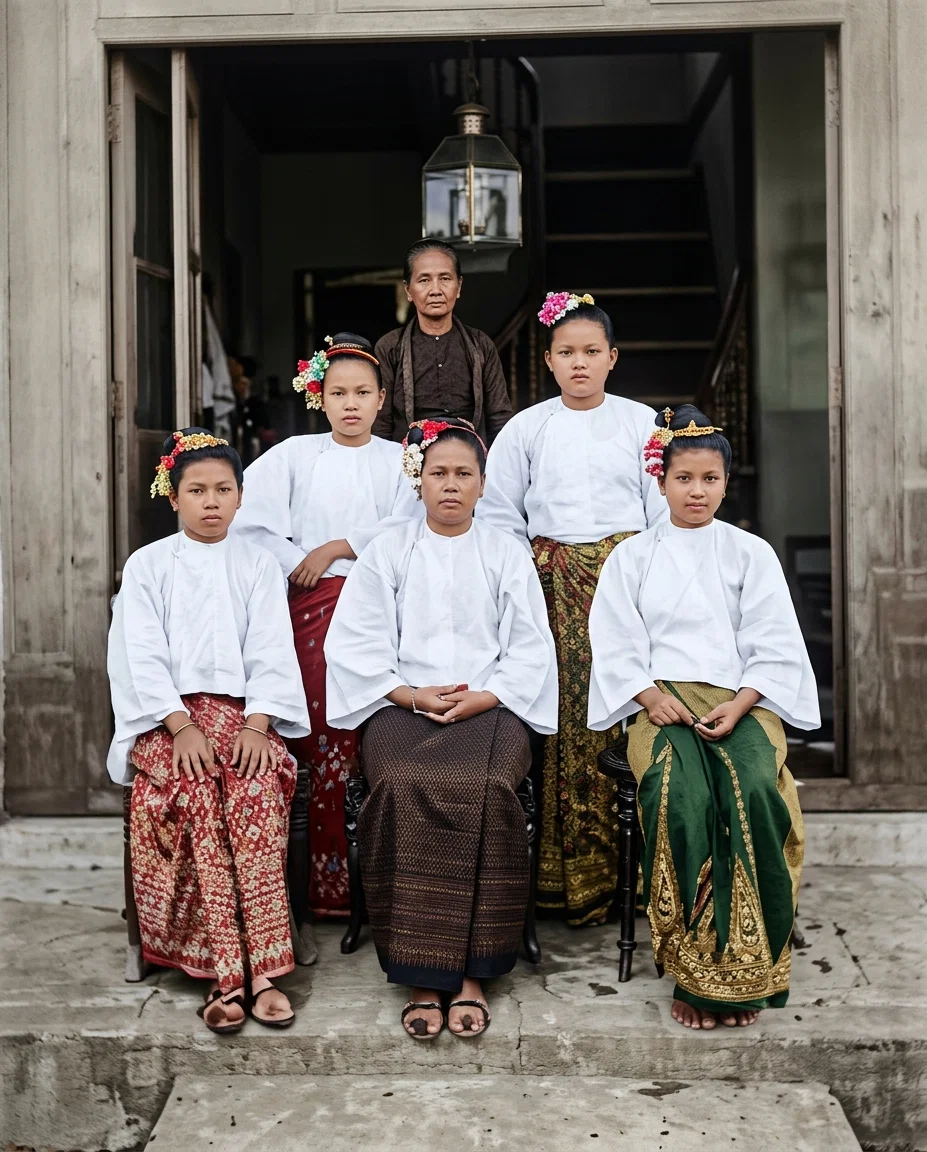
ACCORDING to the theory held by most ethnologists, Burma has been peopled by successive migrations of tribes from the north. It is even supposed that the Siamese were originally dwellers in this country, but that they were forced farther south by the more hardy tribes that followed them. Whether a tribe of the Karens or the Talaings, also known formerly as the Mons, were the next emigrants, it is difficult to say. Without attempting to prove that the theory advanced concerning these things is true in all particulars, it will suffice to say that there is much that seems to give evidence confirmatory of it.
Among those now to be found in the land Burmese, these predominate: Shans, Chins, Kachins, Talaings, and at least three distinct tribes of Karens. All these tribes are related racially, yet they are so different in some respects that one needs to live here but a short time before being able to distinguish between them easily. I shall not try to describe all the tribes in detail, contenting myself with a few general remarks that will help the reader to understand better what is written concerning the Karens, of which nation I wish to write particularly.
After the Siamese had been pushed over what is now Burma's border by the next migration, the Talaings were the first to establish a real kingdom. If the Karens preceded them, they offered little resistance to the Talaings, being content to withdraw to the hill tracts along the Salwin River. Probably another tribe of Karens came next, and occupied the territory to the north of the kingdom of the Talaings. These were soon dislodged by the conquering Burmans, and driven into the mountains that border the rich delta regions and the fertile river valleys. Then the Shans came; and failing to overcome the Burmese, they took territory contiguous to China, in the central and northeastern part of the country. The Chins and Kachins are to be found in the extreme north. They are devil-worshipers pure and simple. They are not civilized at all. It is but a short time since they engaged in head-hunting. Even now a strong military force is kept in or near their territory. Punitive expeditions are necessary occasionally to chastise them for some raid made upon a peaceful village.
Karen Girls at Home
Burmese Girls
Prior to the acceptance of Christianity, the Karen would fly at the sight of a Burman. For centuries the Burmese rulers had plundered their fields and granaries. This led them to clear a little plot on the hillside, by burning, plant their grain, harvest it as soon as possible, and move to some new location. Thus they were semi-nomadic, returning only once in three or four years to their old fields and again cultivating them. Since British occupation has given them security, many have settled in the plains, but still large numbers are found in the hills.
One tribe, the red Karens, seemed possessed of a more warlike spirit than the rest of their brethren. These successfully withstood their enemies, and maintained their independence in their mountain fastnesses.
Perhaps because he has been living in the cooler air of the mountains so long, perhaps because he is closer kin to the fairer Chinaman, the Karen is lighter complexioned than the Burman. There is also more red in the cheeks of the Karens. And there is a different expression of the face, and a vague something, hard to define, about the shape of the head, back, and hips, that distinguishes them. The difference is most marked among the women, the veriest novice being able to see the difference between the women of the two nations.
As I remarked, the Chins and Kachins have remained outright pagans, excepting the very few who have embraced Christianity and Buddhism. The Talaings, Shans, and Burmans all accepted Buddhism centuries ago, and this land is known as the home of the purest Buddhism of the "northern school." But the history of the Karens is different, and to students of missions it is most interesting. In some respects it is without parallel in all the records of missionary endeavor.
The Karens
In Judson's day, the Karens first came into contact with the missionary. When first discovered, it was found that their traditions told them of creation, a sinless pair in the garden, the fall, the Flood, and other things of which the Scriptures speak. In all essentials, the account they have is in agreement with the Word.
Added to this they say that the knowledge of the true God was lost to them through disobedience and a failure to prize His revelation as its worth demands. They say that the Lord offered the Bible to the other nations, but that it was refused by the natives of India,—by the Burmese, and by the rest. At last it was offered to the Karens, the "younger brother" among the tribes. It was accepted, but not heeded and followed. Finally, God took the knowledge of Himself from them, but not until He had promised that He would again visit them and restore what had been taken away. His agent was to be "white men from the west."
During the time of their darkness and ignorance, they became animists. This is not strange, for it seems that all Mongolian races are especially given to devil-worship. But the Karens said that they did thus because of fear only, until the Great God should again reveal Himself. They illustrated their position thus: A father with his children was traveling up the mountainside. It was necessary for the parent to leave the children for a time. Giving into their charge the domestic animals that he owned, he bade them wait for him on a projecting ledge of the mountain. During his absence, a tiger approaches by the path over which they had come. Filled with fear, they push one of the animals over the cliff. This appeases the brute, and they are spared.
"So," they say, "we offer sacrifices to these malign spirits only because we fear them; but when our Father returns we will worship Him because of love." And by the thousands they have accepted the Gospel of Jesus Christ. The Baptists alone have fifty thousand converts. Other missions have also seen marked results for the labor put forth. Further, they seem to grasp the spirit of Christianity. It is often said in these lands, that it takes three generations to make a Christian; but with the Karens it does not seem so. They have their failings. If they did not, they would hardly be mortals. Some things are trying for the worker. Like other people of the tropics, they seem to be lacking in ambition, and to be smitten with the same "tired feeling." They have a saying that is about as follows: "If you go to school and work hard and get an education, you eat rice; if you stay in the jungle and cut wood, you eat rice."15Still they seem different from most heathen people. Even writers that have but scant sympathy for missionary effort as a whole, admit that in the case of the Karens the results seem to have justified the efforts put forth.
Some six or seven years ago, a missionary of the Baptist Church reported the discovery of another branch of the Karen people. These are located on the Burmo-China frontier. Their language is different from that of the people of the lower part of this province, but the dissimilarity is only as much as would be expected to exist among tribes without a written language, that have been separated for some centuries. The likeness is such that a person who knows one, very readily acquires the other. This last discovered branch holds the same traditions that their brethren have, to which reference has been made. They have eagerly accepted the Gospel. From a distance of many days' journey each way, they have come to the mission compound seeking for light. As many as two hundred inquirers have been at the station at one time, I am told.
Who Will Come?
Ever since we first learned of this intensely interesting people, we have pleaded for some one to come and bear to them the knowledge of the Lord's return. Repeatedly we have mentioned them in the articles prepared for publication. Again and again we have presented them before the Mission Board. During a furlough in the home land, we spoke of them whenever opportunity presented. Yet after all these years we have no one who can speak to the Karens in their own tongue.
Some time ago, a Karen man came to the home of our worker in Maulmain, and said that he had been observing the Sabbath for several months. He begged to be instructed further.
After our last biennial conference, Miss Gibbs came to Burma, and has begun the study of Karen. She is making encouraging progress; but some one should come, for it will not be possible for this sister to pioneer alone in the villages. We need a consecrated young man and his wife to help. Who will be the apostle of this message to the Karens? The harvest of souls will be a bountiful one. O that the Lord might lay the burden on some one! How long must the Karens wait?
H. H. VOTAW.