It is a truth iterated and reiterated in the Bible that the Israelites had the Gospel. Not merely those who lived in the days of Christ, but those who antedated them by many centuries. For we read that "unto us was the Gospel preached, as well as unto them; but the Word preached did not profit them, not being mixed with faith in them that heard it." Heb. 4:2. By reading the last part of the preceding chapter it will be observed that the apostle refers to the Israelites who were in the wilderness for forty years. We have noticed some of the Gospel truths connected with the sanctuary. We will consider at this time some precious Gospel truths immediately connected with the most holy place of the tabernacle of the wilderness.
This apartment was separated from the holy place by a curtain of blue, purple, and fine-twined linen, and was not to be entered by any one save the high priest, and then at a special time in the year. This will be noticed later. The holy of holies contained very few pieces of furniture, but these were significant indeed.
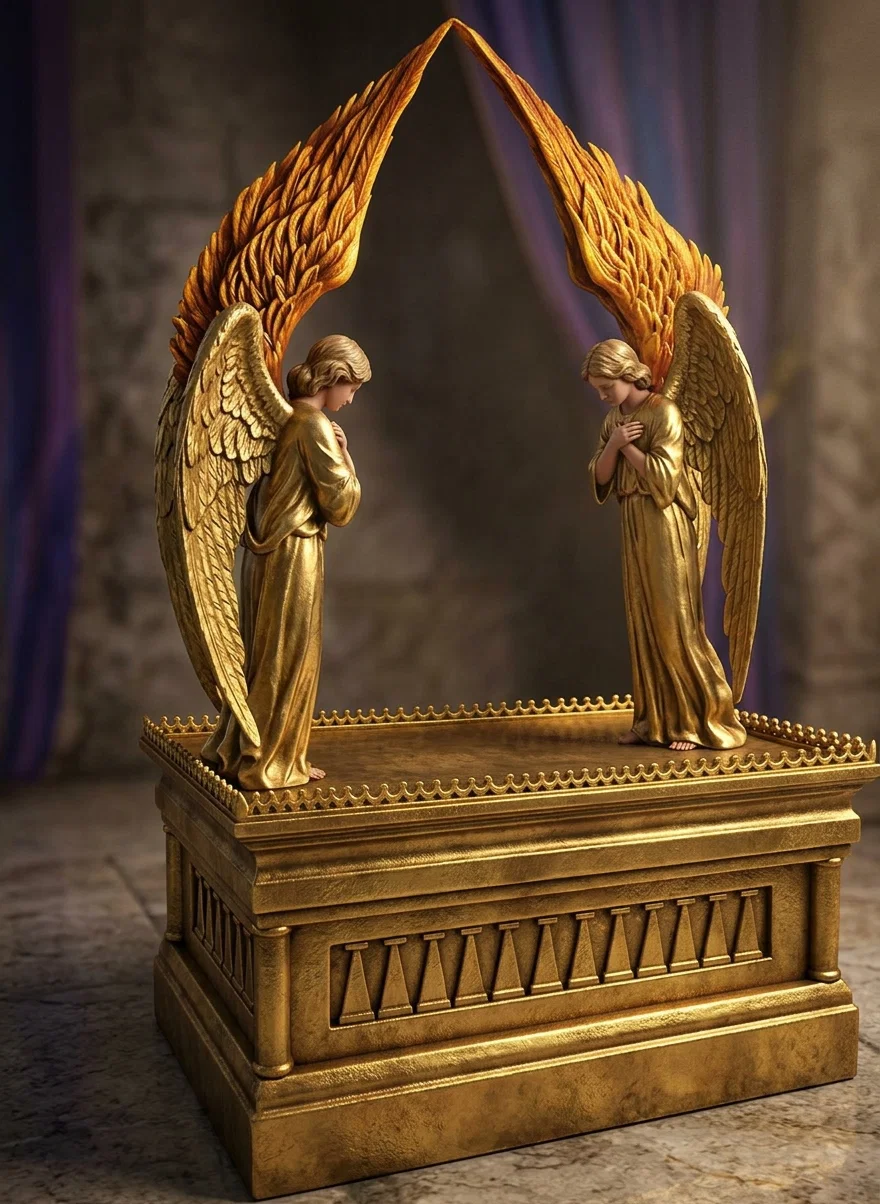
Directly inside the vail was a chest made of shittim wood, and called the "ark of the covenant," "the ark of the testament," "the ark of God," etc. It was covered with pure gold, and lined with the same material. Upon the top, and all around it, was a golden crown. In this ark were placed the two tables of stone, tables of testimony, upon which God wrote his sacred law with his own finger. And for this reason it was called the "ark of the covenant," because the Decalogue was God’s own covenant which he declared unto the children of Israel, and also was the basis of the covenant which God made with the children of Israel. Ex. 25:10–16; Deut. 10:1–5; 4:13; 5:22; Ex. 19:5. Above the ark, and covering the top, was to be a mercy-seat made of pure gold, where by his shekinah, or glorious manifestation, God would meet with the priest, and from that place commune with his servant. At each side of the mercy-seat, God commanded a cherub to be placed, made of pure gold, to be made of beaten work, with their wings stretched out, so that
they would cover the mercy-seat, and their faces looking toward the mercy-seat; thus making the mercy-seat the pivotal point. This was all the furniture for the holy of holies. No light was to be there of any kind save the glory of God resting on the mercy-seat.
How beautifully are Christ and his work manifested in this part of the tabernacle. This is not the only place in the Bible where an ark is mentioned. Before God brought the great Deluge into the world, he told Noah to prepare an ark for the saving of himself and as many more as would believe the word that the world was then to be destroyed. Gen. 6:13–22; 1 Peter 3:20. When Moses, who was to be the deliverer of the children of Israel, was born, his mother placed him in an ark of bulrushes, which, in the providence of God, was the means of saving his life. Thus all through the Bible we see that the ark was used as a means in God’s hands to save people.
Thus it is with this ark. Therein was contained God’s holy law. Man had violated that law, and had forfeited his life. The fiat had gone forth, "The wages of sin is death" (Rom. 6:23); and "sin is the transgression of the law" (1 John 3:4). Hence the law, while it was given to man for life, was found to be unto death. Rom. 7:10. Nevertheless God had the means of salvation there, for the ark contained a mercy-seat. And it was upon this seat that God dwelt to meet with the priest. And for what purpose?—To manifest his character, which is "The Lord, The Lord God, merciful and gracious, long-suffering, and abundant in goodness and truth, keeping mercy for thousands, forgiving iniquity and transgression and sin." Ex. 34:6, 7. "Who is a God like unto thee, that pardoneth iniquity, and passeth by the transgression of the remnant of his heritage? he retaineth not his anger forever, because he delighteth in mercy." Micah 7:18.
The ark indeed was a refuge to which men could flee, and be saved; for Jesus had prepared mercy with that ark. And not only prepared mercy, but much more. "Being justified freely by his grace through the redemption that is in Christ Jesus; whom God has set forth to be a propitiation, or mercy-seat. The Greek word hilastirion never signifies "propitiation," as rendered in our common version; but is always used for mercy-seat in both the Old and
New Testament, wherever it occurs. Rom. 3:24, 25. Thus Christ not only dispenses mercy, but is the Mercy-seat of God, the very essence of mercy, God having put him forth as the very characteristic of that divine disposition.
How beautiful it must have been for the priest to dwell in such a place! No one but the priest could tell what it was like; for none but he was allowed admittance. When the shekinah of God rested upon that place, and the whole apartment was filled with the effulgence of that glory, how grand it must have been to be there! The Lord came there to speak peace to all the people through the priest; and the latter was to declare to the Israelites that the God of mercy had met with them, and the very seat of mercy was the Christ. Truly, Christ is "the Alpha and Omega" of the Bible; the beginning and ending of the salvation of God. There is no place where we can turn, but what we find Jesus there; and every time he comes to us with a revelation it is to reveal some new phase of his love.
The cherubs placed at each end of the seat of mercy appeared as tho they supported the throne of God, and formed a beautiful arch for the glory of God. When the priest saw the glorious display, how it must have taught him the grand truth of the seating of God’s throne in the human soul, covered with the wings of the angels, and protecting him by their power. Isa. 57:15; Ps. 34:7.
This is the privilege of every Christian to-day. "But we all, with open face beholding as in a glass the glory of the Lord, are changed into the same image from glory to glory, even as by the Spirit of the Lord." "For God, who commanded the light to shine out of darkness, hath shined in our hearts, to give the light of the knowledge of the glory of God in the face of Jesus Christ." 2 Cor. 3:18; 4:6. And when we approach the Lord, we can look up to him to heaven, his dwelling-place, where he is seated upon his most glorious throne, having his seat of mercy between the cherubim, Christ anxiously waiting to dispense that grace. 1 Kings 8:39; Isa. 6:1; Zech. 6:12, 13; Ps. 80:1; 99:1; Heb. 4:15, 16.
This is a part of what God desired to teach Israel anciently concerning salvation, and we shall learn in future articles how Israel perverted these truths. But it is blessed to know that Jesus is pledged to abide in our heart and make it a seat of mercy, that we may dispense it to others, thus not only enjoying him for ourselves, but leading others to see him who is our Mercy-seat, and the Giver of all our good gifts.