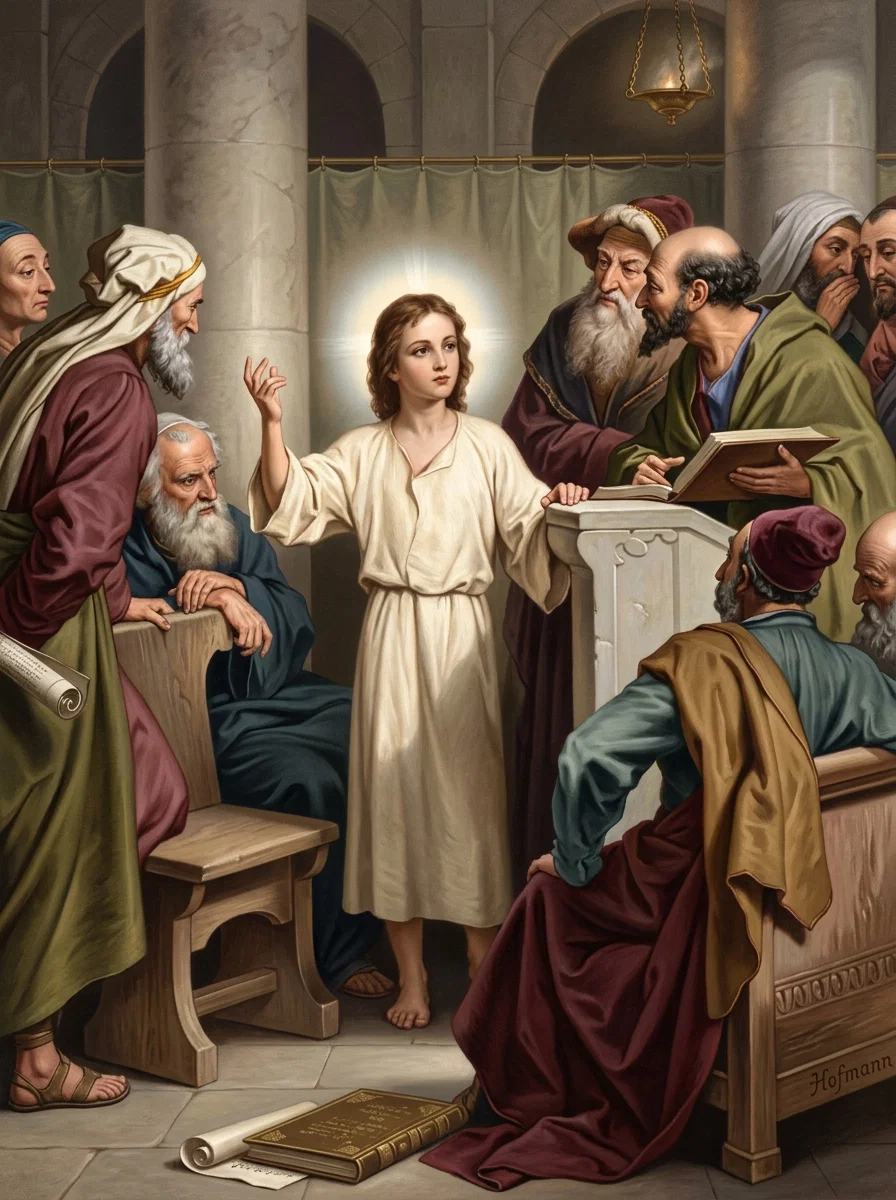
JESUS attended the Passover services of His people at Jerusalem with Joseph and Mary, His mother, when He was twelve years old, this being the age, according to Jewish regulations, when a son was first permitted to engage in the Passover services. Altho He had never before engaged in the celebration of these rites, He had doubtless seriously studied their significance, and was enabled at that time, through Spirit-quickened mind, to comprehend the national and the Gospel lessons they contained.
JESUS AT TWELVE YEARS OF AGE IN THE TEMPLE
In those times there was associated with the Passover gathering a short term of school in the temple, where special lessons were given for the benefit of those who wished to know more about the real meaning of these annual services. No one else then could have as deep a personal interest in things studied in this temple school, as the twelve-year-old Jesus; for He was the Christ of whom Moses and the prophets wrote, the Holy One of Israel who had come down from heaven to give His life as a ransom for man. All the sacrifices offered pointed to Him. He was the source and the center of all that the Passover meant, and the time had come for Him to know that He was the Lamb of God that should take away the sin of the world.
The twelve years of His allotted childhood had passed away; and opportunity was enabling Him to learn that He was the promised Messiah, the Son of God, and not the son of Joseph. The Spirit of wisdom and of quick understanding was upon Him. The Spirit of counsel and of might, in fulfilment of Isa. 11:2, 3, enabled Him to comprehend the true significance of all the rites He was permitted to celebrate. These qualifications made Him superior to the instructors then in the temple; therefore David had said for Him, "I have more understanding than all My teachers: for Thy testimonies are My meditation." Ps. 119:99.
The teachers in the temple school should have been able to show how the Passover rites pointed to the atonement which the Redeemer would make for transgression. But what they lacked in ability was supplied on that occasion by Jesus, the youthful Nazarene, who had joined the classes.
He doubtless spent much of the time during His stay in Jerusalem at the temple school. It is certain that He either became so deeply interested in the studies, that He did not know when His people left for their homes in Galilee, or else He remained behind on purpose. He could be about the Father's business by remaining in the temple, and He gave Himself up to this business.
Joseph and Mary were anxious to get home to look after their temporal affairs, and did not think to let Him know when the time came for them to return home; so they departed and traveled one whole day without Him. When the night came on, they searched the whole camp over, but could not find Him. Then they returned to Jerusalem to see if He could be found there.
Sadly they traversed the streets, and inquired of the watchman to learn if they had seen Him. This searching they kept up for three days, and then found Him in the temple, sitting in the midst of the doctors, both hearing them and asking them questions. All that heard Him were astonished at His understanding and His answers. Luke 2:46, 47.
Then His mother asked why He had treated them thus, causing sorrow to their hearts. Jesus answered, "How is it that ye sought Me? wist ye not that I must be about My Father's business?" He showed by this answer that He knew He was the promised Messiah, and not the son of Joseph. It seems, too, that providence was overruling affairs so that Joseph and Mary could retrace the eighty miles between Jerusalem and Nazareth in company with Jesus rather than return with a visiting multitude, for they needed to know more fully the character of the sacred trust God had committed to their care.4
It was necessary that they be taught more about the meaning of Christ's mission to this earth, and how it would be done. His tarrying at Jerusalem caused them to part company with the returning throng, and connect with Jesus only on their journey home.
Jesus Himself did not enjoy the spirit of the multitude, neither did He want His earthly guardians to partake of their ways. In holy counsel and quietness He wished to return with Joseph and Mary to Nazareth, for He was yet to spend eighteen years waiting for the year to come which had been announced by Gabriel for the presentation of "Messiah, the Prince." Dan. 9:24-26.
Probably on His return to Nazareth He spoke of the significance of the dying lamb in the Passover rites, and of the atoning work the heavenly Father had sent Him from heaven to perform. What an opportunity this homeward journey afforded Jesus to talk of the great things which redemption must do for mankind, and how God must work to correct the desolations that sin had wrought!
He did what He could to help them to see the scope of His work and to impress them with their need of cooperating with Him in His "Father's business."
It is very possible that with all His labors of this character they failed to understand the fulness of His mission; but let us strive to know what our relation to it should be, and how we should cooperate with Jesus in His Father's business of saving sinners from destruction, that they may enter into the everlasting kingdom.