Christ's Coming the Destruction of All Earthly Kingdoms
By H. W. Cottrell
By H. W. Cottrell
THE second coming of Christ will bring an end to the reign of all earthly kings and kingdoms. All who are in authority will then surrender that power at the feet of King Jesus.
His coming will also terminate the long, cruel, dark reign of selfishness and sin. The King of the universe will then take to Himself His subjects, and they will dwell evermore with Him in a kingdom then to be set up, of which kingdom and reign it is not our purpose to treat in this article.
Earthly kingdoms have borne sway for thousands of years. Four universal kingdoms have swayed the scepter, some for a longer and others for a shorter period of time. Babylon was the continuation of the old Assyrian kingdom, and was the first world kingdom. That she was a world kingdom is evidenced by numerous scriptures (to say nothing concerning the historical evidence of the fact), one of which reads, "Nebuchadnezzar the King, unto all people, nations, and languages, that dwell in all the earth." Dan. 4:1.
Successive Empire
While it is true that other kingdoms existed, yet all were subject to the kingdom of Babylon, and to the dictates of its King. They were thus brought into subjection by arbitrary power—force. The history of the King is summarized in the words, "He became great in the estimation of men, and he died." The kingdom acquired world renown; and while it was great, its subjects were providentially humbled in the sight of men by its being conquered by the Medes and Persians.
This kingdom having absorbed the authority of its predecessor, also its subjects, all others stood in awe of it. It also had world-wide authority; and when it reached the zenith of its greatness, it fell, suffering its humiliation at the hand of the Grecians.
Alexander, at the head of the Grecian world power, then took the reins of government; and in the prime of manhood and worldly greatness, the whole earth appeared to be blossoming in honor, power, and human exaltation before him and to him. Even he, Alexander the Great, succumbed to death in the midst of his worldly greatness. Dan. 8:20-22.
Later followed Rome, the iron kingdom, which bore universal earthly sway; for we read of a world-wide decree issued by this kingdom, through the specific authority of its King, "And it came to pass in those days, that there went out a decree from Cæsar Augustus, that all the world should be taxed." Luke 2:1. Thus the fact is evidenced that the kingdom was world-wide, and the King its sole monarch.
It was the rulers in this kingdom that endeavored to take the life of the "child Jesus." This great power, with an allied power, put to death the Redeemer of mankind on Calvary's cruel cross, while He was tendering to each individual an endless life.
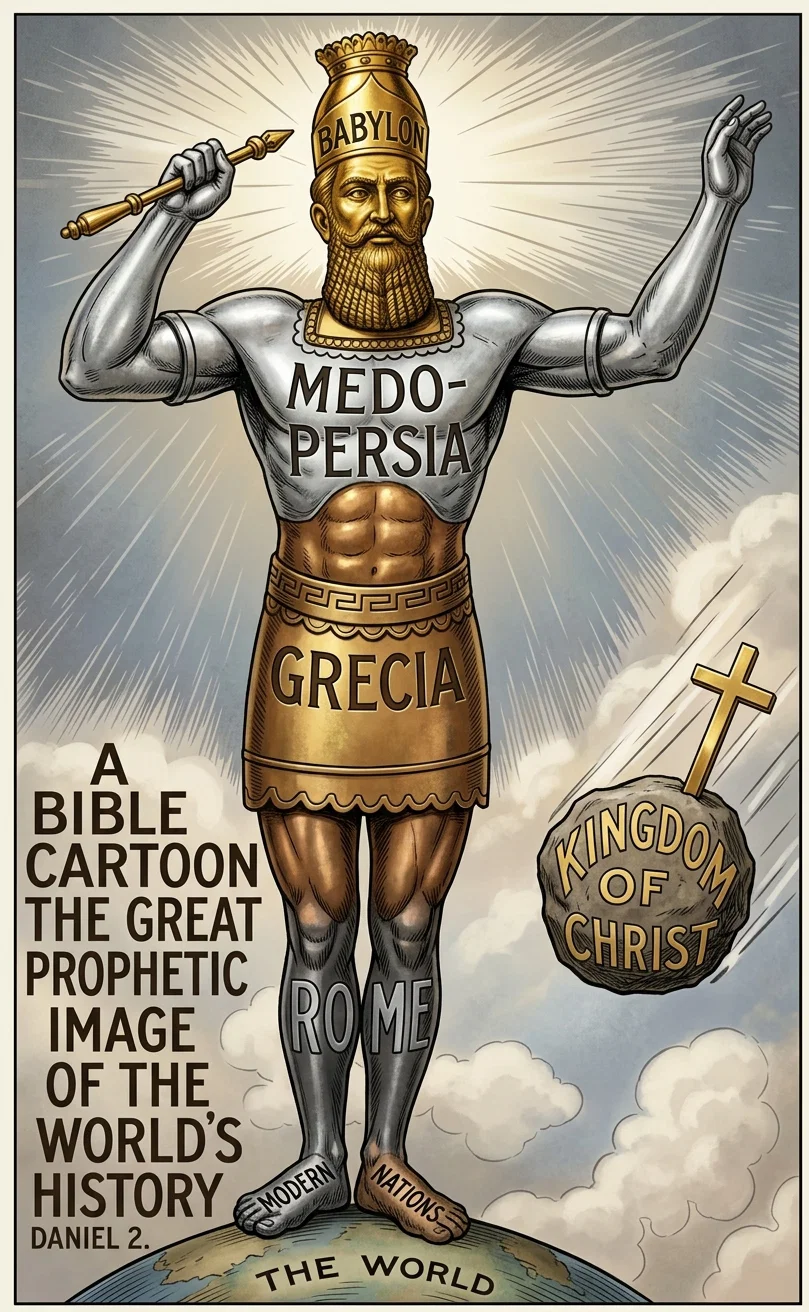
The prophet Daniel forecast the future of this kingdom and all other earthly powers in the following language, the final culminating point to be reached at the second coming of Christ:
The Fourth Monarchy
And the fourth kingdom shall be strong as iron: forasmuch as iron breaketh in pieces and subdueth all things; and as iron that breaketh all these, shall it break in pieces and bruise. And whereas thou sawest the feet and toes, part of potters' clay, and part of iron, the kingdom shall be divided. Dan. 2:40, 41.
In harmony with God's Word, Rome was divided, and thus it has been and will continue to remain for all time.
The Gospel in prophecy pictures the thrilling event of the final destruction of all earthly kingdoms, in its metaphorical description of the breaking to pieces of the historic metallic image of the second chapter of Daniel. This image is explained to represent the earth's four universal kingdoms, while the stone therein represents the kingdom of Christ.
Earthly kingdoms must give way to the heavenly kingdom, kingdoms of time to the kingdom eternal. "Thou sawest till that a stone was cut out without hands, which smote the image upon his feet that were of iron and clay, and brake them to pieces. Then was the iron, the clay, the brass, the silver, and the gold, broken to pieces together, and became like the chaff of the summer threshing-floors; and the wind carried them away, that no place was found for them; and the stone that smote the image became a great mountain, and filled the whole earth." Dan. 2:34, 35.
The Eternal Kingdom
From the time of the second advent of Christ, henceforth and forever, there will be no "place" for earthly kingdoms. But Christ and His kingdom will bear universal and eternal sway.
The subjects of every earthly kingdom, and of every other finite form of government, have died throughout ages past, and left the kingdom to other people. But at the coming of Christ, when time is absorbed by eternity, and temporal powers are no more, the eternal kingdom will come into possession of the children of God, and it "shall not be left to other people." Dan. 2:44.
With the aid of the prophetic telescope as placed in the student's possession in the seventh chapter of Daniel, we view the dim vista of earth's past history, and see the four universal monarchies rise and then fall. We behold the fourth universal kingdom—Rome—divided into ten divisions. "Thus he said, The fourth beast shall be the fourth kingdom upon earth. . . . And the ten horns out of this kingdom are ten kings that shall arise." Dan. 7:23, 24. "And in the days of these kings shall the God of heaven set up a kingdom, which shall never be destroyed." Dan. 2:44.
The culmination, however, will be reached when all things earthly give way to Christ, the King of the universe. "And the kingdom and dominion, and the greatness of the kingdom under the whole heaven, shall be given to the people of the saints of the Most High, whose kingdom is an everlasting kingdom, and all dominions shall serve and obey Him." Dan. 7:27. "And when the chief Shepherd shall appear, ye shall receive a crown of glory that fadeth not away." 1 Peter 5:4.