An Untamable Thing

7%

Pacific Press Publishing Association · Mountain View, California · May 30, 1911

FromSigns of the Times, Vol. 38, No. 21.

Read the full edition

An Untamable Thing

The inability of man successfully to domesticate and tame certain wild animals is well known. All are familiar with the story of the man who had a pet tiger, which, after licking his hand one day till it tasted blood, seized the man's arm, and was prevented from taking his life only by a timely shot from his pistol.
The truth of this was again confirmed by an incident that occurred not long ago in New York City. A cub tiger caught by a sea-captain, had been given to a man in whose home it was treated as a pet. It seeming so gentle, the man felt no hesitancy in letting his little ones play with it and make a pet of it. Later, however, as the animal grew larger, it became sulky and restive, and the man was thinking of giving it to the Zoo. Still he did not chain it up, tho he warned the children against playing too roughly with it.
One day while sitting in his parlor, he heard his six-year-old daughter screaming in the kitchen. Hastening thither he found her cowering in a corner before the young tigress. The animal had suddenly become ferocious and turned on the little daughter. The angry beast crouched before her, with its lips drawn back over its fangs, its tail swishing, its claws protruding, while it snarled menacingly.
The man was unarmed; but as the animal seemed about to spring upon the girl, he sprang forward and kicked it in the head. The blow knocked the beast over; but it was on its feet like a flash, and crouched, lashing its tail in fury. Again the man kicked the tigress, and as it toppled over he kept up his attack, shouting to his daughter to run. The child obeyed; and as the cub staggered to its feet, still bent on fight, the man decided to despatch it at once by asphyxiation in the gas-range.
Herein lies a lesson on that evil and untamable thing called an ecclesiastical establishment, or a union of Church and State. Like the pet tiger, at first it may seem innocent and harmless, and many may be inclined to pet, favor, and fondle it; but sooner or later its true character is revealed, and instead of a friend, men discover that they have been petting and fostering a cruel, despotic, and deadly foe. The tiger, they find, is a tiger still. The first taste of persecution or thrill of power only whets its appetite for more.
"Intolerance," says Dean H. H. Milman, "seems inherent in the religious spirit when armed with authority." "The separation of the ecclesiastical and the civil powers," he adds, "appears to be the only means of at once maintaining religion and tolerance!"
Ecclesiastical despotism is an untamable thing. The union of religion and the State is a deadly foe. It means bondage, oppression, and ruin. Adopting the words of Alexander Campbell regarding the Papacy, the most striking example of a union of Church and State the world has ever witnessed, it may be described as "naturally, essentially, and necessarily, despotic, cruel, and implacable. It constitutionally claims a sovereignty over not only the secular sword, but over everything on earth,—thought, language, action, spirit, soul, body, and estate. It regards itself as the heir of all earthly things, and by a right divine and irrevocable, the only earthly king of kings and lord of lords. Its motto is, 'The empire of the globe or nothing.' The law of gravity will cease to act sooner than this superstition sleep on this side of absolute dominion. It can not be the guest of any land. It must be the host."
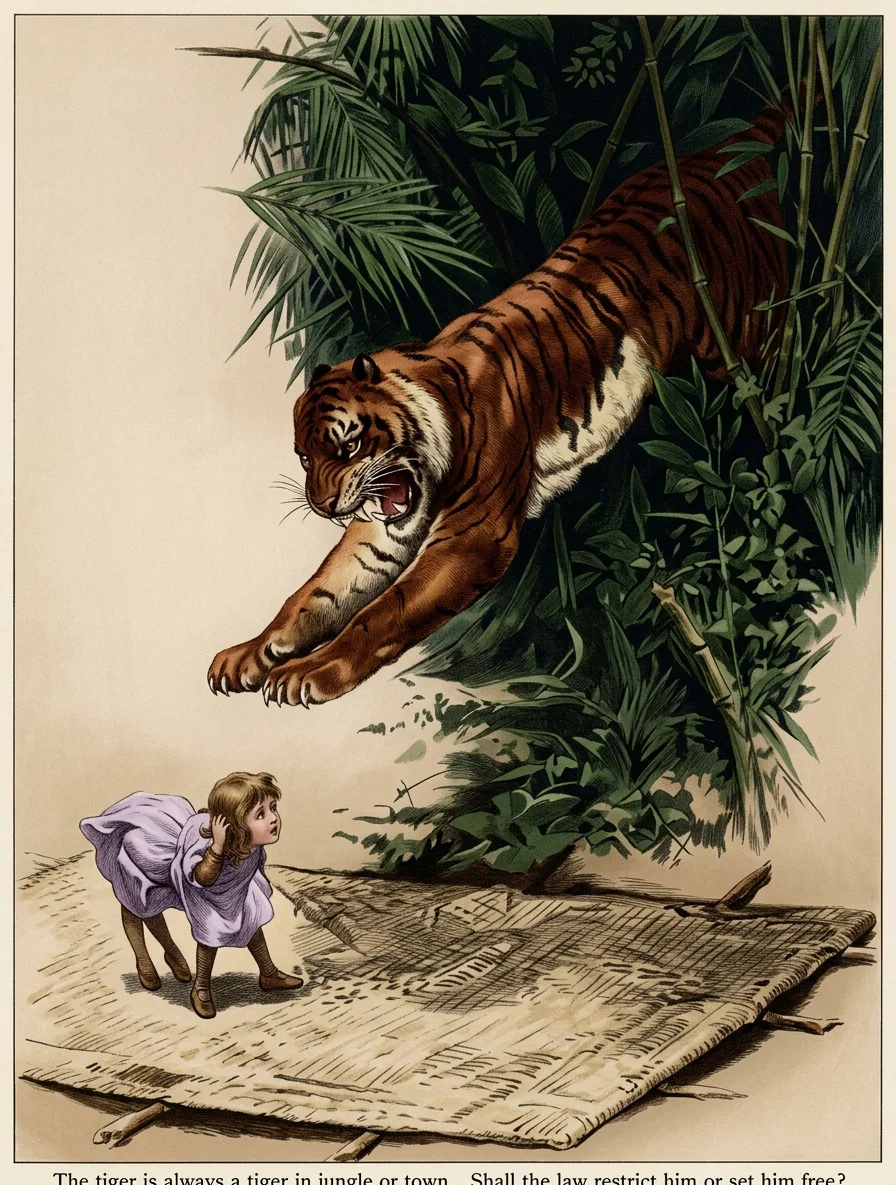
The tiger is always a tiger in jungle or town. Shall the law restrict him or set him free?
Wise would the American people be if they guarded sedulously against this terrible evil. Its encroachments are already seen in affairs of State and the insistent demands for Sunday legislation. Speaking of this, another has well said: "The Sunday movement is now making its way in darkness. The leaders are concealing the true issue, and many who unite in the movement do not themselves see whither the undercurrent is tending. Its professions are mild, and apparently Christian; but when it shall speak, it will reveal the spirit of the dragon." To many the disillusionment of this thing will come too late.
Any church that seeks to control politics, is to that extent political; and any church that seeks to control politics in the interests of the church, is not only political, but is an exponent of a union of Church and State, and thus an enemy of freedom of conscience, the rights of men, pure religion, and good government, and should be treated as such, regardless of its name or profession. And any minister who intermeddles in politics, or who seeks to secure religious legislation, should be rebuked as Washington rebuked a Methodist preacher in his time, who, by incautiously meddling with civil affairs, incurred the displeasure of those in authority.
Being asked by Washington who he was, Mr. Martin Rodda, the man in question, said that he was one of John Wesley's preachers. "Mr. Wesley," rejoined Washington, "I respect; but Mr. Wesley, I presume, never sent you to America to interfere with political matters, but to preach the Gospel to the people. Now go and mind your own proper work, and leave politics alone."
And while, in harmony with the Constitution, no religious test should ever be required as a qualification to any office or public trust under the Government of the United States, the separation of Church and State being an express provision of the Constitution, and thus a fundamental principle of the Government, it would be perfectly proper, and the question would be entirely relevant, to ask every candidate for office or public trust under it, where he stands on this question. No man who believes in or advocates such a union, is a proper candidate for such office or trust, nor can he consistently take oath to support the Constitution.
Every concession to ecclesiastical domination here, every law passed for the compulsory observation of Sunday, means a departure from those grand principles upon which this Government was founded, and a lapse backward into the old order of savagery in government and religion. And, standing as she has for over a century as a beacon light of liberty to all the world, the downfall of the principles of religious liberty in America will mean their downfall the world over. Against such a catastrophe every lover of liberty ought by pen and voice to wage eternal warfare.