To say that the great nations of the world are to-day absorbed in a feverish preparation for war, is to utter a hackneyed commonplace. Colonel Richard Gaedke, a military expert of the German army, recently wrote in an article contributed to "McClure's Magazine":
The fever for armaments has seized upon almost the whole world. Nations great and small are increasingly trying to perfect armor and guns, and, as far as possible, to place every man capable of bearing arms in the ranks of the national defense. . . . The whole of Europe appears to have been converted into a great armory, where all the material, intellectual, and moral forces are applied in the service of a single idea — the service of destruction, the service of the bloody "struggle for existence."
In territorial extent Europe is only a little greater than the United States. Yet within that comparatively small area, more than three and a half million men are under arms day in and day out, withdrawn from peaceful labor, and training only for battle against one another. And if we were to include those that belong to the militia or to the reserves, who are called out for periodical drilling, we should find as many as six millions sometimes engaged in warlike exercises in the midst of peace. More than a sixth of the number belong to Germany alone, almost a third to Germany and France combined. Both nations, in case of need, would be able to pit against each other the gigantic number of more than seven million men.
Strange to say, all the advocates of our present-day ultra-militarism insist that the only way to insure peace is to be prepared for war, and that the prodigious outlay of money involved in a militarist policy is simply the premium that the nations must pay to insure against war. Not a few, however, of these "Fighting Bobs" contend that war is not only inevitable but a necessity, and hence for a nation to remain unprepared for war is to be criminally derelict.
Influence of the Dreadnought on Naval Armaments
This terrible mania for big navies and big armies has by no means reached its climax. It is still growing lustily. In February, 1906, England launched the original Dreadnought battle-ship; Germany responded by laying down two. To preserve her lead in the race for naval supremacy, England must lay down three; Germany retorts by laying down four; and England, making a gallant effort to retrieve herself, lays down six. Whereupon Germany devises the super-Dreadnought, much more terrible than anything yet invented, and the whole game must begin anew.
The parent Dreadnought had a displacement of 17,900 tons; its immediate successor ran to 18,600 tons; and those which next followed, to 19,250. In 1904 the General Board of the United States Navy recommended the Connecticut, of 16,000 tons, to be the standard of displacement and dimensions. But the advent of the Dreadnought rendered all previous standards obsolete. Hence the latest planned battle-ships for the American navy call for a displacement of 27,000 tons. Because of strained relations between Brazil and Argentina, the former is building three Dreadnoughts of 19,000 tons displacement each, and the latter, two of 28,000 tons each. It is now universally held that only Dreadnoughts can contend with Dreadnoughts. In March, 1910, Secretary Meyer, of the United States Naval Department, actually requested Congress to authorize the building of a 32,000-ton battle-ship, to be the largest in existence, at an estimated cost of $18,000,000. Congress has not yet complied with the secretary's request.
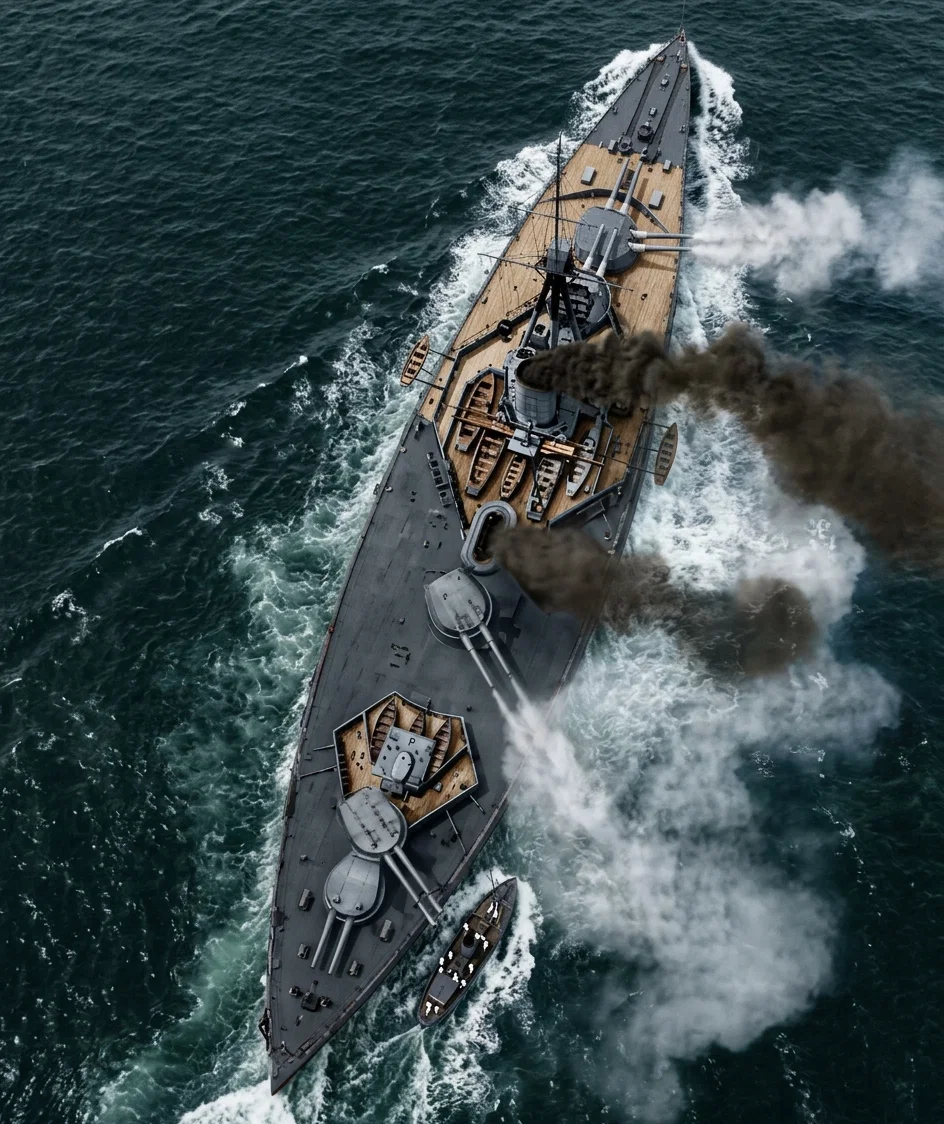
The Monarch, England's latest improved war-ship of the Dreadnought type. She carries but one military mast, and is so built that she has the least possible superstructure, so that "every scrap of unnecessary gear may be done away with." She can fire a broadside of ten 13.5 guns, each projectile weighing 1,250 pounds. She has a displacement of 22,500 tons, and 27,000 horse-power. Her small boats, two of which are shown in the cut in the act of being launched, are provided with "shelter screens," so that they may be protected from the fire of the enemy.
Up to the year 1900, Great Britain and France were the only really strong naval powers in the world. Rear-Admiral A. T. Mahan tells us that the great navies of Germany, of the United States, and of Japan were created during the last decade. It was England's construction of the initial Dreadnought that enabled Germany, which was hopelessly behind in numbers of smaller battle-ships, to start, by prompt action, nearly even in the class of fighting-ships "which by preponderant contemporary naval opinion is alone fit to lie in the first line of battle." This condition is the essential factor that led to the present frantic building competition between Germany and Great Britain. As the London "Times" (March 21, 1910) said, "Our naval program is made abroad, and made mostly in Germany." The British prime minister predicts that by the spring of 1913 Germany will have twenty-one super-Dreadnoughts to Great Britain's twenty-five — a narrow margin compared with England's traditional advocacy of the two-power standard. In this class of battle-ships the number built and building in 1910 were: Great Britain, sixteen; Germany, thirteen; United States, eight; Japan, four. In the January (1911) issue of the "World's Work," Rear-Admiral Mahan tells his readers that at the present moment the German navy is second to that of Great Britain; that of the United States is a close third; while France has dropped to fourth place; Japan follows France, with fifteen battle-ships to the French twenty-three.
Even poverty-stricken Italy has authorized the construction of three pre-Dreadnoughts, each of which will have a displacement of 24,000 tons and will carry thirteen 12-inch guns and eighteen 4.7-inch rapid-fire guns. They will have the unprecedented speed of twenty-three knots. A recent despatch from Vienna states that Austria's naval program for the next five years will necessitate an expenditure of $200,000,000. The United States is now expending $135,000,000 yearly on her navy.
Apropos of the Dreadnought-mania the world over, that sturdy journal "The Nation" indulges in the following bit of irony:
Are treaties observed by your neighbor? That is because you have a large navy; make it bigger still. Are treaties violated? Then you must increase your navy. Are you anxious for peace? Build a bigger navy. Are you determined upon a policy of aggression? Build a big navy. Are you prosperous? Build ships, or you will be attacked. Are you poor? Build ships, or you will be prevented from attaining prosperity. The Dreadnought underlies all things, remedies all things, answers all things. . . . It does not matter that Great Britain's increased armaments would only spur on the other nations and leave relative conditions as before. No; in rain or shine, in calm or storm, in hard times or easy times, against everybody and against nobody, build ships.11
Militarism and Poverty
Stupendous are the pecuniary burdens imposed by the militarist policy upon the people of the several nations. A London despatch, dated October 16, 1910, to American newspapers, stated that Mr. Lloyd George, the British chancellor, said at the Mansion House in London:
I must admit that the increase in expenditures, not only in this country, but in every land under the sun, is due to the insane competition in armaments between the nations of the world. These nations are spending annually $2,250,000,000 upon the machinery of destruction. In ten years there has been an increase of one billion dollars per annum on this expenditure. All nations seem to be infected with an epidemic of prodigality in that respect, which seems to be sweeping over the world, and sweeping to destruction.
I must remind the reader that in 1866 the gross expenditures of all Europe upon armaments was only $600,000,000.
According to the "Mexican Herald," and corroborated by the "safe and sane" "Springfield Republican," it has cost Europe, since 1885, to maintain its armed peace footing, the fabulous sum of $29,000,000,000, all this apart from the cost of wars actually fought. Since 1866 the public debts of Europe have risen from $5,325,000,000 to $30,200,000,000. A noted French economist says that disaster must inevitably come, for the colossal aggregate of obligations can never be paid. President Jordan, of Stanford University, said to a Chicago audience last December that one third of all the money in the world is due on the war debt of Europe alone. The Rothschilds and a few other money-lending families control the situation.
Mr. Lloyd George further testified that it costs England $350,000,000 yearly for her army and navy, or forty dollars for every household in the kingdom. He goes on to say that of the 420,000 adults who died last year in the British Isles five sixths were in poverty. They left no property worth any one's while to pick up. The other one sixth who died in the same period left property worth $1,500,000,000.
Were England's militarist burden removed, says the chancellor, the government could afford to pay every wage-earner in the kingdom an additional four shillings a week. In London alone 1,800,000 people live in dirty poverty, and still another million have nothing between them and deadly want but the scanty wages of a week, while there are 125,000 registered paupers, and one person of every four is buried at public expense. In the world's metropolis 300,000 people belong to families that have one room to a family, and each family has from five to twelve members. "Is there any horror recorded of war that compares to this?" asks Charles Edward Russell. The coroners hold 600 inquests yearly in the East End over babies smothered in bed by their parents. Yet London is but an epitome of England, and England of the world. Of every 1,000 persons in Great Britain 939 die in poverty; 8,000,000 simply struggle on the ragged edge of starvation; and 30,000,000 more "may not be comfortable in the simple, clean sense of the word."
According to Congressman Tawney, the United States devotes seventy per cent of its annual expenditure of $1,260,000,000 to war disbursements. In an article entitled "An Appeal to President Taft," contributed to the February number of the "North American Review," the Hon. Wayne MacVeagh informs his readers that in 1863, in the midst of the Civil War, when our navy was blockading the coast from Maine to Texas and pursuing the Confederate cruisers on every sea, the entire cost of the naval establishment was $63,000,000. In 1910, in time of profound peace, without an enemy in the world or the rational possibility of an enemy, the cost of the navy was $130,000,000. In 1895 the cost of our army was $24,000,000; in 1910 it was $110,000,000. Mr. MacVeagh declares that Congress, in its reckless waste of money on the army and navy, is exhibiting "a kind of insanity in throwing away taxes wrung, in considerable part, from the unskilled and inarticulate men, women, and children who are already living in a destitution of which we all ought to be ashamed."
In the last eight years the appropriations for the navy were in the aggregate $600,000,000 in excess of the aggregate for the preceding eight years. A similar comparison of army expenditures shows an excess of $472,000,000. All this in the face of the terrible fact that 10,000,000 of our population are, owing to their extreme poverty, living beneath the line of physical efficiency. In this, the richest country on earth, there are 500,000 children who go hungry to school every day because their parents are too poor to supply adequate food. One person of every eight in New York City is doomed to a grave in the potter's field.
Scores of thousands of families in Germany are compelled to live almost exclusively on a regimen of potatoes, while the army and navy of Germany cost her people $350,000,000 annually. France sacrifices annually $250,000,000 to the Moloch of war, most of which is wrung from the miserable earnings of the peasants. Nine tenths of the people of Russia are desperately poor, yet they are compelled to lay $270,000,000 yearly on the altar of the god of war. The Young Turks, administering the affairs of a nation on the brink of bankruptcy, recently prostrated themselves before all Europe in order to wheedle from the money lords another thirty-million dollar loan for war purpose — to maintain peace. Owing to Italy's policy of extreme militarism, the burden of taxation has become positively insupportable, and as a consequence millions of her people are emigrating from her shores every year. Italy taxes salt and all the other necessaries of life until the children of the poor (the vast majority of her people) have rickets and are half famished, and then she lavishes the money on Dreadnoughts.
A modern navy is a fabulously expensive luxury. The San Francisco "Examiner" (February 24, 1911) says editorially that warships that cost Uncle Sam $140,000,000 are now obsolete. Recently the cruiser Detroit was sold for $20,000. She cost $1,250,000 in 1890. The world-noted Oregon is in reserve. Even the battle-ships of the famous fleet that sailed from Hampton Roads in 1908 have passed from the first rank. For several years England has been selling to junk dealers ships that ten years ago were the fighting monarchs of the seas. How true it is that, as the "Examiner" says, "science daily makes war more expensive as well as more terrible."
It has been said that there are twelve hundred millions of poor in the world, and that every one "carries a soldier on his back." What can rid our stricken world of the all-consuming fires on the altars of the time-old war-gods Woden and Mars? — Nothing but the advent of the timeless kingdom of the Prince of Peace.