PROGRESS IN CEYLON

5%

Pacific Press Publishing Company · Oakland, California · Apr 22, 1897

FromSigns of the Times, Vol. 23, No. 16.

Read the full edition

PROGRESS IN CEYLON.

CEYLON, the "Pearl on the brow of India," occupies a strategic position both from a political and a missionary point of view. The first missionaries to Ceylon chose it as a point from which to evangelize India. They realized that, if the people on this island could be won, they in turn would take a share in the work of winning India for Christ. Their expectations are beginning to be realized, for already scores of the brightest Christian young men of Ceylon can be found in many parts of India, as well as in Burma, Singapore, Penang, the Straits Settlement, and Borneo, doing noble work for Christ. They are employed as helpers by twelve leading missionary societies. Not a few have turned away from government service with its offer of a large salary, prospect of promotion, and retiring pension, and have chosen Christian work with barely a living salary. They have learned that there is something better worth living for than merely making money.

Christian Education.

Ceylon is a unique educational center. When the missionaries went to Ceylon, early in this century, they found the great mass of the people sunk in ignorance and superstition. The Buddhist and Hindu priests and a few others could read, but the majority of the people were entirely uneducated. It is probable that there was not then one educated native woman on the island.
When the missionaries began to open schools, the people willingly allowed the boys to attend, but they ridiculed the idea of giving an education to girls, saying: "What would be the use of sending a girl to school? A girl could never learn to read any more than a sheep." On one occasion a missionary was urging a native gentleman to allow his daughter to attend school. The native, pointing at a horse by the road side, said, "Sir, could that horse learn to read?" The missionary replied in the negative. "Well," rejoined the native, "if an intelligent animal like a horse could not learn to read, how do you think a women could learn?"
This was the low ideal which Hinduism had given of the capacity of women. In a Hindu home a woman is never, as a rule, allowed to eat with her husband. He and the sons eat first, the mother and daughters eat afterwards. The term which even a small boy uses in addressing his mother is a term used for an inferior.
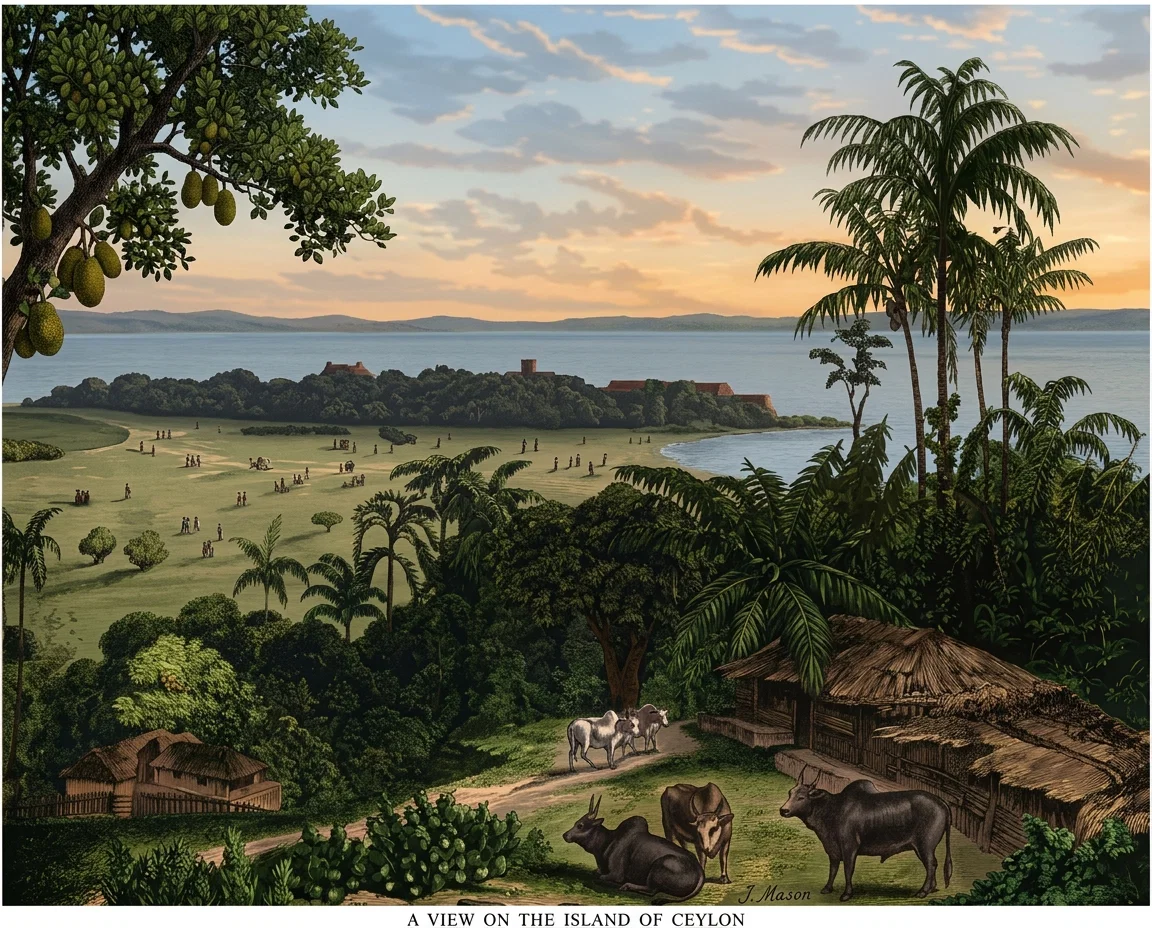
A VIEW ON THE ISLAND OF CEYLON
The missionaries labored earnestly for two years before they were able to induce even one girl to attend school. The first who came committed to memory the 240 letters of the Tamil alphabet and began to read. When the people saw that a girl could learn, they were surprised, even pleased. At present, in connection with the five Protestant missionary societies at work on the island, there are nearly 50,000 children in mission schools, about one-third of whom are girls. There are not only primary and middle schools in the villages, but girls' boarding schools, at the mission stations, also normal training and industrial schools, colleges, and theological schools, for young men. Fully 5,000 young men and women are receiving a higher education under mission auspices. Many of the brightest of these are becoming teachers, evangelists, and Christian workers in Ceylon and India.

Self-Support.

The expense of the educational work to the mission board is very slight. For example, in the American Board's mission, only four per cent. comes from the home board, ninety-six per cent. being secured through fees from pupils, the income from various endowments, and liberal grants from the government, Ceylon being a British crown colony.
There are nearly 12,000 Christian communicants in the Protestant churches in Ceylon, and more than twice that number of inquirers and adherents. The majority of the churches are self-supporting, and have native pastors ordained over them; the others are aiming at self-support. In the American Board's mission only ten per cent. of the whole expense for church work is met by the home board, ninety per cent. being raised in Ceylon.

Proportionate Giving.

The native Christians also contribute very liberally to the native Bible and Tract Societies, and to their own native missionary societies, in connection with which they are supporting a considerable number of native workers.
In Ceylon, as in most heathen lands, the majority of the people are poor. The ordinary day wage of a working-man is equal to eight American cents. On this sum a man must support his wife and children, and sometimes one or two aged relatives. The average income of the working people per man, woman, and child, is not more than a cent a day! The majority of these do not have more than one meal of solid food a day, and their expense for luxuries does not exceed per individual more than three-quarters of a cent a month.
Nevertheless the poverty of these poor people abounds to the riches of their liberality. It is a rule among the native Christians to give a tenth of their income to Christ's work. Those who are in receipt of salaries, give a tenth of their salaries; those who are farmers, give a tenth of their crops, and those who have fruit trees, give the fruit of each tenth tree. They have found by experience that nine-tenths, with God's blessing, goes as far as ten-tenths used to go. The Christians are not impoverished by this giving. The Christian community is the most prosperous, the most educated, the most respected community on the island, and presents a striking contrast to the heathen community. Altho the native Christians begin by giving a tenth, they do not always stop there. That is the standard below which they do not intend to fall. Many of them, especially those who are prosperous, give more than the tenth.

Self-Sacrifice.

The principal food of the country is rice and curry. Each morning when a Christian woman measures out the rice for the family for the day, so many handfuls for her husband, for each child, and for herself, she takes one handful ormore and puts it into a box marked "The Lord's Box," thus diminishing by a little the amount the family would have eaten. This custom is almost universal among the Christians. From time to time the church treasurer of each church visits all the Christian homes, collects the rice from these boxes, sells it, and sends the money to the native missionary society.

A Worthy Example.

The native Christians in Ceylon can not enjoy many luxuries. They have no stained-glass windows in their churches, no paid choirs, and no church debts, but they enjoy one magnificent luxury. Many churches numbering not more than a hundred members, not only support their own native pastor, but support as well each their own native missionary in some outlying district in which there is no resident foreign missionary. If the weak, struggling churches in Ceylon can do this, could not the strong, wealthy churches in America each enjoy the luxury of supporting its own foreign missionary, through the channels of its own denominational board?

Work for the Masses.

Not only do the Christians of Ceylon give money, they give themselves to Christ's work. In connection with most of the churches large Sunday-schools are held on Sunday morning, when the children of the outlying village schools are brought together. Nearly all of the church-members may be found teaching in these Sunday-schools, after which comes the morning service, when the native pastor gives to his people good plain Gospel food. Then, instead of attending a second service, and getting spiritual dyspepsia by eating too much Gospel food and doing too little Christian work, the native Christians are accustomed to go out into the villages in groups for work among their heathen neighbors.
Early in the afternoon one may see bands of Christian women and girls starting out in different directions to hold cottage meetings among the women, and Christian men and boys going to villages one or two miles distant to hold village Sunday-schools or open-air preaching services. In this way the Gospel is being widely disseminated. If Christians in America would pursue a similar plan, giving up their Sabbath afternoons or evenings to work among the un-evangelized, one would not much longer hear the old cry, "There are so many heathen at home!"—Missionary Review.