Our London Letter

3%

Pacific Press Publishing Association · Mountain View, California · Jun 20, 1911

FromSigns of the Times, Vol. 38, No. 24.

Read the full edition

Our London Letter

From Our Own Correspondent
ENGLAND is all astir over the approaching coronation. Guests are arriving from all parts of the empire; banks of seats are erected along the route which will be followed by the royal processions; huge exhibitions and entertainments are organized to take advantage of the crowds that are expected to flock to London; and plans for bonfires and all kinds of local jubilations are in full swing. If the weather is favorable, festivities on a grand scale will be carried on this summer.
Circumstances are combining to put the people in high spirits. Trade has been excellent of recent months, and money is plentiful; the naval scare has died down; the political situation seems easier; and the talk of everlasting peace between England and the United States has created an atmosphere of optimism and good-will. The coronation could hardly take place under happier auspices. The King and Queen are popular, and the impression is deepening that they both have sincerely at heart the well-being of their people.
There is no doubt that the position of the royal family in England is much more secure to-day than it was a few years ago. In the latter part of the reign of Queen Victoria there was a powerful sentiment in favor of a republican form of government; but this entirely disappeared before the tactful, genial personality of the late King Edward. He became a commanding figure in English and European life, and his son succeeds to a stable and influential throne. It may be that England has been as near to republicanism as she will ever be. The people love the splendor and pomp associated with royalty, and a brilliant coronation will go far in deepening the loyalty of the multitude.
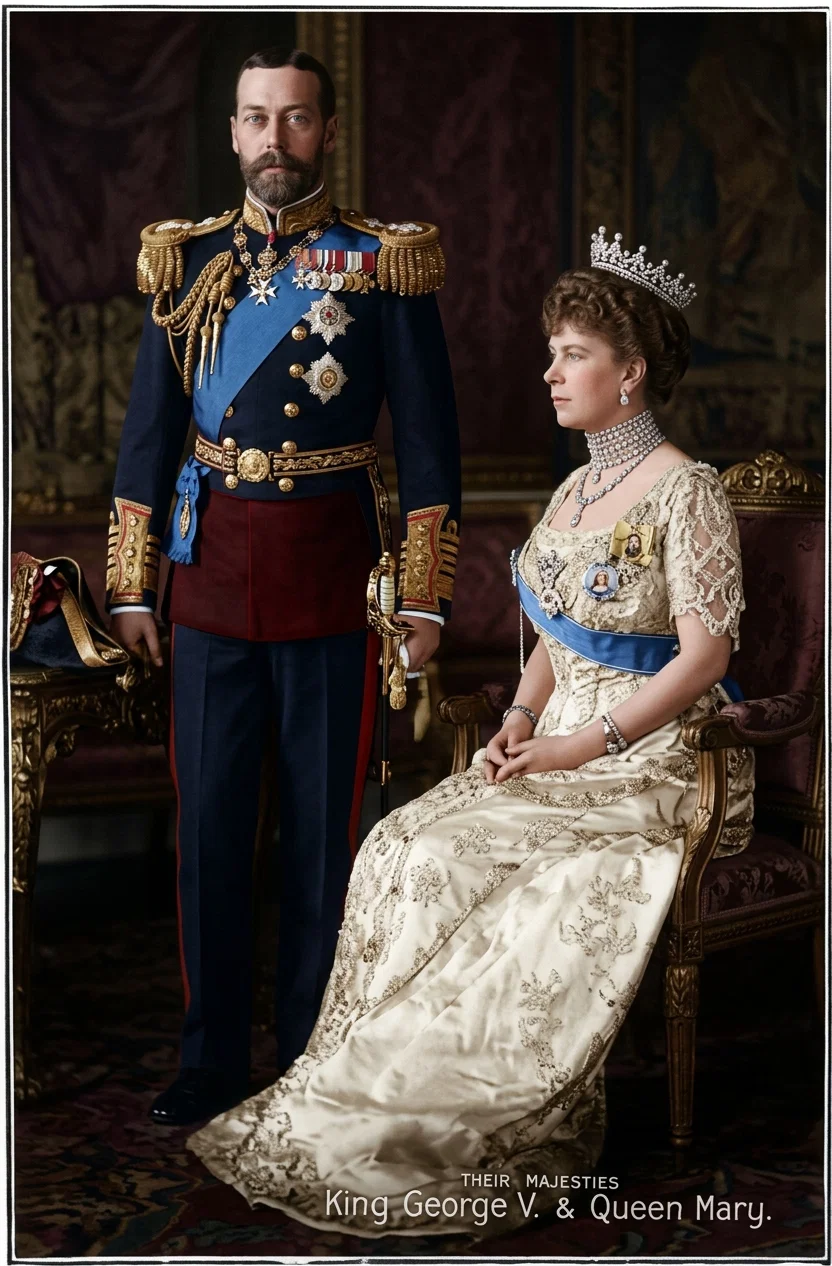
Their Majesties George V and Mary, Rulers of the United Kingdom of Great Britain and Ireland

Restricting the House of Lords

The bill for restricting the veto of the House of Lords has passed through the House of Commons with less of opposition and delay than was expected. Now it has to go up for acceptance or rejection to the House of Lords, which body will not finish with it before the coronation. The prime minister, however, has stated explicitly that the bill as it stands will become law, and every one understands this assurance to mean that the King will create all the peers necessary to force the measure through the House of Lords, if that extreme step has to be taken. There is a general feeling, however, that the lords will not fight to the death. They may postpone their surrender, but they are expected to make it sooner or later. Possibly they will reserve themselves for the struggle yet to come when the government produces its bill for the reform of the Upper House. Mr. Asquith has undertaken to proceed with legislation to this end as soon as possible, altho his supporters among the Labor party protest that there is no need whatever of a second chamber, that the cause of progress would move along faster without one.
The Well-Known Crystal Palace near London
The principal weapon made use of by the Conservatives against the veto bill was the accusation that advantage would be taken of it by the Liberals to rush through a program of Irish Home Rule, to which the country had never given its consent. The Liberals met this charge boldly, acknowledging that they regarded the veto bill as a means to an end, a machine for use. They declared that one of the first pieces of work the machine would be called upon to perform would be the legislating into existence of a Parliament for dealing with Ireland's local affairs, and they proved from the utterances of themselves and their opponents that this issue had been placed fairly before the country. We may expect, therefore, that ere long Ireland will enjoy the boon of self-government she has been craving so many years. English political life will seem a new thing entirely when it is no longer embittered by the struggle carried on by the Nationalists of Ireland for what they conceive to be rights unjustly and tyrannically withheld.

Disestablishment in Wales

The Welsh members have also been promised that the alien Church of England shall soon be disestablished in their principality; and as soon as the necessary time can be found, a new education bill will also be brought in to remedy the inequalities of the present system. To-day passive resisters are still going to prison rather than pay the education rate. These Non-conformist protesters consider it a grievous wrong that the public money should be taken to support schools that are not under public control, but are managed by the Church of England, and made use of for the teaching of Church of England doctrines.

Insuring Working Men Against Loss of Employment
Meanwhile the present government is already offering to the House of Commons another substantial instalment of reform in the shape of a bill for insuring the working classes against sickness and unemployment. This measure has received a warm welcome from all quarters, friend and foe alike. The details have yet to be made known in their entirety, but if the plan does what Mr. Lloyd George, the chancellor of the exchequer, hopes to accomplish by it, it will go a long way toward helping the toilers over their frequent periods of disablement, whether caused by sickness or by falling off in trade. Mr. Lloyd George knows something of what it means to be incapacitated by sickness, for he has been absent from the House of Commons for months, owing to a breakdown in health, and he has devoted his comparative leisure to working out the details of this bill. The chancellor is certainly proving himself a very zealous and able advocate of the cause of the poor. They already owe him and his colleagues of the Liberal party their old age pensions, and the present measure will confer no less signal benefits on the laboring classes during the working portion of their lives. Whether these social reforms will work for good or evil in the long run remains to be seen.
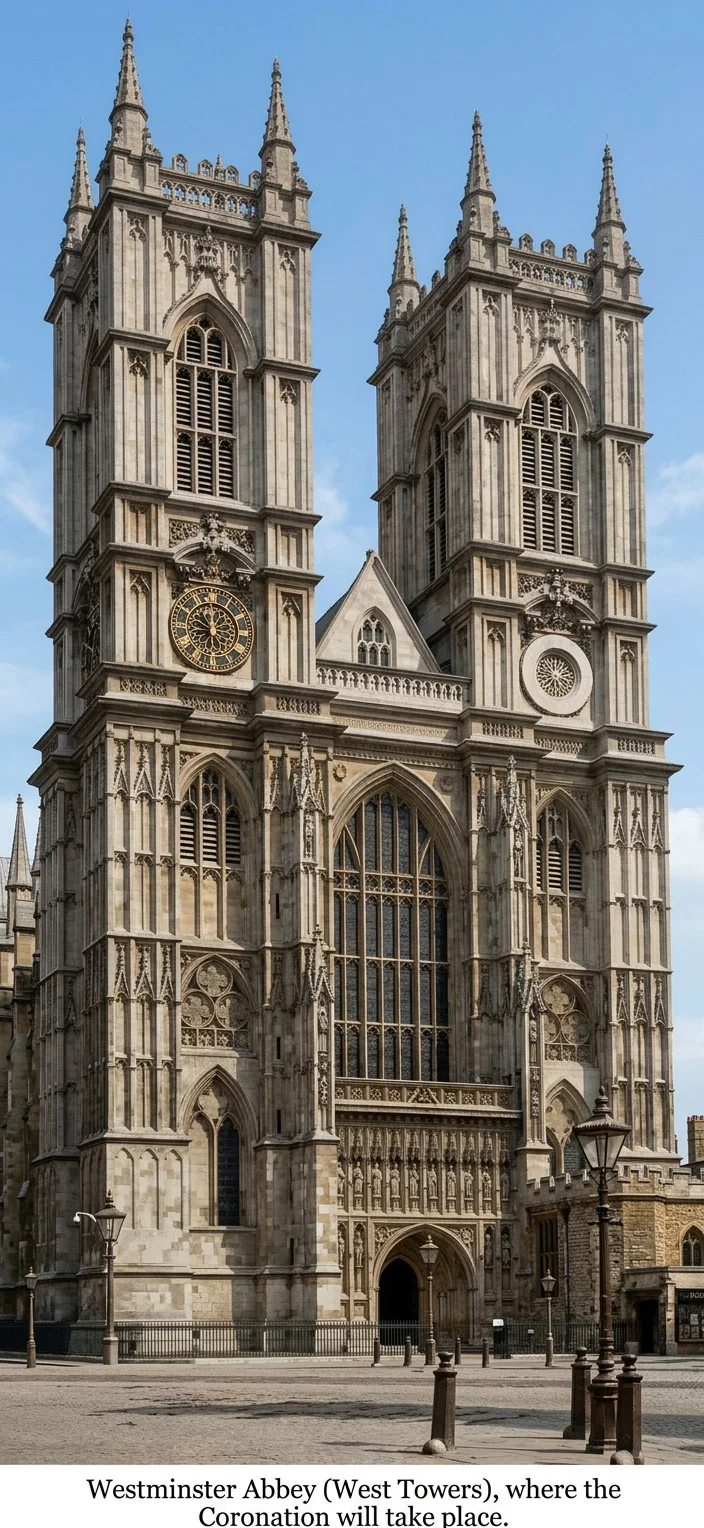
Westminster Abbey (West Towers), where the Coronation will take place

Significant Facts from Scotland

The recent census, altho its figures are only partially known, has brought to light some startling facts. It appears that the rural population of Scotland is rapidly disappearing, not so much by absorption into the cities as by emigration. It is easy to see that the strength and wealth of any country consists in a vital measure in the possession of a sturdy race of people such as can be found only on the land; but in Scotland this reserve of national strength is rapidly disappearing, and the revelation of the fact has produced wide-spread alarm. The House of Lords is severely blamed for the situation, because it rejected some years ago a Scottish land bill designed to facilitate the acquirement of land by small farmers. Instead of meekly accepting the rebuff, and allowing themselves to be crowded more and more off the land by deer forests and game preserves, Scottish farmers have simply left the country for other lands, where fewer obstacles are placed in the way of an independent existence. Ten years ago the number of emigrants from Scotland was 8,869, last year it was 33,366, and in one intervening year it was 44,180 — a serious drain when it is remembered that the population of Scotland does not reach five millions. One writer points the moral in saying: "Our measures of social reform and land reform, so far from being rash and premature, have, on the contrary, been much too long delayed."

Tercentenary of Authorized Version

One of the most interesting events of recent months was the celebration of the tercentenary of our Authorized Version. Many flattering things were said on this occasion about the Scriptures and their powerful influence upon the fortunes of the English-speaking people; but it was also lamented, by men who knew the facts, that the habit of private Bible study had largely fallen into decay. An appeal was made to the nation by the archbishop of Canterbury that it should signalize the three hundredth anniversary of the translation by a return to the old practise. While the pulpits, however, are filled with critics of the Scriptures, people are not likely to be drawn back to daily Bible reading. So far as statistics show, the cause of religion is steadily declining in this country. All the main divisions of the free churches register a decline in membership, while the large missionary societies also show serious deficits in their balance-sheets, and this notwithstanding the impetus given to missionary effort by last year's world conference in Edinburgh. The churches are also sending up a lamentation over the serious falling off in Sunday observance. This has not been at so low an ebb for many years. In a number of towns consent has been given by the local authorities that picture theaters be opened on Sundays, and this action is based on the ground that they provide a strong counter-attraction to the saloons, which are open on that day.

A Bill Favoring Sunday Trading

There is just now before the House of Commons a bill dealing to some extent with Sunday trading. It permits this in a number of cases where the practise has become established, but seeks to prevent any extension. Jews who have closed their shops on the Sabbath are permitted to open them until two o'clock on Sundays; and newspapers, tobacco, alcoholic liquors, refreshments, bread, milk, and cycle and motor accessories, may also be sold on Sundays. The churches are very dissatisfied with the bill, which, they complain, will perpetuate Sunday trading on a large scale instead of abolishing it. But the home secretary, Mr. Winston Churchill, who has charge of the measure, declines to interfere with the Sunday businesses that have been, through the inaction of the authorities, permitted to grow into being, or with the Sunday markets that meet the needs of the poorest classes. Mr. Churchill seems to have, like some of his colleagues, a considerable degree of sympathy for the poor. He will not sacrifice their little interests to the clamors of would-be religious reformers.

The Peace Movement

The peace movement about which we are now hearing so much affords a pleasant change from the outcry against dangerous rivals on the continent; but notwithstanding all the talk of peace, the manufacture of Dreadnoughts goes on unchecked, and A. J. Balfour, M.P., has warned us that the signing of an arbitration treaty with the States must not be expected to produce any results for the present in the shape of a reduction of armaments. Germany looks on with cynical worldly wisdom at the peace movement, and prefers to put her faith in steel and gunpowder rather than in treaties; in which, however they may talk about a more excellent way, the other countries seem at heart to think she is right, judging by their unremitting preparations.
W. T. Bartlett.
— ★ ★ —

No Apologies to Make

THE Gospel Messenger, and other religious papers as well, complain that the United States Government is in league with the brewer in commercial circles abroad. The Messenger says:
But what an example to set before other nations! The faithful foreign missionary struggles in vain against the vile drink traffic, when the foremost Christian nation openly espouses and promotes the manufacture and sale of that which "steals away man's brains" and leaves him poor indeed.
It would be a wonderful blessing to the cause of Christ if missionaries would learn, (1) that there is no such thing as a "Christian nation;" (2) that they do not, or ought not even to suppose that they do, hold their credentials from the nation or government of whom they happened to be a citizen when sent as a missionary; (3) that therefore they have no apologies to make for the misdoings of any people or government; (4) they are ambassadors of the divine government to sinners, and their work is to "preach the Gospel," preach the Word, and so reconcile souls to God through Christ.
— ★ ★ —

Startling Losses from Evil Things

THORO investigation of the causes that led to the recent conflagration in a New York factory by which nearly 150 girls lost their lives, seems to indicate that a lighted cigar, carelessly thrown among inflammable material, was to blame for the start of the deplorable affair. Now it is reported that the Bangor, Maine, fire, with its loss of some $6,000,000, was started by a cigarette stub, thrown into some hay in a room where men were playing poker on a Sunday afternoon. There would seem to be abundant reason why smoking should be entirely prohibited in places where human life is thereby imperiled; but, candidly speaking, is there a single good reason why any one should engage in a practise so manifestly injurious to his own health, and of so great a danger to his fellow men?
— The Gospel Messenger.