READER, the evening hour has come. Take seat. Say "Nay" to all of to-day's claim for regret over mistakes you may have made. Say "Nay" to all keen sorrow over unkind words you may have spoken during its twelve hours of sunlight. Decline to lament over gracious opportunities you may have let pass unheeded.
Turn the key against all to-morrow's insistent pleading for fore-thinking, for pre-planning. Drop the curtain against all its enticing offers of pleasure. Refuse to consider its exhibit of club-life advantages, its society satisfactions. Put aside the morning papers, brimming with reports of crime, casualties, and predictions of war.
Unto bedtime let the hours be yours,—yours for gathering sheaves of useful knowledge, measures of lofty wisdom; yours for learning how better to DO, how more nobly to LIVE; yours for meditating upon awe-inspiring words spoken by the Creator of the universe; yours for studying the character and the never' equaled position of the greatest leader of men, except Christ the Maker of man.
Bring your Bible from its one place. Open it at the first chapter of the book of Deuteronomy, its date 1451 before Christ and the final year of Moses' life, also the fortieth year after Israel's miracle-attended exit from Egypt, and the thirty-eighth of their cloud-led, fire-led journeying from Sinai.
Step back mentally to that date in man's history upon the earth. Cross to the eastern side of the famous Jordan, into the land of Moab, son of the daughter of Lot, the nephew of great Abraham.
Survey the unparalleled scenes there presented, an encampment of about three millions of men, women, and children waiting impatiently to be conducted to the sunset side of the world-famed stream, to their long promised land, a land opulent in fruits and flowers, in springs and streams, in lofty mountain ranges and lines of low hills, in soil, in atmosphere, in promise of affluence.
Notice, before that eager host stands their gifted leader, Moses, mighty, complete, through long face-to-face communion with Jehovah, the immutable One. In his hands is the "book of the law," whose amazing contents, given by the Lord, through him, to Israel, from flaming Sinai, have now been inscribed accurately, faithfully, by his hand, and henceforth, to the end of their history, is to form their constitutional and legal text-book.
Moses is well aware that, as soon as he has rehearsed in the ears of that uneasy, unsteadfast assembly the fundamental and wonderfully relevant system of statutes, laws, and mandates which he holds in his hand, his unique, unmatched, powerful, yet strangely humble career must come to an end upon Mount Nebo, over against Jericho.
Therefore, with a might, a loyalty, a clear grasp of the situation, a keen certainty of the subtle dangers awaiting his forty-years charge, and a fore-view of their quick apostasy, almost superhuman, he read to them that God-given code of civil, moral, religious, personal, and family regulations, commandments, laws, and privileges constituting the extraordinary book of Deuteronomy.
So keen was Moses' fear of their forsaking the God of their fathers Abraham, Isaac, and Jacob, of their worshiping the hand-made gods of the nations they were commissioned to "drive out from the land whither they were going to possess it," that he warns them, pleads with them, testifies to them, reminds them repeatedly, in language sometimes touching to an extreme, then firm and stern to the limit, now replete with salutary caution, now alive with congratulation and promise, scintillating, glowing with cheer and encouragement, thus:
"Ye are this day as the stars of heaven for multitude. . . . How can I myself alone bear your cumbrance, and your burden, and your strife?"
"Take ye therefore good heed unto yourselves, . . . lest ye corrupt yourselves." "Beware that thou forget not the Lord thy God, in not keeping His commandments, and His judgments, and His statutes, which I command thee this day." "Beware lest thou forget the Lord, which brought thee forth out of the land of Egypt, from the house of bondage. . . . Ye shall not go after other gods, of the gods of the people which are round about you."
"It shall be, if thou do at all forget the Lord thy God, and walk after other gods, and serve them, and worship them, . . . that ye shall surely perish." "I call heaven and earth to witness against you this day, that ye shall soon utterly perish from off the land. . . . Ye shall not prolong your days upon it, but shall utterly be destroyed."
Now the cheer and encouragement:
"Ask now of the days that are past, . . . since the day that God created man upon the earth, and ask from the one side of heaven unto the other, whether there hath been any such thing as this great thing is. . . . Did ever people hear the voice of God speaking out of the midst of the fire, as thou hast heard, and live?
"Or hath God assayed to go and take Him a nation from the midst of another nation, by temptations, by signs, and by wonders, and by war, and by a mighty hand, and by a stretched out arm, and by great terrors, according to all that the Lord your God did for you in Egypt before your eyes?"
"But if from thence"—their places of banishment, because of sin—"thou shalt seek the Lord thy God, thou shalt find Him, if thou seek Him with all thy heart and with all thy soul. . . . He will not forsake thee, neither destroy thee, nor forget the covenant of thy fathers."
No reader, closing his mind for the hour to all outside cares and affairs, and fixing thought upon the strangely simple but lofty and thrilling language of this book, upon its clear-cut rehearsals of the various swift, signal punishments suffered by discontented Israel, after the construction of the golden calf at Sinai; after the cutting rebellion of Korah, Dathan, and Abiram, with the two hundred fifty famous princes of the great assemblage; after the remarkable chastening of Miraim at Hazeroth; after the spectacular disaffection, the wide-spread murmuring, of "all the children of Israel" in the wilderness of Paran, because of the false report of ten of the men sent to inspect the land of promise; after the fanatical course of Duke Amalek at Rephidim, for the which the remembrance of him was put out utterly from under heaven, can contemplate with feeling short of amazement the great mental power of Moses, his impressive judicial acumen, his admirable fidelity. During this memorable review Moses seems to have clear prospect of almost every possible circumstance of Israel's future national life, of their family life, of their tribal relations, and to have at hand law, statute, or judgment applicable for every emergency. (Continued on page 9)6
The Fifth Book of the Pentateuch
(Continued from page 5)
It is wonderful into what details he plunges, for what changes in conditions and circumstances he provides, even to mere lapses of memory on the part of the people, always having the fit rule, precept, instruction, or commandment ready on demand.
He plans even some features of their dietary with decisive precision. With the authority of a master chef he devotes nineteen verses of chapter 14 to lists of animals, fowls, fishes, and birds the people may or may not eat, keeping always sharply in mind their physical health and cleanliness—yes, and also their moral soundness and purity, since man’s diet is frequently accountable for man’s conduct.
Chapter twenty-eight is an astounding, a thrilling piece of literature. It is a mingled accumulation of peaceful, soothing promises and assurances IF the people obey, do the right; but of flashing, blazing, fearful threatenings, curses, and pledges of severe requital should they “go aside from any of the words” commanded them that day.
Fever, the sword, blasting, mildew, blindness, and other supreme afflictions, would become their portion until they “should perish from off the earth,” “be plucked from off the land” whither they were bound, should they fall away and worship the idol gods of the nations they were to drive out, exterminate.
Please study that pinnacle chapter. Think upon it, from beginning to end. Every sentence takes hold of the heart, the LIFE. Reflect that all these fearful pledges were kept to the letter; all the sharp threatenings were executed, made actual, years afterward, upon the descendants of that listening multitude, chafing to pass over Jordan.
Now read, in chapter 31, first, Moses’ noble charge to Joshua, his most able, Spirit-equipped successor in command of the great host. Note his command to place the “book of the law” which he had written and proclaimed to the people, “in the side of the ark of the covenant of the Lord,” that it might there become a steadfast “witness” against them.
Observe carefully chapter 32, forty-three verses of which embrace the song which God commanded Moses to write, also as a witness for Him against the children of Israel. The song constitutes a most singular fragment of composition. By it Israel is specifically indicted, as when it declares: “Jeshurun . . . forsook God who made him, and lightly esteemed the Rock of his salvation.” “Of the Rock that begat thee thou art unmindful.”
“They sacrificed unto . . . gods whom they knew not, to NEW gods that came newly up, whom your fathers feared not.”
Now, in language highly figurative, beautifully picturesque, the poem depicts Jacob’s emergence into being—as the lot of God’s inheritance, whom He found “in the waste howling wilderness;” whom He kept “as the apple of His eye;” whom He fed with “honey out of the rock, and oil out of the flinty rock,” with “butter of kine, and milk of sheep, with fat of lambs,” “fat of kidneys of wheat,” and refreshed him with the “pure blood of the grape.”
Now, in words which stir deeply one’s every being, he portrays Jeshurun’s—Jacob’s, Israel’s,—quick, flagrant apostasy and its grievous effect upon God, the Rock who begot him, evoking against Jeshurun sentence woful, final, just, except he turn and repent. Listen to a portion of the sentence, the judgment:
“I will spend Mine arrows upon them;” “will hide My face from them;” “will also send the teeth of beasts upon them, with the poison of serpents of the dust. . . . The sword without, and terror within.” “For they are . . . children in whom is NO FAITH, . . . a nation void of counsel.”
Finally, the inspired song concludes with Jehovah’s fervent plea, outcry, on behalf of His beloved inheritance: “O that they were wise, . . . that they would consider their latter end!” followed by His graphic citation to them to bring forward the pleasing, tempting gods “in whom they trusted,” which had eaten “the fat of their sacrifices,” had drunk “the wine of their drink-offerings.”
Lastly come Moses’ farewell utterances to the encamped host; his blessings invoked upon the twelve tribes, depicting the fruits, the outcome of character as foreshown impressively in each tribe; rich in symbol, in emblem, in historic reference, in tender petition, in faith triumphant; in beatific anticipation exultant.
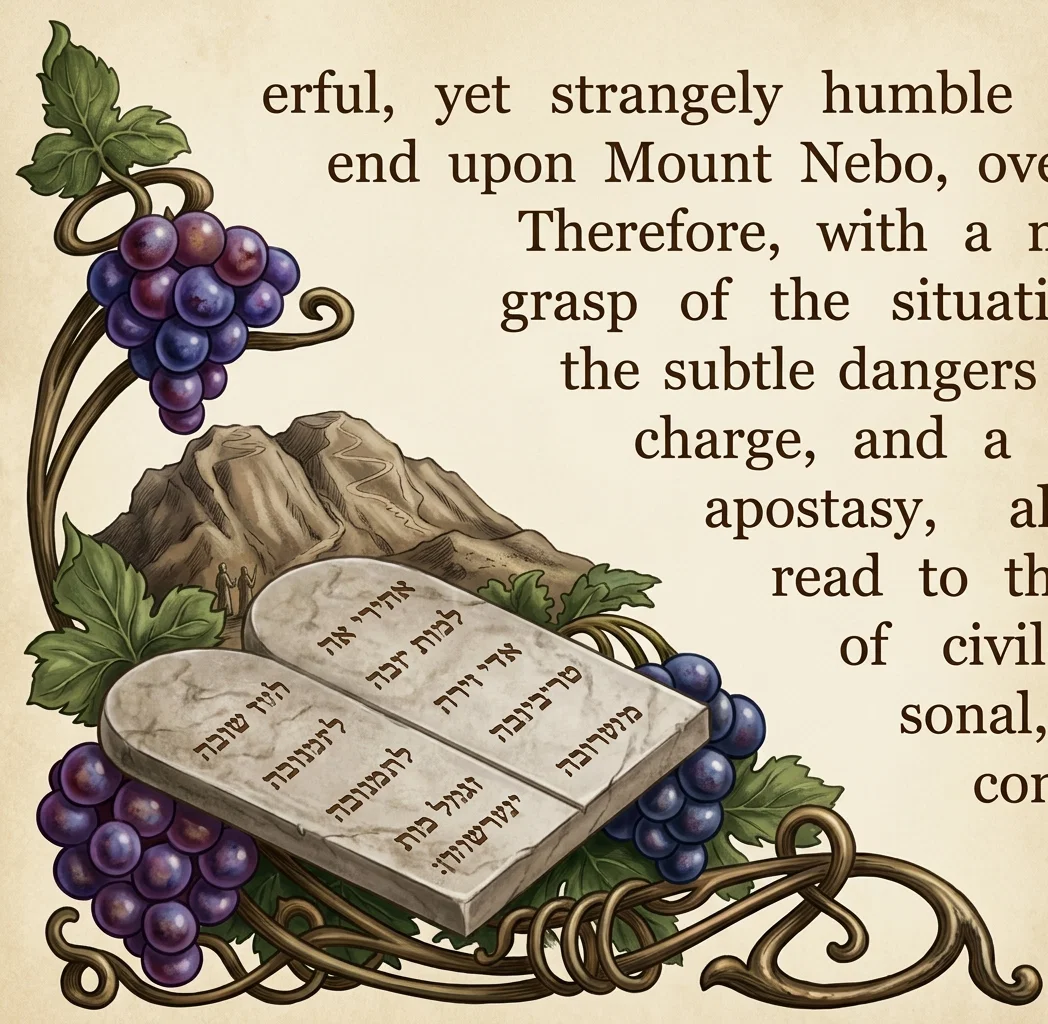
Now the fascinating culmination: “Moses went up from the plains of Moab unto the mountain of Nebo, to the top of Pisgah, that is over against Jericho. And . . . died there . . . according to the word of the Lord.” And the Lord “buried him in a valley in the land of Moab, over against Beth-peor.” “And,” so writes other hand than that of Moses, “there arose not a prophet since in Israel like unto Moses, whom the Lord knew face to face.”