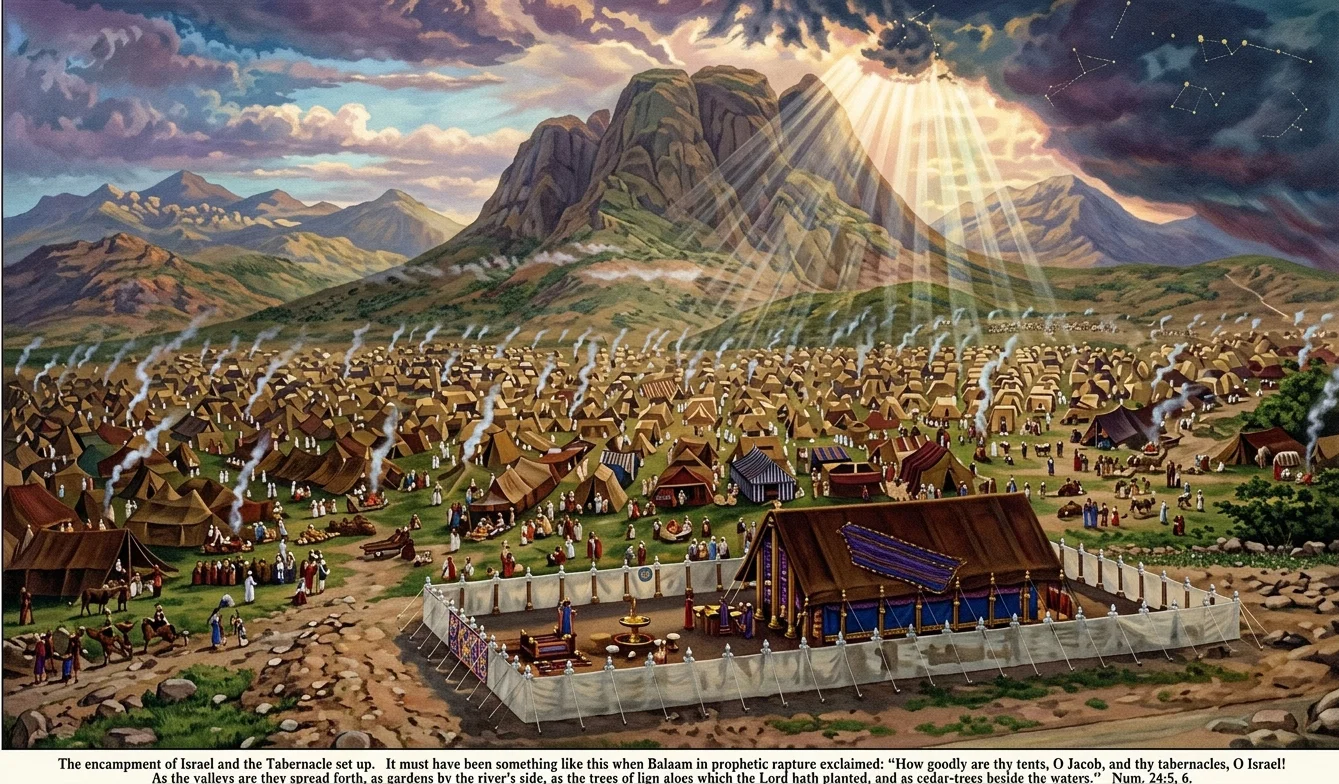
WHEN Israel came out of Egypt, their minds were so beclouded by sin that they could no longer see the promised Saviour in the simple offerings made by the father as priest of the household. Consequently when God gave Moses instruction in regard to the building of the sanctuary, He connected with it the Levitical priesthood, which was to continue until the Saviour Himself should officiate as our great High Priest in the sanctuary above.
By divine direction the tribe of Levi was set apart for the service of the sanctuary. The priesthood, however, was restricted to the family of Aaron. Num. 18:2, 7.
Purpose and Character of the Priesthood
The purpose and character of a priest are set forth in Heb. 5:1-3: "For every high priest taken from among men is ordained for men in things pertaining to God, that he may offer both gifts and sacrifices for sins: who can have compassion on the ignorant, and on them that are out of the way; for that he himself also is compassed about with infirmity. And by reason hereof he ought, as for the people, so also for himself, to offer for sins." Before Aaron and his sons entered upon their ministry for others, special consecration ceremonies were performed, and consecration offerings were made.
Holy garments "for glory and for beauty were put upon them." The anointing oil was poured upon Aaron, also upon the tabernacle and all that pertained to it. When all was thus sanctified, Moses and Aaron came out of the tabernacle to bless the people, and the glory of the Lord appeared to all the people, and filled the tabernacle. "And fire came out from before the Lord and consumed the burnt offering." See Leviticus 8 and 9; Ex. 40:34, 35. Likewise when we consecrate our all to God, the anointing oil of His Holy Spirit is poured upon us, and the glory of the Lord fills these temples of clay, and we are then fitted for service and for the indwelling of the Most High.
That there were sinners connected with the sanctuary and priesthood, the following plainly shows: "The first covenant had also ordinances of divine service, and a worldly sanctuary." "The priests went always into the first tabernacle, accomplishing the service of God." Heb. 9:1, 6. Not only the sanctuary itself, but the ministration of the priests, was to "serve unto the example and shadow of heavenly things." Heb. 8:5. Thus it was of great importance that the Lord should give the most definite and explicit instruction concerning every point of the typical service.
The ministration of the sanctuary consisted of two divisions, daily and yearly service. Heb. 9:6, 7. The daily service was performed at the altar of burnt offering and in the holy place, and consisted of the morning and evening burnt offering, the offering of sweet incense on the golden altar, and the special offerings for individuals. The yearly service was in the most holy place. The Israelites were in every sense a typical people. Their history in all its details was typical; and all their ordinances have a typical meaning, and admit of — nay, require — a spiritual application.
The Daily Service
We will now consider the daily service. Every morning and evening there was burned upon the altar a lamb a year old,4which symbolized the daily consecration of the nation to Jehovah. As this sacrifice was offered, the priests went into the holy place and offered sweet incense, while the whole congregation stood without praying. Luke 1:9, 10. The incense, ascending with the prayers of Israel, represents the merits and intercession of Christ, His perfect righteousness, which through faith is imputed to His people, and which alone can make the worship of sinful beings acceptable to God. The most important part of the daily service was that performed in behalf of individuals. The very order in which their offerings were to be made, was designed to teach a sinner how to come to Christ.
After Aaron and his sons had made their consecration offerings, they then offered for the people. Note the order: "And he brought the people's offering, and took the goat, which was the sin-offering for the people, and slew it, and offered it for sin. . . . And he brought the burnt offering, and offered it according to the manner. And he brought the meat-offering. . . . He slew also the bullock and the ram for a sacrifice of peace-offerings." Lev. 9:15-18.
From this we learn that a man must first come to God as a sinner to have his sin put away — sin-offering. He must consecrate himself to God to be accepted in Christ — burnt offering. He must feed on Christ, the living bread — food- or meat-offering. The result of this will be peace.
Different Aspects of Christ's Sacrifice
In these different sacrifices we get so many different aspects of Christ's own sacrifice. It took every offering to represent feebly the one great offering of Christ for us. All the sacrifices also stood for the persons that offered them; for Christ gave Himself for us. Eph. 5:2.
When a man came with a proper sin-offering, he never failed to get rid of his sin; and when a man comes to God bringing Christ as his sin-offering, he obtains pardon and peace, he is saved from his sin.
Altho we much desire to dwell at length upon each of these offerings, our space will permit of but the briefest mention of one or two that deal the most directly with the sanctuary service; namely, the sin-offerings, in which the fourth chapter of Leviticus is wholly devoted. In this chapter are brought to view four classes of individuals for whom offerings were made,—the priests, the whole congregation, the ruler, and one of the common people.
The offerings were dealt with in two ways, representing the two ways in which Christ bore our sins. Every individual was represented in both kinds of offerings. The sin-offering for the priest and the whole congregation was dealt with in the following manner: The priest that sinned, or the elders if it was the whole congregation, laid their hands upon the head of the victim, virtually saying: "We are sinners. We deserve to die, and to be accursed of God." That offering stood in the sinner's place, and his sin and his guilt were laid upon it, and it was cast out and burned as an accursed thing. The fire outside the camp at the spot that has been termed "the Calvary of the wilderness," was expressive of the anger of God at sin. The wrath of God fell upon it, and it was not spared. The fire was unquenchable so long as a bit of flesh or bone remained. The offering was made sin by imputation. It had not committed any sin, it knew no sin; but the sins of another were laid upon it, and it died for those sins, while the real sinner went free. Thus "Christ hath redeemed us from the curse of the law, being made a curse for us" (Gal. 3:13); "for Christ also hath once suffered for sins, the just for the unjust, that He might bring us to God." 1 Peter 3:18.
The Sinner Really Separated from His Sin
But a further work must be done for the sinner. He must be separated from his sin; atonement must be made. An atonement is satisfaction rendered for disobedience. What could satisfy a broken law?—Only the life of the transgressor, or his substitute. What stood for the life? See Lev. 17:11; "For the life of the flesh is in the blood: and I have given it to you upon the altar to make an atonement for your souls: for it is the blood that maketh an atonement for the soul." The priest took of the blood of the offering, and brought it into the sanctuary, and there sprinkled it before the veil seven times, and put some upon the horns of the altar of incense. The remainder was poured out at the bottom of the altar of burnt offering. Lev. 4:5-7. "Thus shall ye separate the children of Israel from their uncleanness; that they die not in their uncleanness, when they defile My tabernacle that is among them," was God's word to Moses. Lev. 15:31.
The sinner went to his tent free from the load of his guilt; but every spot of blood in the sanctuary and on the altar testified of sin committed, of the defilement of God's dwelling-place, yet spoke pardon to the transgressor.
When a ruler or one of the common people sinned, the blood, instead of being taken into the sanctuary, was put upon the horns of the altar of burnt offering, and the remainder poured out at the bottom of that altar. Lev. 4:25. The flesh was not burned outside the camp, but was eaten in the holy place, by the priest that offered it (Lev. 6:26); for "God hath given it you to bear the iniquity of the congregation, to make atonement for them before the Lord." Lev. 10:17.
Christ Became the Real Sin-Bearer
The ceremonial act of eating the sin-offering, was expressive of full identification. To eat the sin-offering, meant to make another's sin one's own. The blessed Lord Jesus did this perfectly. Not only on the cross was He identified with sinners, but He was "made of a woman, made under the law." He came "in the likeness of sinful flesh." "He took on Him the seed of Abraham. Wherefore in all things it behooved Him to be made like unto His brethren."
We have already seen that the priest could not eat of his own sin-offering, or the sin-offering of the congregation; for when the whole congregation sinned, the priests would be responsible, for they were "to teach the people all the statutes" of the Lord. Lev. 10:10; 11. Hence to eat of the sin-offering of the congregation, would be the same as eating of their own sin-offering; which they could not do without typically feeding upon sin.
Since the priest desired freedom from his sin, he must transfer it, with the sin of the whole congregation, to the sanctuary, through the blood, and with the same blood make the atonement. The flesh in every such instance was to be burned outside the camp. Lev. 6:30.
Two Lives in the Blood of the Offering
The question might be raised, How could the blood convey defilement to the sanctuary, and at the same time cleanse the sinner?—From the fact that two lives were represented in the sin-offering,—the innocent life of the lamb, and the imputed sinful life of the one who offered it. This is clearly shown in the offering of the red heifer, Numbers 19. Even the priest that sprinkled her blood was made unclean; and the clean person that gathered up the ashes, as also the one that sprinkled the ashes mingled with water upon an unclean person, had to wash his clothes, and be unclean until evening, while the unclean person was cleansed by the same ashes. Thus Christ on the cross was made sin, and was even suffering as the vilest of sinners; yet at the same time, by virtue of His own pure life, He cleansed the thief.
Note again how every spot of blood from the sin-offering on a garment conveyed defilement, as being loaded with sin, and was taken into the holy place and cleansed. Also all vessels used for such sacrifices had to be either broken or scoured. Yet the same offering is said to be "most holy." Lev. 6:27-29.
Paul makes the application of the offering to Christ in the following language: "We have an altar, whereof they have no right to eat which serve the tabernacle. For the bodies of those beasts, whose blood is brought into the sanctuary . . . for sin, are burned without the camp. Wherefore Jesus also, that He might sanctify the people with His own blood, suffered without the gate." Heb. 13:10-12. Those priests had "no right to eat" of their own sin-offering; but we have a right to feed upon — nay, must feed upon — our sin-offering, Christ, and by so doing will partake only of His righteous life.
Here the type failed because of the imperfections of the earthly priests. The purpose of the Gospel is not simply to free the sinner from his guilt, but also to remove sin from the universe; but day by day throughout the year the sins of Israel were transferred in a figure to the sanctuary. The holy places were defiled. It is therefore evident that a further work of the high priest is necessary in order to make a final and everlasting end of sin. This further work of the priest will be considered in our next article.