The Peace Propaganda

3%

Pacific Press Publishing Association · Mountain View, California · Jun 27, 1911

FromSigns of the Times, Vol. 38, No. 25.

Read the full edition

The Peace Propaganda

By George W. Rine

A Momentous Movement

We of to-day are confronted with perhaps the strangest phenomenon of all history. Throughout the civilized world unprecedented preparations for war are paralleled by unprecedented agitations for peace. The mightiest peace propaganda in the annals of man is now in full swing. In every nation many of the most eminent publicists and scholars demand that the nation shall at once enter upon a program for disarmament, while others of equal distinction are relentless in their demands that the nation shall arm herself to the limit of her taxing and borrowing power. The former class contend that disarmament is the only guaranty of international and internecine peace; while, strange to say, many of the advocates of ultra-militarism are equally insistent that the only way to insure peace is to be prepared for war, and that the prodigious outlay of money involved in the militaristic policy is the premium that the nations must pay to insure against war.

The Peace Propaganda

As the managing editor of the New York "Independent," Mr. Hamilton Holt, has said, it will surprise most people to learn how many societies and individuals throughout the world are now engaged in promoting the cause of international peace. The first OFFICIAL step to organize the world for peace was taken in 1888, when J. B. McCreary succeeded in having a bill passed by the Federal Congress establishing the Pan-American Conferences. The conferences are now the legislative branch of the Pan-American Federation of Republics. Already they have met four times — at Washington, Mexico City, Rio de Janeiro, and at Buenos Aires. They maintain a bureau at Washington, now called the Pan-American Union. The union is housed in a million dollar palace, the gift of Andrew Carnegie. It is the first building of its kind ever erected.
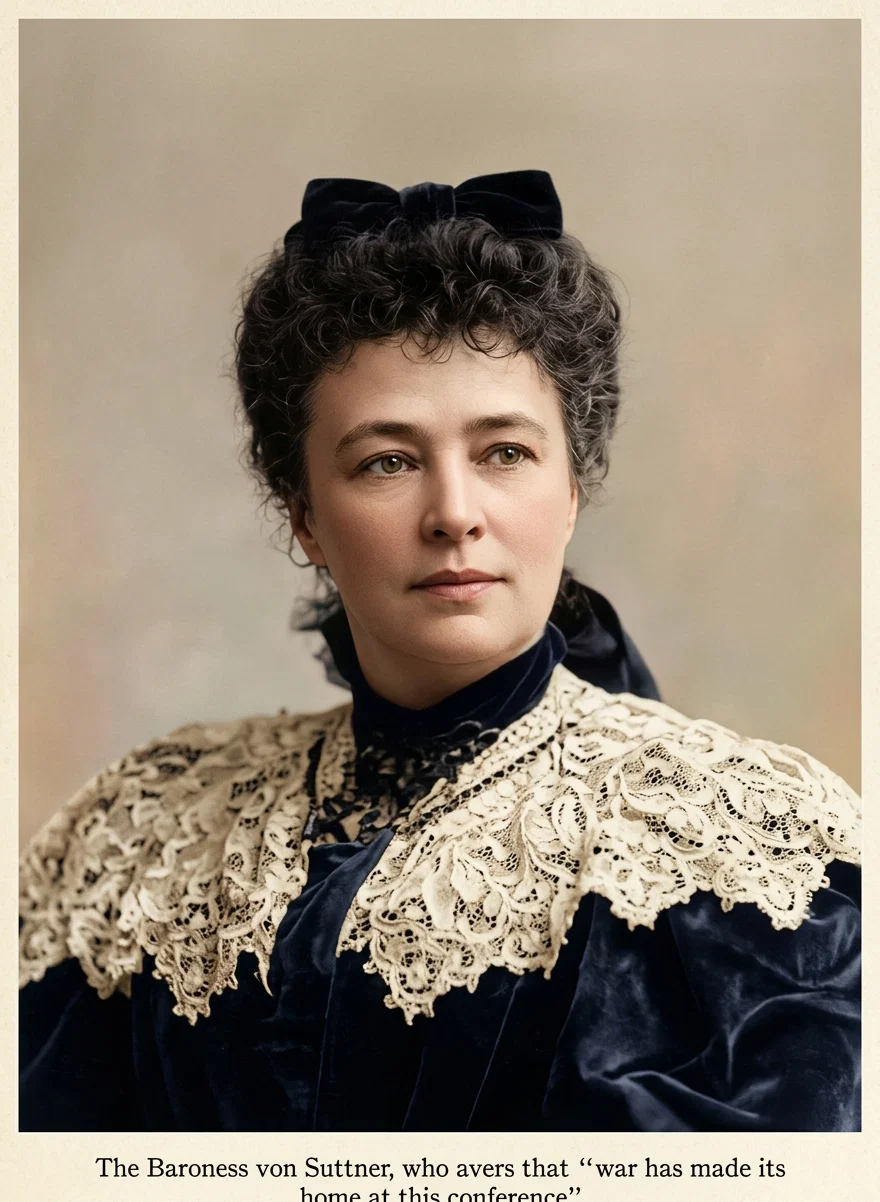
The establishment of the Hague Conferences — out of which grew the Hague Court — is regarded as by far the most important step yet taken to insure peace through world organization. Two conferences have already been held, in 1899 and in 1907; the third will be held in 1915. The work of the two conferences has been wholly of a negative character. "It assumed that war was to continue to be a legal method of self-redress for years to come, and simply attempted to ameliorate the conditions under which it occurs." The second Hague Conference, we are told, was the first time in history when ALL THE NATIONS came together to discuss questions common to all. In reference to this conference, the "Independence Belge" said, "To tell the truth, the conference has been called together with the avowed intention of more strictly regulating war." The Baroness von Suttner, who was present at the conference, avers that "war has made its home at this conference; nine tenths of its labors was devoted to the consideration of war rather than how to insure peace." We see, then, that the Hague Court has so far not lifted a finger to bring about world peace.
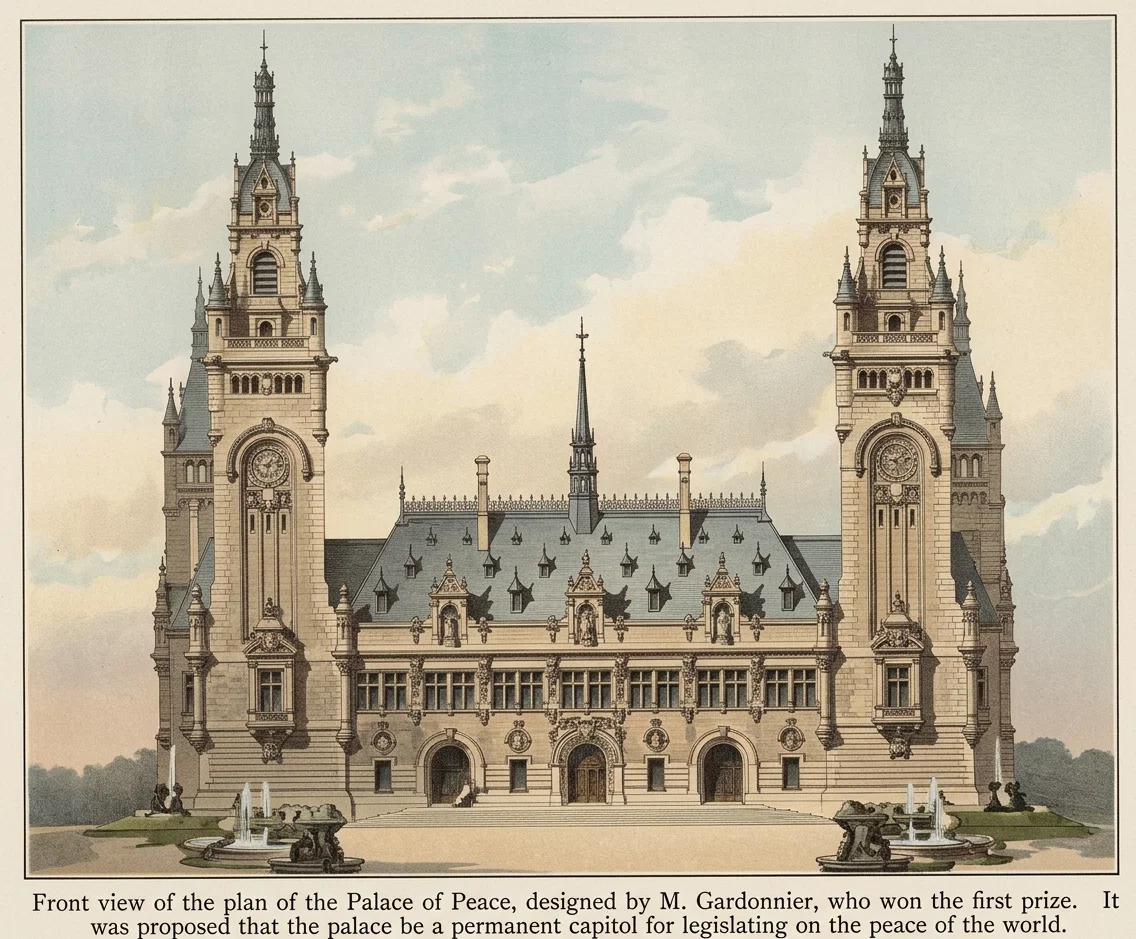
Front view of the plan of the Palace of Peace, designed by M. Gardonnier, who won the first prize. It was proposed that the palace be a permanent capitol for legislating on the peace of the world.

To Develop an International Legislature
The advocates of peace are now working to develop the Hague Court into an international legislative assembly, with jurisdiction over forty-six nations, similar to that exercised by our Congress over the forty-six States. They are sanguine, too, that the Hague Conference of 1915 will carry through an international treaty of compulsory arbitration. Since the first Hague Conference there have been negotiated 133 treaties of arbitration; but there is a fly in the ointment, as in all these treaties "honor and vital interests" are RESERVED FOR THE ARBITRAMENT OF WAR. The reader is probably aware that the peace champions of the world are aiming at nothing short of the establishing of an international government, with a united nations congress, a supreme court of the world, modeled after the Supreme Court of the United States, and a president of the united nations of the world, modeled after the executive department of the Government of the United States — all this to abolish war and so to insure permanent and universal peace. In this connection it must not be forgotten that Mr. Carnegie has given $1,500,000 for the erection of a peace palace at the Hague. The palace is expected to be ready for occupancy when the third conference meets in 1915.
"House in the Woods," the building in which the 1899 Hague Conference was held
The Baroness von Suttner, who avers that "war has made its home at this conference"

United States Commission to Limit Armaments

Last June our Congress passed a bill authorizing the President to appoint a commission of five members "to consider the expediency of utilizing existing international agencies for the purpose of limiting the armaments of the nations of the world by international agreement, and of constituting the combined navies of the world an international force for the preservation of universal peace."
The commission is to make its report within two years, and a sum of $10,000 was voted for its expenses. The "Independent" says jubilantly, "This bill is nothing short of a ways and means measure to bring about a world federation, LIMITED TO THE MAINTENANCE OF PEACE." (Capitals ours.)

Secretary Knox on Peace

"The Spirit and Purposes of American Diplomacy" is the title of an address delivered by Secretary of State Knox, at the commencement of the University of Pennsylvania, last June. Mr. Knox concluded with what the "Independent" styles "this far-visioned peroration":
We have reached a point when it is evident that the future holds in store a time when wars shall cease; when the nations of the world shall realize a federation as real and vital as that now subsisting between the component parts of a single State; when by deliberate international conjunction the strong shall universally help the weak, and when the corporate righteousness of the world shall compel unrighteousness to disappear and shall destroy the habitations of cruelty still lingering in the dark places of the earth. This is the spirit of the wide world brooding on things to come. That day will be the millennium, of course; but in some sense and degree it will surely be realized in this dispensation of mortal time."This is the first time," continues the "Independent," "that a responsible minister of foreign affairs of a great world power has ever prophesied while in office the coming of the 'federation of the world' and its corollary, the reign of universal peace. . . . It contains the true and final philosophy of the peace movement — interdependence for independence, organization for chaos, law for war." The same writer hastens to character Mr. Knox as the greatest "peace" secretary this country has yet produced. The most potent semiofficial agency engaged in furthering peace is the Interparliamentary Union founded in 1888 in England. It is open to all persons who have been members of national parliaments. It now has a membership of more than 3,000. More than 200 members of the United States Congress are now represented in this union. In the words of the "Independent": "Should the union grow anywhere near so fast in the future as it has grown in the past, it will not be a very long time before the nations can, IF THEY DESIRE, actually "VOTE peace on earth."

Numerous Societies Working for Peace

Mr. Holt tells us that there are now nearly 600 unofficial peace societies throughout the world. There are 175 in France, 85 in Germany, 70 in England, 50 in Sweden, 35 in Italy, and 63 in the United States. Of those in the United States, the American Peace Society (with headquarters in Boston) is the oldest and best known. It publishes the "Advocate of Peace," the most influential peace journal in the world. This society is engaged in organizing branches, and has at present fifteen scattered over the country. Some of the other societies in this country are: the Annual Mohonk Conference on International Arbitration, the Intercollegiate Peace Society, the American Society of International Law, the World Federation League, of New York, and the Arbitration and Peace League. In addition to the peace societies of the world, there is an International Peace Congress that meets every year. Its eighteenth session was held last year at Christiania, Norway. Nearly every country of Christendom has its national peace congress, which meets annually.

Vast Sums Donated for Peace

In 1910 Mr. Edwin Ginn, the famous Boston publisher, gave $1,000,000 to the cause of the peace movement; Mr. Carnegie soon followed with a princely donation of $10,000,000. "As long as capital bears interest," says Mr. Holt, "this fund will yield its $500,000 a year; and when war ceases, as war inevitably must when the nations learn the better way, it will be needed to abolish the next greatest 'scourge of mankind.'"
July 6, 1910, the San Francisco "Examiner" said editorially:
Governments and emperors and kings and presidents are discussing peace as the great practical policy of all nations. The great cause of universal peace is marching on. Of all the great causes and developments of the century nothing is moving now more swiftly to its glorious end. . . . The President that is and the President that was have spoken bravely into the records of the new year their vigorous advocacy of arbitration and disarmament. The Secretary of State, on behalf of the Government, has forwarded an appeal to forty-eight nations of the world to join in the effort to enlarge the powers of the Hague Tribunal and its Prize Court to a Court of Arbitral Justice to harmonize international strife. The Congress of the United States has passed a resolution for a millennial commission to sound the parliaments of the world upon an agreement for the disbanding of armies and the disarmament of navies. Another resolution — the best of all — only waits the next Congress to invite the parliaments of all nations to assemble in common deliberation in some great American city to give essential legislative force and sanction to the agreement for universal peace. The dead King of England died with the song of universal peace upon his lips. The new King of England catches the refrain from the silent lips of his ancestor and gives it volume for the new day of his reign. The martial Emperor of Germany goes from the funeral pomp of the English Edward to breathe the spirit of peace. The peace societies of America and the interparliamentary unions of Europe are unfurling every banner and unloosening every song that pulses the practical suggestion of peace. . . . The Hague Conference is approaching another wonderful session, which will report the organization of the united nations of the world, with a capital, a constitution, and a flag devoted exclusively to the great cause of universal peace. The spirit of universal peace is in the sentiments of thinkers, in the pockets of taxpayers burdened with the staggering cost of armaments, in the intelligence of nations, in the air, and in the hearts of men.
This editorial closes with these roseately optimistic words: "The future is radiant with promise. The cause [of peace] of causes is marching on."
The noted New York clergyman, Dr. C. H. Parkhurst, July 13, 1910, contributed to the Hearst newspapers a stirring appeal to the nations to disarm, and by so doing make the "world's peace sure." He declares that if either England or the United States had the self-assurance to set the pace in a movement toward disarmament, the other nations would instantly follow suit.
Near the close of his article, under the title, "The Dawn of the World's Peace," published in "The World's Work" for March, 1911, Mr. Hamilton Holt indulges himself in this sanguine hope respecting the advent of world peace: "The future, indeed, is bright with promise, for all things work together for peace." He says finally, "Let us add to the Declaration of Independence the declaration of interdependence."
Similar citations might be given indefinitely from the pens and lips of thinking men and women of all nations, but space will not permit. We have given enough to show how colossal in magnitude and how ubiquitous is the "peace propaganda" of to-day. Will it succeed? What is the outlook? The realization of permanent, world-wide peace is certainly a "consummation devoutly to be wished."
We have nothing but praise for the estimable men and women who are devoting their money and their lives to so sacred a cause. We should all work for peace. The great mistake that these good people are making is that they are confidently predicting that the movement will be crowned with success, in the very face of the verdict of inspired prophecy to the contrary, as we shall abundantly show in the next number of this journal. — —