Millions for Minutes

7%

Pacific Press Publishing Association · Mountain View, Cal. · Apr 25, 1911

FromSigns of the Times, Vol. 38, No. 17.

Read the full edition

Millions for Minutes

W E have had the age of stone, the age of wood, the age of iron, the age of steel. This age is a combination of them all—and more. It combines the stone and iron, the steel and cement, the coal and oil, the steam and electricity. Everything is made to pay heavy tribute to man and his manufactures.
Above all it is an age of rush. The demon of hurry is everywhere manifest. The bacillus of rush, more virile and contagious than plague, bubonic or pneumonic, has infected the age, awakened sleeping nations, and is swinging the world into its rushing procession. Evil, malevolent, deadly, is the virus of rush; it gives no time for the eternities; its whole aim is to concentrate eternity into time, ages into years, days into minutes, hours into seconds. It is here, and here to stay, and as wise men we must reverse its spirit while we use its speed.
Upon no other departments of life is the unreasonable rush demand made as upon those of communication and transportation. Fast mails, and ever faster, telegraph, telephone, night and day letters by wire, demand more rapid transportation. Rivers must be spanned or tunneled, mountains must be bored, obstructions in the way, in the language of Holy Writ, “dissolved,” to permit, in the language of the Bible again, “the chariots” which “seem like the torches,” to “run like the lightning.” See Nahum 2:3-6. And railway companies must respond,—whether they believe in the mad rush or not, they must respond. And they are responding wonderfully.
No railroad in the world has met this demand like the New York Central, which we take as a type, the head of the type, of a marvelous combination of transportation facilities. Its consideration for a little while will, we believe, be of profit to our readers; for this article is no paid advertisement, both facts and photos were secured by the editor solely for our readers’ benefit.
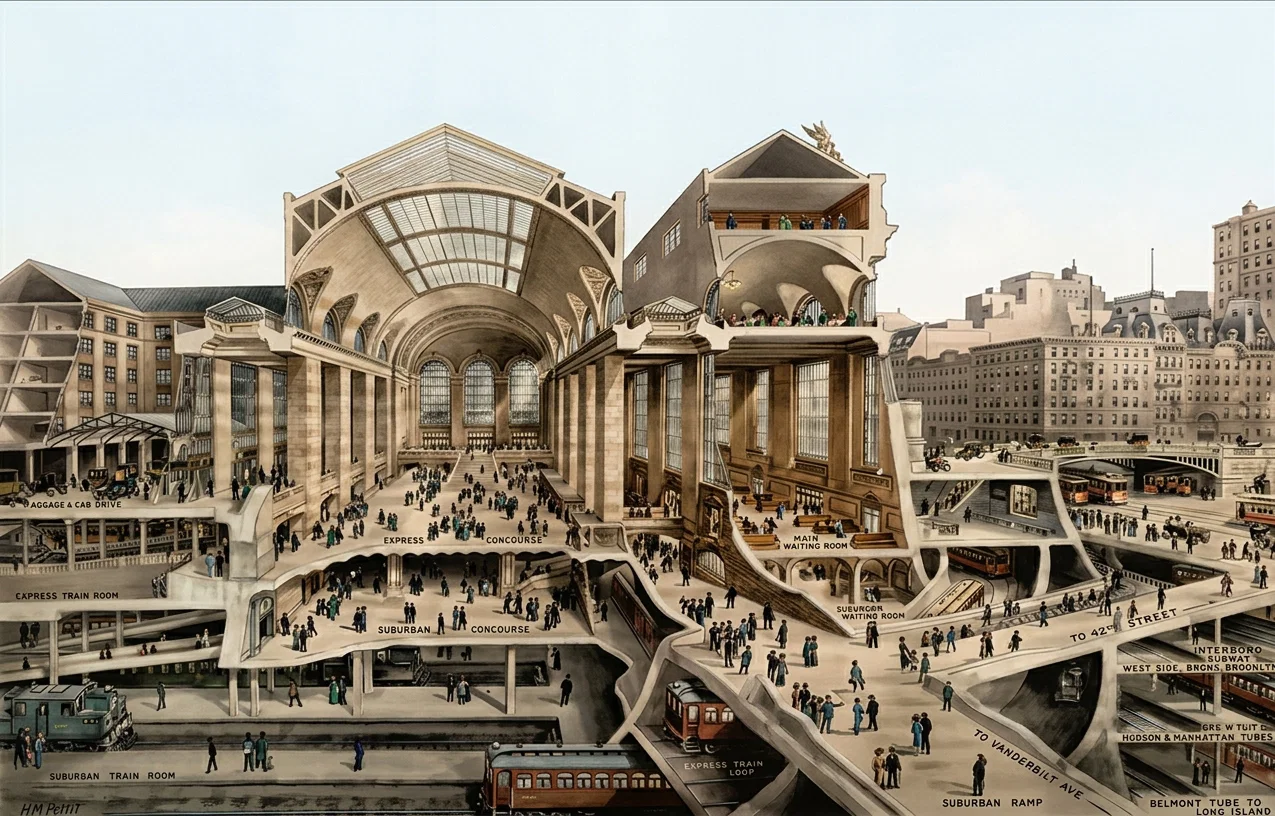
A sectional view of the Grand Central Terminal, showing the different levels, ramps, and subway connections. The main building above.
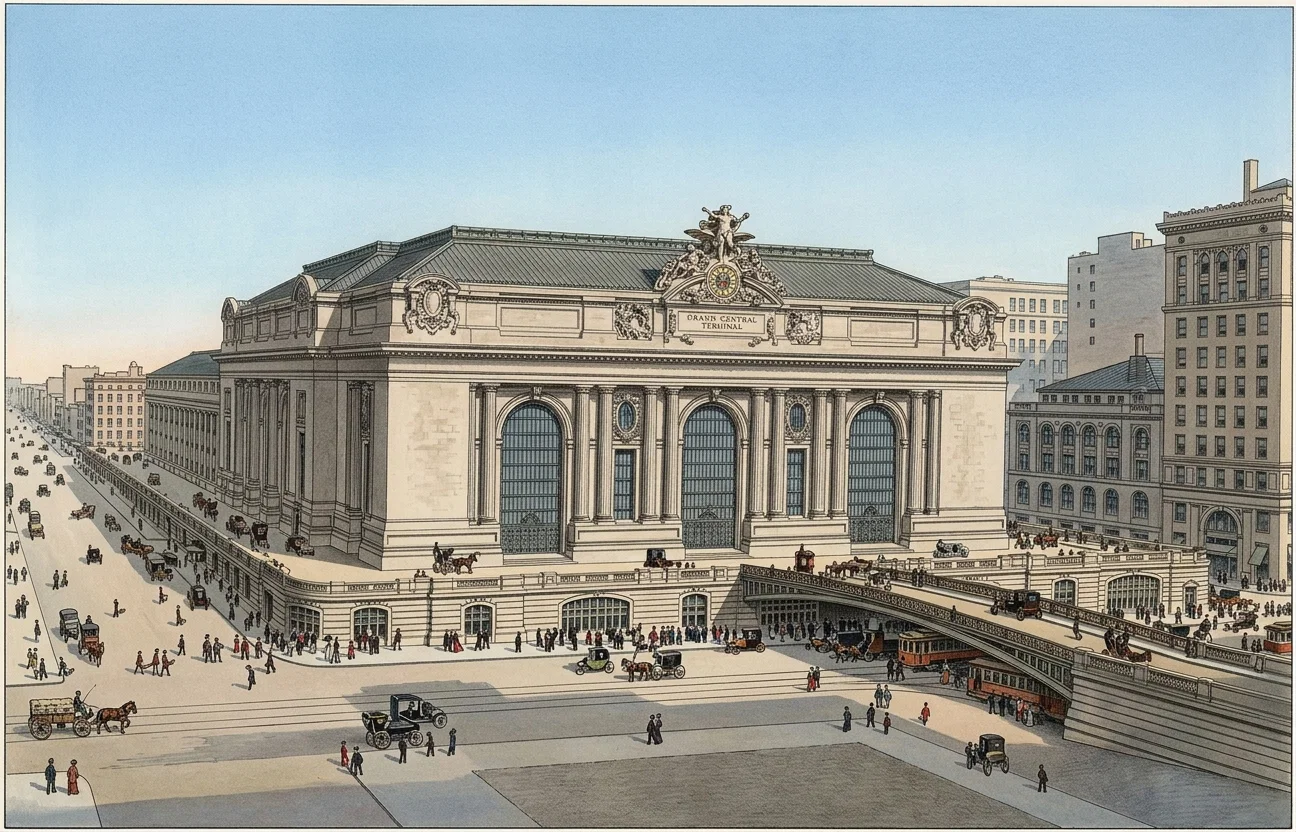
The reproductions of what is and what is to be, in the pictures upon this page, tell briefly but almost incomprehensibly the vast wealth that is expended to save time, to turn millions of dollars into minutes.
At the New York Grand Central Terminal 60,000 passengers and 400 trains arrive and leave daily. How to provide facilities so they may do this easily was a problem. It is settled in the building of the largest station in the world, more than twice as large in fact as any other yet planned. It is a stainless station; all passageways, galleries, concourses, are on gentle inclines or “ramps.” And all the machinery of this vast building, or collection of buildings—the signals, the tracks, the hundreds of trains—will not be seen from the street. All are below the street level. Prices in New York City real estate demand it, when the space for one car costs, exclusive of the station, $30,000.
There are four levels in this station. The gallery on 42d Street will be the upper level. Next below is what is called the concourse, from which level 42 tracks will handle the through trains, connecting also with the subway trains. On thethird level are the 25 tracks for suburban trains; and underneath this, subways for handling baggage.
The “ramp” idea came from the old Romans, the inclines built for their chariots. These inclines were tested personally by great railway specialists of every type of man, tall and short, fat and lean, loaded with hand baggage and free, and by women of all types, and the easiest gradients were adopted, the steepest 8 feet in 100, and some not more than 4 feet in 100.
Through these developments the new station can handle one hundred million people a year; it now handles twenty-five million. And all these passengers will alight from their trains and reach the street without mounting a single step; and 70,000 passengers an hour can be handled. There is no conflict, no meeting of human streams. Where steps are shown they need not be used, and in some cases elevators are in evidence.
In that new station are a lot of dressing-rooms at nominal rent, for women as for men, in which one may change his clothes; a rest room with medical attendance, and nurses if needed. Great trains are named as well as numbered to help the passenger to remember.
As compared with the old well-known station the following figures may be of interest: The area of the old terminal was 23 acres; the new, 70 acres; the car capacity of the old, 366; of the new, 1,149 cars. On the street level the station building proper is 600 x 300, and 105 feet high; below the street level it is 745 x 480 feet, 45 feet deep. 85,000 tons of steel will be used in its construction.
It will be a great and mighty gateway to a great and growing city, a wonderful help in this rushing age for men and women to rush safely; a wonderful example of what great capital and large thinking men can accomplish. Would that the same energy and foresight, under divine direction, might be used in the moral world!