[The following was a part of the article which appeared in our Outlook department last week. It finds a fitting place in our Missions this week, and we are sure will be read with interest. Ed. S. of T.]
THE year 1910, like its predecessor, was not marked by any large accessions to Christianity. The attitude of the Hindu to Christianity has been twofold, that of the lower castes and that of the high castes. Among the lower castes there have been certain mass movements toward Christianity, large numbers of the lower castes in certain localities coming over in a body. For several years now these movements have largely ceased. Thoughtful observers, however, predict their renewal in the near future, some saying that in the next few years more than 30,000,000 of these lower castes will come into the fold of Christianity.
On the other hand there seems to be an almost entire failure on the part of Christianity to impress the higher Hindu mind. Thirty years ago there seemed great promise of Christianity's making rapid progress among the upper classes. This hope has largely disappeared. This fact is stirring the hearts of all who have India's progress at heart. Mr. Paul, secretary of the National Missionary Society, recently said:
"It is not Christ that has been rejected of the Hindus, but it is Christianity that has utterly failed to impress the Hindu mind. From Christ they have not turned away, but it is Christianity they have left severely alone as being outlandish and even injurious to their national life."
At first this may seem to be a distinction without a difference, but a little careful thought may teach us that there is much in Christianity as interpreted by Western peoples that makes it unacceptable to the Oriental mind. After all, Jesus Himself was born in Asia. In the midst of Asiatic thought and customs Christianity had its birth. The real question to settle now is this: Are Christian missions and missionaries to-day confining themselves to the command of the great commission to teach only what Jesus commanded, and to teach all that He commanded? Our SIGNS readers understand well that the spirit of apostasy in the Dark Ages so controlled the church visible, that the pure doctrines of primitive Christianity were superseded and a flood of errors adopted from Greek, Roman, and even the barbarian paganisms. These errors have so changed the concepts of God, the universe, the nature of man, etc., that even the great Reformation was not successful in bringing the church back fully to the apostolic doctrines and practise. The church thus handicapped with erroneous interpretations has weakened its message among the heathen.
An educated Indian Christian, quoted last week, closes his eloquent appeal with these words:
Christ must have a living message for us, a message that is in no sense antiquated. But who will declare the message? Who will make known the revelation? Where is that keen vision of Himself, that deep insight into the transcendent wonder of His character and life, that all-absorbing religious passion, which will light up the mystery of His great sacrifice with the light we need?
The third angel's message is God's answer to this appeal. It comes to the world as the last message from heaven. In it we are to be divested of all the errors of the Dark Ages. Do not such appeals as this, rising from all quarters of the earth, send a challenge throughout our ranks that calls for unreserved consecration of our best from our young people for the enlightenment of the world? While the foundation pillars of this message are founded on the rock of truth, still is there not in this appeal a call to the prayerful study of the Book itself, divested of all commentaries and helps which are only reflections of those concepts which have appealed to Western minds, that we may be so led of God in the study of His Word that our message may not be handicapped by Western modes of thought or reasoning?
Influence of Higher Criticism
It seems clear to the writer that another great cause for the refusal to listen to the message of Christ is the inroads of the New Theology and Higher Criticism. At the Puna Missionary Conference, not long since, the Lord Bishop of Bombay read a paper on Bible Criticism. He divided the critics in three classes,—those who believe in verbal inspiration, cautious critics, and incautious critics. By verbal inspiration he did not mean the inspiration of each English word, but that the subject matter was written under direct inspiration of the Spirit of God in all cases. Among the missionaries gathered there the writer alone took his stand for the inspiration of the Bible according to the generally accepted ideas of our fathers. A professor from the College of Science made a most effective speech along the same line. The reader of the paper placed himself in the second class; while the head of the largest mission in Puna, a missionary who comes more in touch with the educated and higher classes of Hinduism than any one else in the city, boldly advocated the extremest school of Higher Criticism.
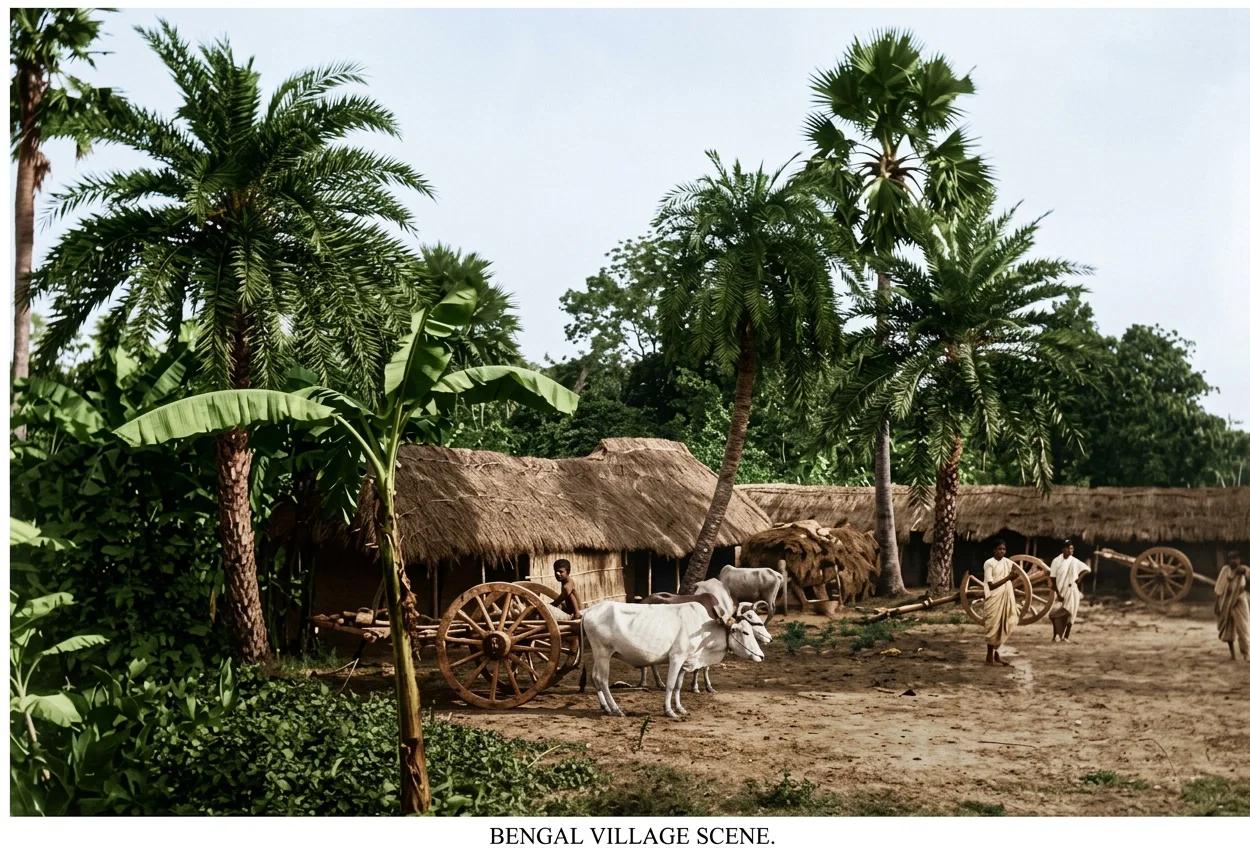
BENGAL VILLAGE SCENE
In a speech in the city of Bombay the head of a large mission said it was immaterial to him whether the Indian accepted Christ as Deity or simply as a great teacher. He was quite content to present Him simply as a teacher. There can be little doubt that this weakening of the message of the Bible is responsible for the failure of the message of Christ to reach the higher classes.