A Century of Religious Wars — A Continuous Example of the Working Out of God's Purpose — Fruits of the Reformation
THE troubles which Germany experienced early in the Reformation period were mentioned in the preceding article. The struggle began in the year of Luther's death, 1546, and closed in 1555. The emperor and the princes, especially Maurice, were concerned. In the end, Charles was really defeated. Worn out by his troubles and reverses, and by ill health, he was glad to lay aside the cares of state, and retire for the few remaining days of his life.
It was stated that the treaty of peace was not agreeable to either party; but active trouble did not arise until the end of this long period — 1618-1648. The interval between the death of Luther and the beginning of this war is occupied with events in the Netherlands, France, England, and with the Armada launched against the island empire. The ground to be covered by this article is now clear, and will be treated briefly in this order.
Charles V, the father of Philip II, had carried on extensive persecutions in the Netherlands for some time before his abdication, but the Dutch were determined to maintain the Protestant worship. Philip closely watched the course of affairs in France and Germany. He eagerly forwarded every conspiracy against the English Protestant queen Elizabeth, and finally manned a fleet with the purpose of dethroning her. He resorted, moreover, to incredible cruelty in his attempt to bring back his possessions in the Netherlands to what he regarded as the true faith. "The chief ally of the pope and the Jesuits in their efforts to check Protestantism in the latter half of the sixteenth century was the son of Charles V, Philip II." (Robinson, page 444.)
The Horrible Council of Blood
CHARLES always regretted that he did not burn Luther in 1521; and he urged his son — who needed no such urging — to rid the land of heresy. Volumes are necessary to tell of the cruelties of Philip and his servants in the Netherlands. The duke of Alva, Requesens, and Alexander Farnese are the servants of this cruel master. Count Egmont, Horn, and especially William of Orange are those against whom Philip waged his terrible wars. All these men gave their lives for the cause of their country.
It is difficult for us to picture the cruelties practiced and the extensive destruction visited upon this little country. The siege and sack of the most beautiful cities of Europe; the cold-blooded murders and fiendish tortures; the burnings and hangings; the Council of Blood and the Tenth Penny, bring to our minds a scene too horrible to describe if we could. Even a few hours spent with Motley and other historians is enough for any one.
The long struggle cannot be described here. On July 26, 1581, the Netherlands declared their independence from Spain; but this was not publicly acknowledged by that country until the year 1648. Three years after this last-named event, William of Orange, the soul of the struggle against overwhelming odds, was assassinated. Many attempts had been made before upon his life, all of which were known and encouraged by Philip and servants of the church. His last words were, "Lord have pity on my poor soul, and on this poor people." (Schwill, page 172.)
"As long as he lived, he was the guiding star of the whole nation; and when he died, the little children cried in the streets." (Motley, volume 3, last sentence.) "The man and the country are alike; both are an epic." "The man condemned by Philip rises greater than any king, and his low country broke the chain with which Spain tried to bind her, and assumes a unique position in the history of Europe." (Wylie, book 18, chapter 26.) With this brief survey, and final victory for Protestantism and liberal government in the Netherlands, we now turn to a similar struggle in France.
French Civil Wars over Religion
THE attitude of the king toward the Reformation would, in the very nature of the case, count for much. Francis I was a "product of the worldlier Renaissance." He cared little for the religious quarrels of the day. But when he saw that it involved political matters and trouble with the pope, he became interested, and struck at the movement very definitely. When he was a prisoner of war, in 1525, his mother acted as regent. She found that she could have no support of the clergy if she would not consent to allow persecutions. Francis, after his return, stopped them, but soon took up an active crusade against the Protestants. He also signed an order for a wholesale massacre of the Waldenses in 1545.
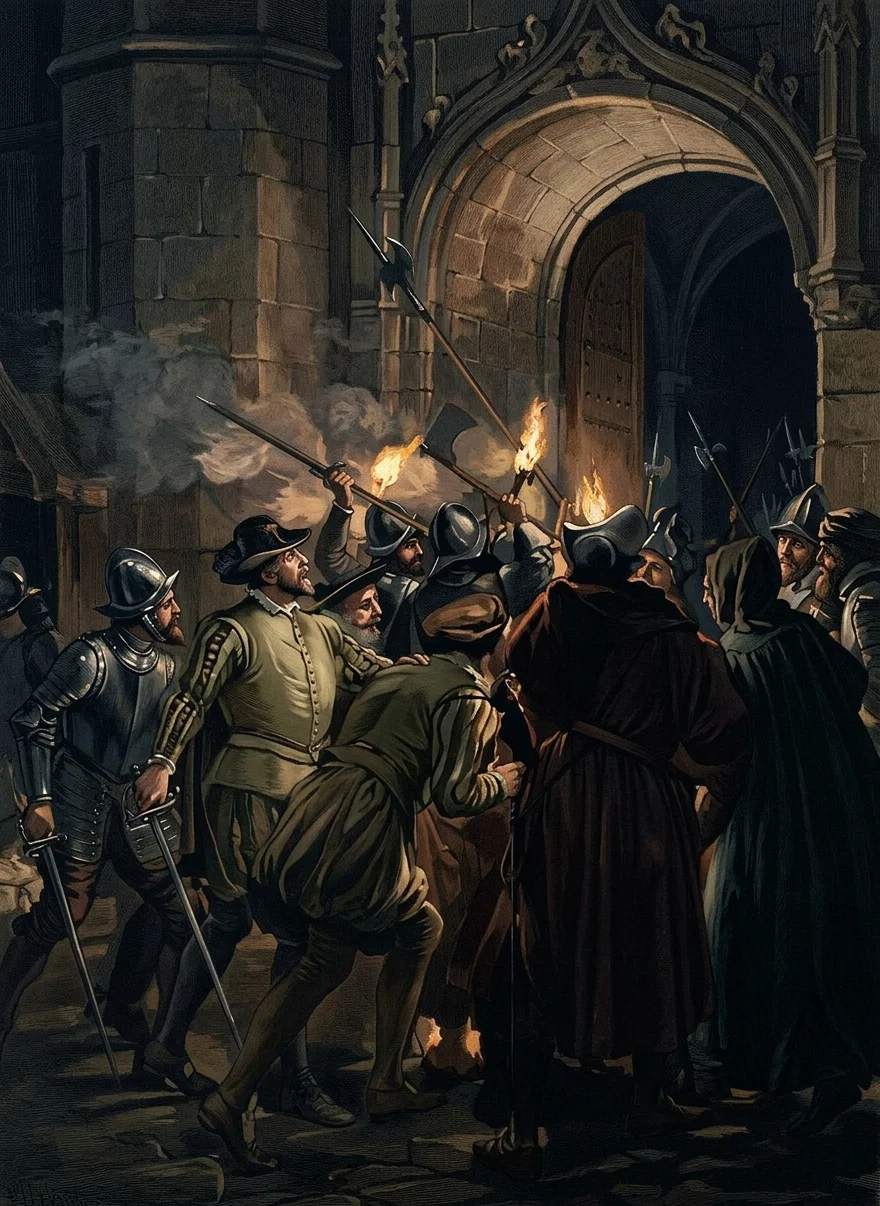
The massacre at Vassy, in 1562, was an act of malice for which no excuse can be given. The duke Guise, with a company of soldiers, in passing through this little town, found a number of Huguenots worshiping in a barn. A few short quotations will be given, in order that the reader may understand the true cause and nature of the trouble. "His retainers first insulted them, and then attacked them, killing about forty, and wounding many more." (Myers, "Modern Age," page 164. Schwill says sixty were killed, and about two hundred wounded. Robinson agrees with Myers as to how the trouble started; also Hausser, the German historian.) Although unarmed, they tried to defend themselves. This was on Sunday, March 1, 1562; and thus began the civil wars in France over religion, which were seven or eight in number.
Preparing for the French Revolution
THE Massacre of St. Bartholomew, 1572, is an event so well known that there is no necessity for telling of it at length. Suffice it to say that the queen mother finally succeeded in persuading her son Charles IX to sign the infamous decree for this midnight murder. It almost chills the blood to think of that deliberate attempt to murder a people whose crime was, that in matters involving religion, they maintained the right to differ with the established order of the church.
Persecutions in the Seventeenth Century
To the Huguenots quite full privileges were given by the Protestant king Henry IV (1589-1610). But in 1685, Louis XIV revoked all these privileges; and the horrors of the persecutions that followed are beyond the power of pen to portray. Children under seven were to be taken from their parents and brought up as Catholics. Soldiers were quartered in the homes, and by every inhuman device known, tormented the inmates until some professed the Catholic faith. All the pastors were to leave the country, but the members of their congregations could not. They were burned, hung up by the hair and feet, and made to lie on hot coals, or kept awake for weeks until bereft of their reason. In face of this, the chancellor, when affixing the seal to the decree, said, "Now lettest Thou Thy servant depart in peace, since mine eyes have seen Thy salvation." (Wylie, book 22, chapter 5.) Madame de Sévigné, a liberal-minded Catholic, said, "Never has a king done . . . aught so memorable." (Id.) In a word, France, was preparing for the greatest and most terrible upheaval of history—374the French Revolution — which came in just one hundred and four years after Louis revoked the edict made by Henry IV. France refused absolutely to receive the seeds of the Reformation. On November 7, 1793, an attempt was made to abolish Christianity. It was determined not to rest until "the king of heaven as well as the kings of the earth had been dethroned." (Myers, "Modern Age," page 382.)
The Attempt to Restore Catholicism in England
PHILIP II, the Spanish king before mentioned, married Mary, queen of England (1553-1558). He hoped to bring England back, in some way, into the papal fold. The Reformation in England began first as a result of the work of the Humanists. After the break of Henry VIII with the pope, he had himself recognized as the head of the church in England, which came to be called the Church of England, or the Anglican Church. During the latter part of his reign, and during that of Edward VI, his successor, many reforms were introduced into the church. As Mary was a Catholic, it was hoped that this union with Philip would help to restore the supremacy of Catholicism in England.
But this scheme failed, because Elizabeth succeeded to the throne, and her reign of forty-five years settled the question as far as the national policy was concerned. A number of attempts were made to take the life of Elizabeth, but all of them failed.
It is necessary, at this point, to mention Mary queen of Scots, who was for many years a prisoner in England. The plots to assassinate Elizabeth involved placing Mary on the throne, as she was a Catholic; and these intrigues did not cease until Mary was beheaded in 1587.
In the year following, a fleet of one hundred twenty ships was prepared and sent over the English Channel; but adverse winds, the better and swifter ships of the English, and their "fire ships," destroyed sixty-six of the fleet. The "Invincible (?) Armada" returned to Spain some weeks later. Thus was ended all danger of invasion from the country which devised and put into operation the Inquisition. From that time, Spain sank until she was no more recognized as a European power of the first rank. The revolt of the South American colonies in the early nineteenth century, and our war of 1898, left her hardly a bit of territory outside of Spain proper.
The Thirty Years' War, lasting from 1618 to 1648, probably has had no equal until the present one. It was begun by some Bohemian insurgents' tossing two royal governors out of a window into a ditch about a hundred feet below. This trouble soon spread into the Palatinate. Europe began to be alarmed at the success of the arms of the Catholic party. When Christian IV of Denmark attempted to help the German Protestants, the promised aid of England and Holland failed to materialize. In a battle fought in 1626, he was defeated and pursued into his own territory. He was glad to promise that he would remain at home. This is what is known as the Danish period.
Hausser speaks of the Swedish period, the time of Gustavus Adolphus, as the second period of this war, because success came to the cause of the Protestants. The young Swedish monarch gained victory after victory. But in the terrible battle of Lützen (1632), he was killed; and the struggle then degenerated into "fighting as a profession." In spite of this, much permanent good was accomplished by the help rendered to the German Protestants.
France would have entered the war before had she not been busy at home, reducing the power of the nobles, and in conflict with the Huguenots. She helped the Swedes during the previous period, but soon became an active independent factor. This was not for the purpose of helping the Protestants, because France was intensely Catholic, but solely for the acquisition of territory and prestige in European affairs. This period brought the long struggle to a close. The following statements will give the reader some idea of the havoc wrought by this terrible series of conflicts:
Civilization Broken Down
"A FRENCH historian has declared the fact that Germany did not become an out-and-out wilderness, one of the most extraordinary examples of endurance which humanity has furnished."—Schwill, "Modern Europe," page 213.
"In some regions the population was reduced by one half, in others to a third or even less, of what it was at the opening of the conflict. . . . The people were fearfully barbarized by privation and suffering, by the atrocities of the soldiers of all the various nations. Until the end of the eighteenth century, Germany was too exhausted and impoverished to make any considerable contribution to the culture of Europe."—Robinson, pages 473, 474.
"The simple fact is that the material edifice of civilization, together with most of the moral and intellectual savings of an ancient society, had been destroyed, and what was left was barbarism. . . . The generation which survived the war had grown up without school, almost without pastors and churches." —Schwill, page 226.
The principle of toleration was hardly worked out or recognized. But a beginning375was made; and by the next one hundred and fifty years, this idea had reached Europe, and in turn the United States, which, by our Declaration of Independence, constitution, and the French Revolution, became a possession of mankind.
More than a Religious Revolt
BEFORE any endeavor to answer questions which may arise, one statement will help to clear the situation in at least a general way. "Just as the medieval church was by no means an exclusively religious institution, so the Protestant revolt was by no means simply a religious change, but a social and political one as well. It was not merely a change of religious belief, for the church permeated every occupation and dominated every social interest. . . . Education, acts in the home, the guild, books, . . . sat in government assemblies, acted as rulers' minister." "The conflicts which the attempt to overthrow this institution, or rather social order, brought about, were necessarily terrific. . . . Nation rose against nation, kingdom against kingdom. Households were divided among themselves." (Robinson, pages 370, 371. See Walker, chapter 1; Schwill, chapter 2.)
Pope Adrian VI, though a legate, fully confessed, at a German diet, the corruption of the popes. He also said that the German revolt was a divine judgment called down by the wickedness of men, especially priests and prelates. (See Robinson, page 410.) One devout writer of the times said that young men were considered quite good enough to be priests to whom one would not intrust the care of a cow. (Id., page 385.)
From Wycliffe to the present, the period is full of God's special providences. In fact, the whole Reformation is one great example of the working out of God's purpose. We are inheritors of the freedom and liberties which were at least partially worked out at this time. Just as Scholasticism had to give way to a better system of education — Humanism and later reforms — so Catholicism was forced to relinquish her hold on Europe because of Protestantism. Likewise in the political world, republicanism has to a large extent conquered absolutism. These are the three great movements of the late medieval and all of modern history.
Large parts of Germany, Scandinavian countries, Switzerland, Holland, and England championed the new faith; or to put it in another way, northern Europe declared for the gospel as found in the Bible, while the Romance nations and southern Germany rallied to the help of the church. The period fairly pulsates with events of tremendous magnitude.