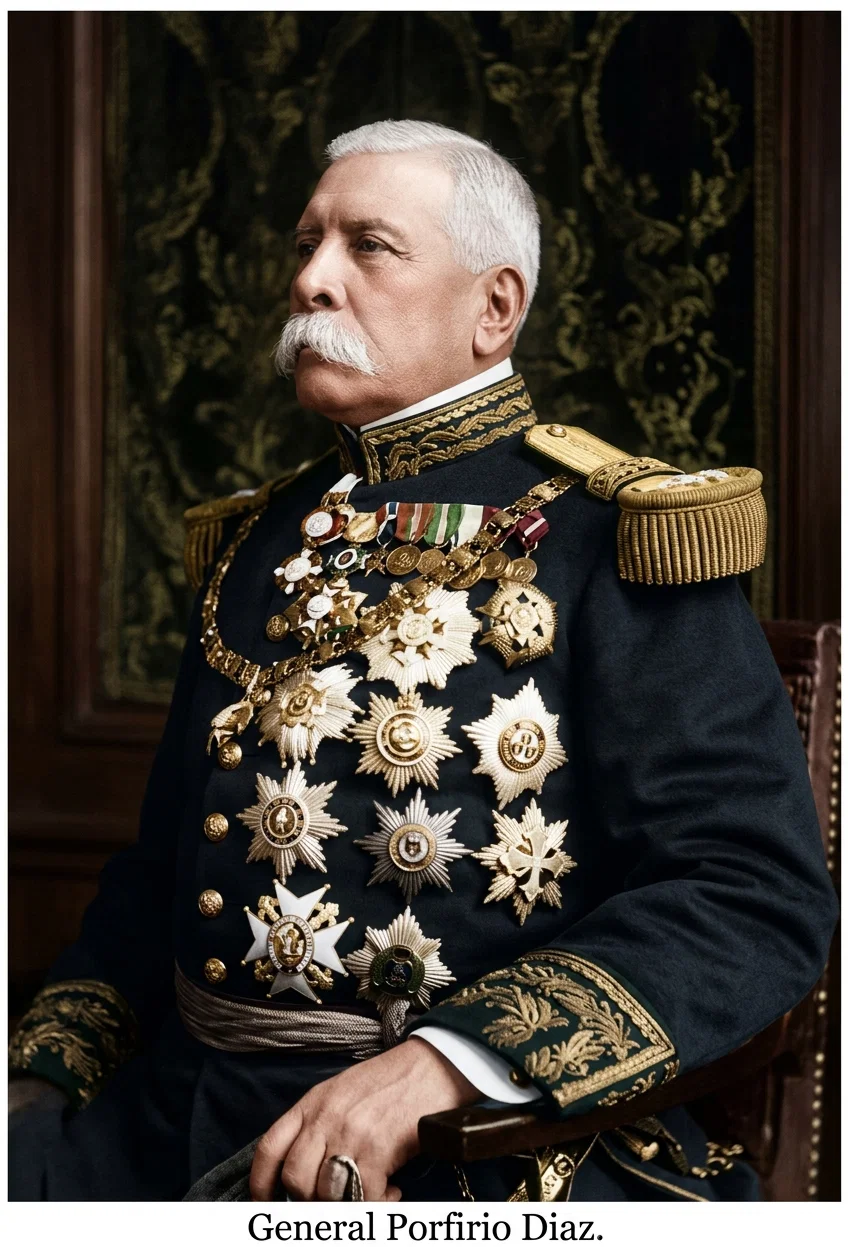
WITH the resignation of President Porfirio Diaz of Mexico, which occurred on the 25th of May, one of the most remarkable rulers of our day passed into private life, at the advanced age of eighty-one years, after serving his country fully half of his long life.
Probably no man now living has had a more romantic and eventful life than General Diaz. He was born in the midst of poverty, with an equal mixture of Spanish and Italian blood in his veins. When twelve summers had passed over his head, he was left fatherless. History records that while doing his utmost to support his widowed mother and her younger children he became an artisan, acquiring the practical trades of shoemaker and gunsmith, obtained a good education, considering his times and opportunities, and refusing the offer of a training for the papal priesthood, he became, instead, an accomplished lawyer, then an influential statesman, and, the occasion seeming to demand it, left the national senate and became a valiant commander of soldiers, fighting, in all, fifty winning battles before peace was established in his country.
Notable Experiences
A few notable experiences in his life are worthy of special mention. Imprisoned by the would-be emperor, Maximilian, and spurning the offer of liberty and a high military position under the Austrian alien, who designed to make the Catholic Church the dominant power in Mexico, he made his escape from prison, and fled to New Orleans, where he worked as a servant, to conceal his identity, Maximilian having offered $50,000 for his head.
Attempting to return by United States steamer across the gulf to his native land, he was identified by a group of Maximilian's officers, and marked for death. To escape them he leaped into the gulf and swam for his life. Joining the greatest of all Mexicans, Benito Juarez, in the overthrow of Maximilian, he became the second president of the republic, and, after one term of office, surrendered the chief magistracy to a friend, who, during a single term of office, made such a dismal failure that Diaz was again put forward for the presidency, and duly elected. Thereafter he served continuously until the date of his resignation.
Jose Yves Limantour, Minister of Finance
Mexico Just before Diaz' Time
During the past few months the subject of this sketch has been a special target for much adverse criticism. It may be well for his overzealous critics to remember that before he came into power, the very soil of Mexico seemed to breed revolution, with a full crop, harvested in spilled blood, almost every year. It is surely to his credit that, under his long administration, the country has enjoyed a continuous term of peace, which was a thing unknown for more than three centuries of its previous history. Before he headed the government, there was little security for life or property within the confines of Mexico. Every city was constructed so that its outmost houses constituted a wall for protection, and the homestead on every ranch or farm must of necessity be a fortress.
General Porfirio Diaz
During his administration, the security of life in Mexico has compared favorably with the protection provided in other countries. This period also witnessed remarkable material progress, in railway construction, in the erection of factories, of telegraph and telephone systems, modern electric street-car service, the opening of mines and of oil industries, also in splendid improvements in buildings, water supplies, and streets in the principal cities, while educational advantages have been extended to almost every hamlet in the republic.
Thirty-two years ago, Protestant missionaries worked in Mexico at the peril of their lives. If for no other work, we can honor Diaz the aged for having held the persecuting power of fanatical Catholicism in check, so that during his administration there has been commendable freedom for the proclamation of "the everlasting Gospel" in a land where probably more than seventy-five per cent of the masses, spurred on by the priests, would gladly suppress Protestantism. It might be truthfully said that during his term of office there has been far less religious persecution by the hand of the law in Mexico than in the United States, and also a more complete separation of Church and State in the former than in the latter.
Grave Fears of Permanent Peace
A very intelligent Mexican lawyer recently expressed to the writer his grave fears for permanent peace in Mexico after the passing of Diaz. He gave these reasons for his misgivings: first, that there was absolutely no man in Mexico sufficiently popular and of recognized ability to take Diaz' place; and, second, that the race of people who compose the republic are by nature of such a revolutionary spirit that the recent taste of blood and plunder will result in the development of scattered bands of bandits, which will be difficult to suppress. I give these items simply as the opinion of a prominent Mexican. Diaz felt compelled to crush the thousands of organized bandits who once overran the country, by very severe measures; and even yet, good families in Mexico bemoan the fact that some of their relatives, being, by accident, as they say, found on the public highways in company with bandits, were summarily executed, without trial. The reason that bandits were executed without trial was because of the well-known fact that, like the Camorrists of Italy, it was impossible to secure evidence on which to convict them legally. This question is well worth weighing. Which policy was better for the protection of the lives and property of the innocent,—to execute swift vengeance upon all organized bands of bandits, or, through the constant failure of court trials, to permit them to continue their reign of terror indefinitely? To take them alive would have meant the death of hundreds of loyal soldiers, and their trials11would have meant financial bankruptcy to the nation.
If the same conditions develop in future, will mild measures suffice to suppress them? We know from precedent how Diaz would have dealt with the Camorrist "black hand" of Italy, had the society developed in his country. He actually had similar conditions with which to deal.
Intelligent Americans living in Mexico express grave fears for the country if the ballot is placed in the hands of the Catholic, priest-ridden masses.
If there is any blame that the large peon class of Mexico have not been educated, it should be attached to the papal priesthood, who have had them under their blighting influence for three and one half centuries, rather than to Porfirio Diaz. The fact is too well known to need proof, that the Catholic system prefers ignorance of the common people, rather than enlightenment, unless compelled by environment to foster education. The condition of all purely Catholic countries substantiates this statement.
It is quite possible that, during his latter years, Diaz has been too largely influenced by men of wealth, who were his advisers. Being human, he had the ambitions common to humanity.
Diaz Did Not Seek Re-Election
Before the last election it was common talk in Mexico that Diaz pressed the matter of retiring from office, but his advisers dissuaded him from his purpose. The revolution that followed, demonstrated that the counsel of the astute old statesman was wiser than that of his counselor.
It is freely conceded that Diaz employed extreme measures to preserve the peace, and, some say, to keep himself in power. He constantly asserted that his only desire was the good of his country. Without any design to cover faults, it is at least charitable to say that he knew the peculiar characteristics of his people better than most observers who take a distant view of Mexican soil across the Rio Grande River.
Mexico's Numerous Tribes
The Government of the United States has had its perplexities with its native Indian tribes. Mexico still has one hundred and eighty-three tribes of proud, independent spirited aborigines, who speak as many different dialects. The classification or amalgamation of the citizens of Mexico, whichever you may choose to call it, is approximately as follows: nineteen per cent pure Spanish blood, thirty-eight per cent mixed, and forty-three per cent pure Indian stock.
Diaz' methods were always military rather than civil in the punishment of high crime, but he believed this to be the only way to preserve the peace. Madero and his associates have had grievances and seen many errors in the Diaz régime. Time will tell whether his successors, altho legally elected, will be able to keep themselves in power to serve out their respective terms of office, without resorting to Diaz' methods of suppressing certain ambitious men, rather than have the country suffer an armed revolution to overthrow the administration.
The public needs no reminder of the fact that a people of the same mixture of blood, occupying Central America, just to the south of Mexico, seldom neglect to keep the revolutionary pot at the boiling point.
Diaz has frankly stated that Mexico was not a republic in the fullest sense, and has expressed a strong desire for such development on the part of his people that they might safely be entrusted with the enjoyment of all the privileges of a true republic.
The Middle Class Lacking
Mexico's weakness in the matter of self-government to-day is the absence of a middle class, of educated, intellectual people. While such a class, essential to self-government in any nation, may be in process of development, as yet the population of Mexico is largely made up of hundreds of the wealthy class as compared with millions of peons.
If Madero is placed in power and can not "make good" on his promises of good wages, good times, and the ballot to these millions, discontent will again reign, which, with suitable leadership, will at least worry the administration.
While we should not condone the wrong, yet, in making our criticisms of men who, under God, have held the destinies of nations in their hands, it is well to remember that popular opinion,—always impetuous, and lacking the opportunity for full investigation, and hence minus the balance-wheel of sound judgment—will one day worship its heroes, the next day stone them to death, and later erect statues to their memory in halls of fame.
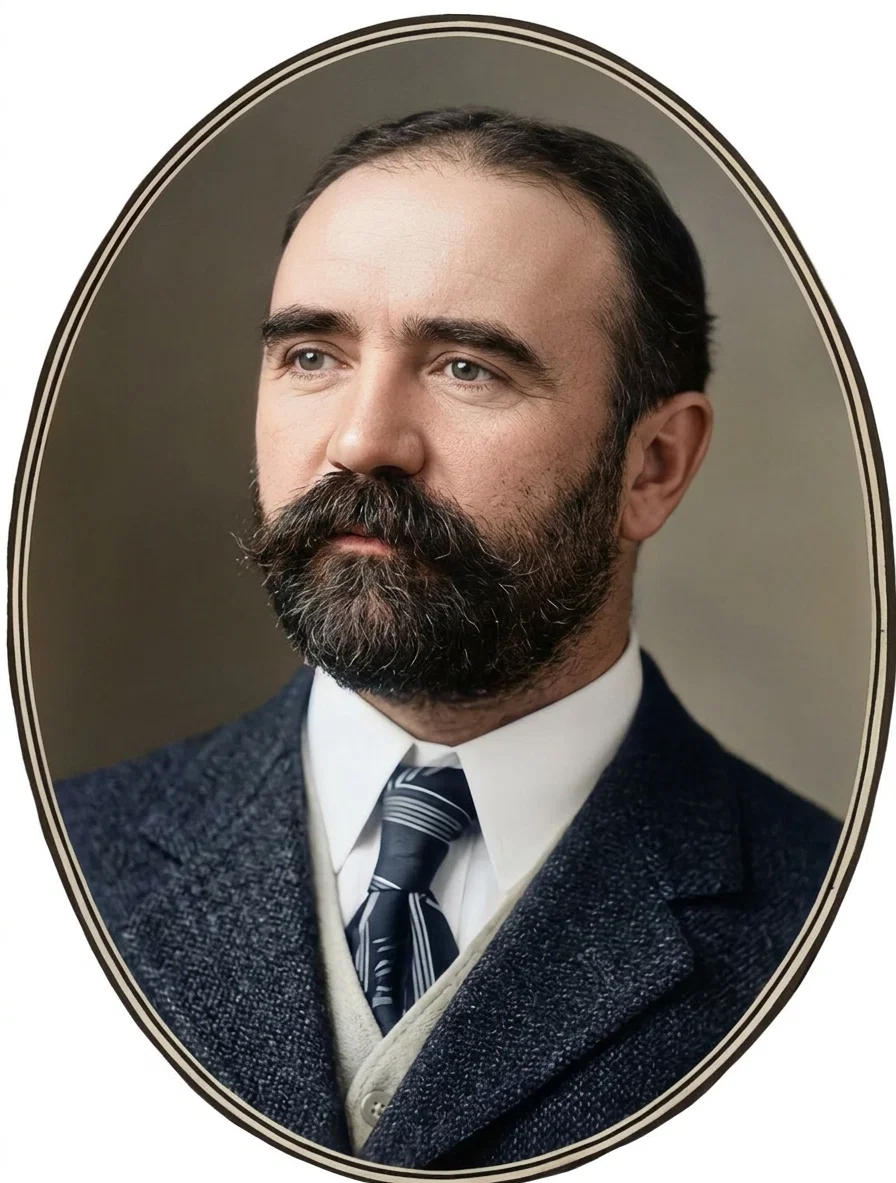
General Francis Madero, the Real Ruler in Mexico
Trusting that the revolution may end with the signing of the terms of peace, let us hope—even against the prophecies of some of her own citizens—that our sister republic may enjoy freedom from political upheaval, and that her famous ex-ruler, who, with a firm hand, has preserved the peace of fifteen millions of people for more than three decades, may have taught them the ways of national peace, and the blessings thereof, and that the remainder of his days may be spent in tranquility, with a peaceful end at last.
G. W. REASER.
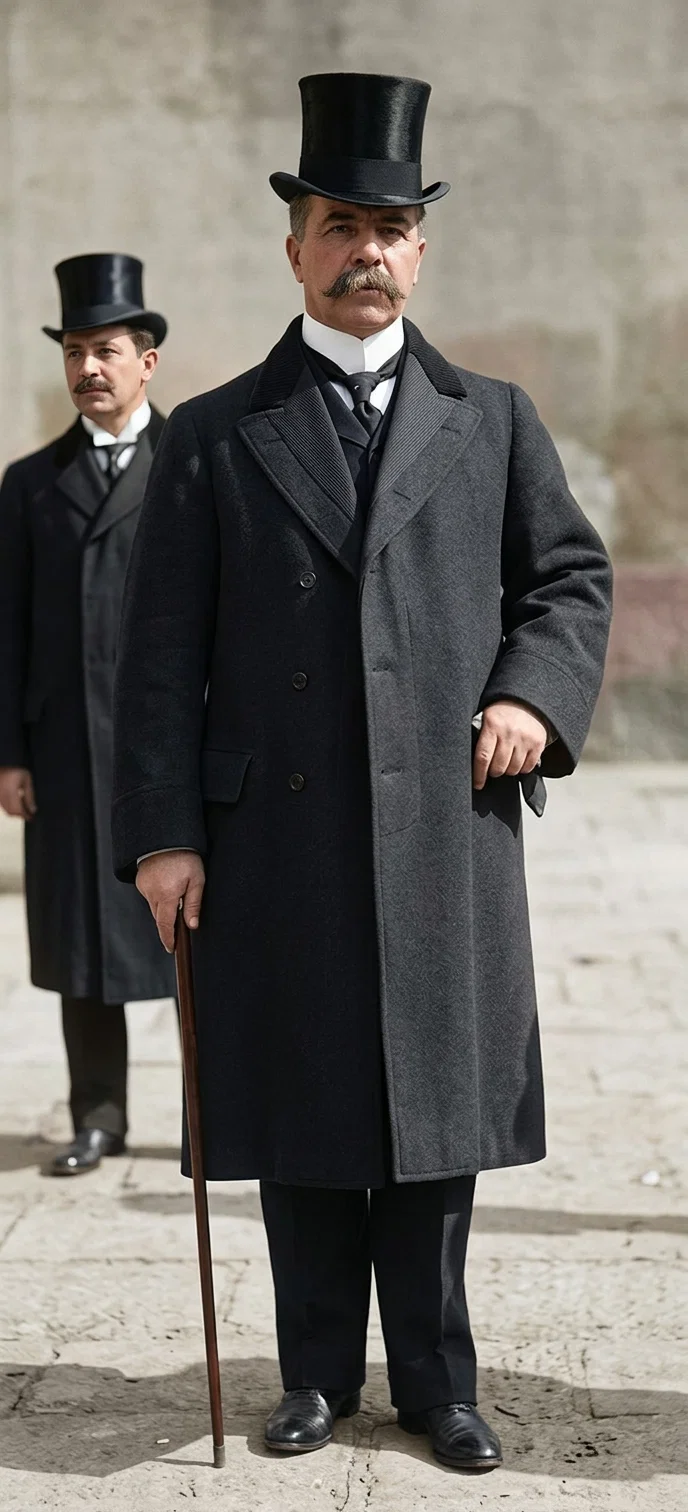
Francisco De La Barra, Provisional President of Mexico