The Religions of China

7%

Pacific Press Publishing Association · Mountain View, California · Jun 13, 1911

FromSigns of the Times, Vol. 38, No. 23.

Read the full edition

The Religions of China

CHINA not only has a religion, but it has a triplet of religions, sometimes existing as separate and distinct sects, and sometimes so blended and interwoven that there is no way of knowing which predominates. These religions are known as Confucianism, Taoism, and Buddhism.

The Sage Confucius

Confucius, the greatest of Chinese sages, was born B.C. 551; and it is his reputed writings and teachings that have laid the foundation of Confucianism, the religion which has probably had more followers than any other religion the world ever knew. Confucianism, or the teachings of Confucius, is the national religion of the Chinese race. For more than two thousand years the teachings of this great man,—for truly he was great, judged by the enduring work he did,—have been accepted as unchallenged truth by the leaders in Chinese thought and by the rulers in the empire. The orthodox Christian believes no more in the divine inspiration of the Word of God, than the Confucianist believes in the infallibility of the writings of the sage of Shantung. Practically the entire Chinese race are Confucianists, while Japan and Korea belong to the same cult. Outside the teachings of the Scriptures, nothing that any one man ever did or said has so influenced such a multitude of human beings as the writings and teachings of Confucius. Those who have read his writings tell us there is nothing in all the teachings of Confucius that imparts any belief in God, or would cause one to suspect that he believed in God.

Confucianism Described

Confucianism is a system of governmental and moral philosophy, ethics, social manners, and instructions in the worshiping of the gods. The Confucian religion is nature-worship. Says De Groot:
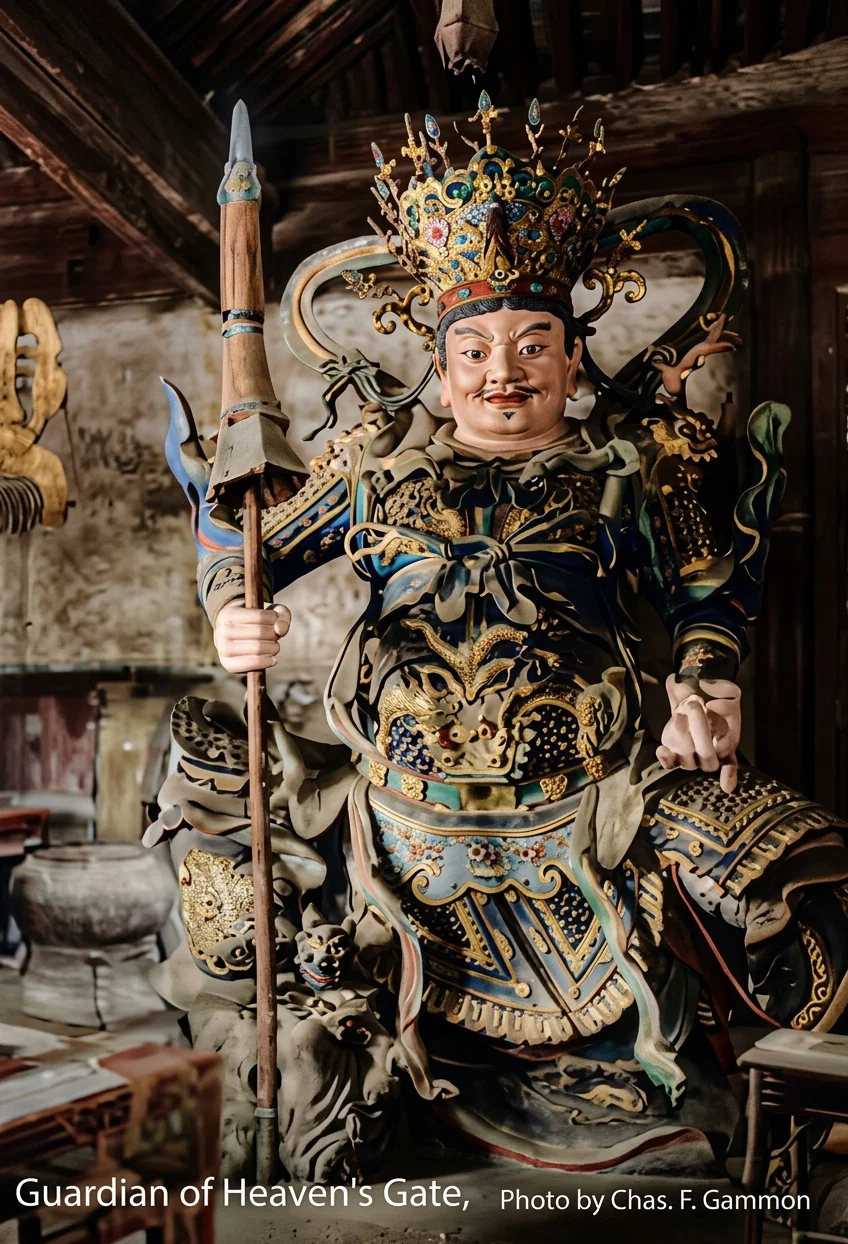
Guardian of Heaven's Gate
We may then define the Confucian religion as a mixture of nature-worship and worship of the dead; or, seeing that the souls of the dead are also parts of nature, we may define it as nature-worship pure and simple.
Ancestral worship is the worship prescribed for the people, and yet they not only worship the spirits, but they worship heaven and earth, the sun and moon and stars, and all animated nature wherever superstition or the hope of temporary reward may lead them.
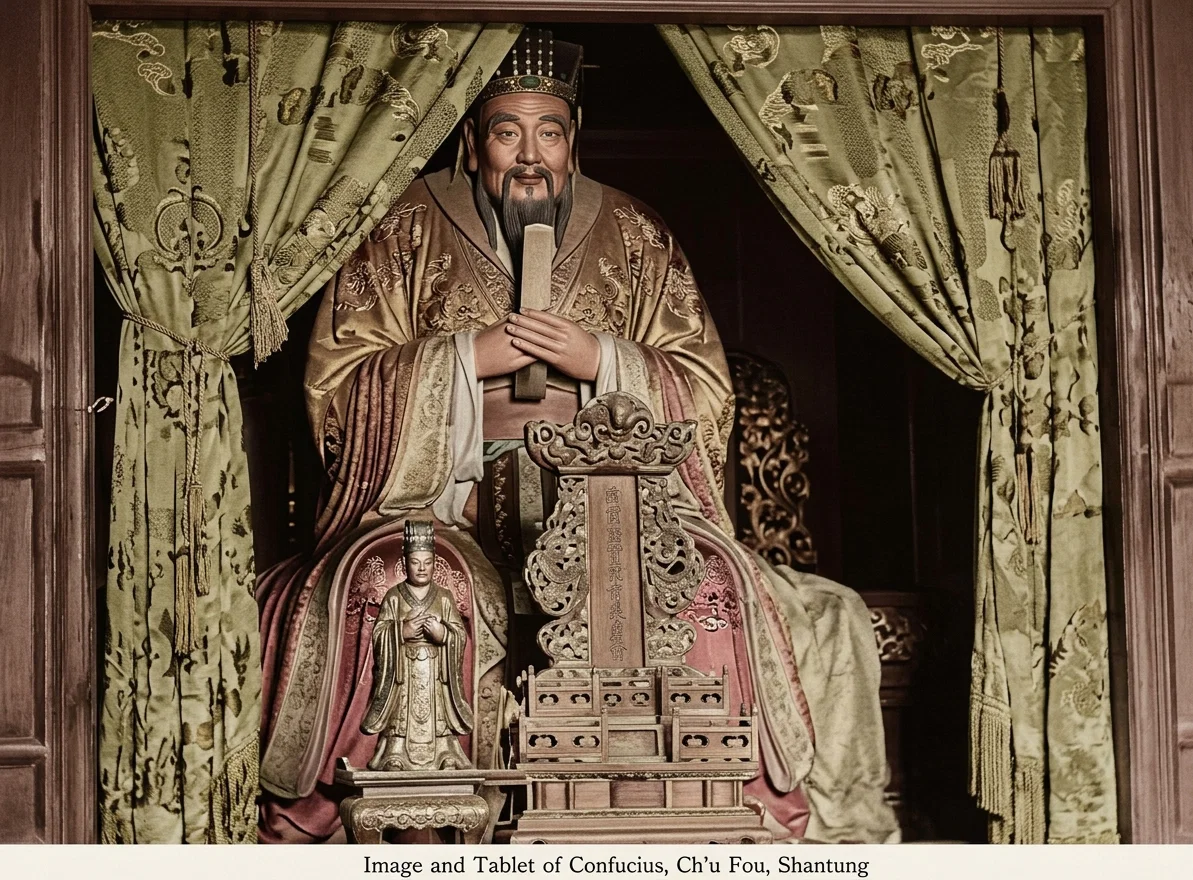
Every heathen home in China has its ancestral tablet in which it is sincerely believed the spirit of the departed dead dwells. Before these tablets food and drink are placed, incense is burned, prayers are said, and the aid and protection of the spirits importuned. "It is the rule to represent the gods who are believed to have lived as men, by images in human form, and the others by tablets inscribed with their principal divine titles. Images as well as tablets are inhabited by the spirits, especially when, at sacrifices, they have been formally prayed to or summoned, with or without music, to descend into these objects. Confucian worship and sacrifice, then, being actually addressed to animated images, constitutes pure idolatry. Certainly it is quite inconsistent with the Chinese spirit that such tablets and images are mere wood and paint."
Image and Tablet of Confucius, Ch'u Fou, Shantung
Not only at home is this ancestral worship carried on, but at the grave and in the village temple or the temple of the clan, as well. Before the altars or tablets erected or placed for the habitation of the spirits, the children of the dead bring their offerings of food, tea, or wine, and pay homage to the spirits that dwell in or visit these material shrines. When we add to this ancestral worship the worship of heaven and earth, the heavenly planets, the mountains, rocks, stones, streams, horses, camels, goats, tigers, fishes, serpents, trees, plants, lightnings and thunder, and a host of other animate and inanimate things, it can be seen to what an extent this people has fallen into idolatry.
Confucianism offers no help to a better life. It holds no promise of a Paradise nor the hope of a better world than this. It leaves every man to order his life so that he shall be in harmony with the universe, without any pardon for failure or reward for merit, or help to attain this harmony. It peoples heaven and earth, the air and water, with innumerable spirits, some good and some evil. There is no love in its religion, either in the family or community. Filial piety is enjoined; but beyond that, there is neither love for the gods nor love for man such as is taught by the Man of Calvary. It fails to satisfy the heart of man, as witnessed by its most devoted worshipers; for they are never satisfied, but wander from temple to temple, worshiping gods and goddesses that they know not, trusting that they may appease wrath and secure to themselves the favor of these gods who it is vaguely hoped will do them good.