Editorial

10%

Pacific Press Publishing Company · Oakland, California · Oct 28, 1897

FromSigns of the Times, Vol. 23, No. 42.

Read the full edition

Editorial

"It is I; be not afraid." The words are those of the Son of God, the Creator of the heavens and the earth, and Master of sea and storm.
The occasion of the words is recorded in the sixth chapter of John, verses 15-21. The day of the event had been a remarkable one. The great Provider had dispensed to the multitude the bread of life, and e're sending them to their homes, had fed with temporal food by means of five barley cakes and two little fishes the five thousand men and the accompanying women and children. All, too, were sufficiently fed, and the fragments of the desert feast filled twelve baskets. Blessings in the hands of our Lord ever increase.
But slow of heart the multitude did not learn the spiritual lessons, did not accept the food as from God, did not hunger for the bread of eternal life, which Christ alone could give. Truly, thought they, this is the king we desire. If he will not assume kingship we will compel him to be king. But Christ's "kingdom is not of this world." John 18:36. Neither expediency, politics, nor force can make him king. He will reign in every individual heart which will truly say, "Thine is the dominion," but he will never sit upon the temporal sinful thrones of men either in person or by proxy. When, therefore, he perceived that they would by force attempt to make him king, he despatched his disciples, some of whom, at least, appeared to be leaders in the plot, to Bethsaida, on the other side of the sea, while he sent the multitude away, and "departed again into a mountain himself alone," to pray for the people who longed not so much for inward holiness as for the loaves and fishes. Mark 6:45, 46; John 6:15, 26. So will he depart from every man or body of people who desire to make him an expedient in politics, or seat him on a political or theological throne of their own devising.
IT IS I, BE NOT AFRAID.
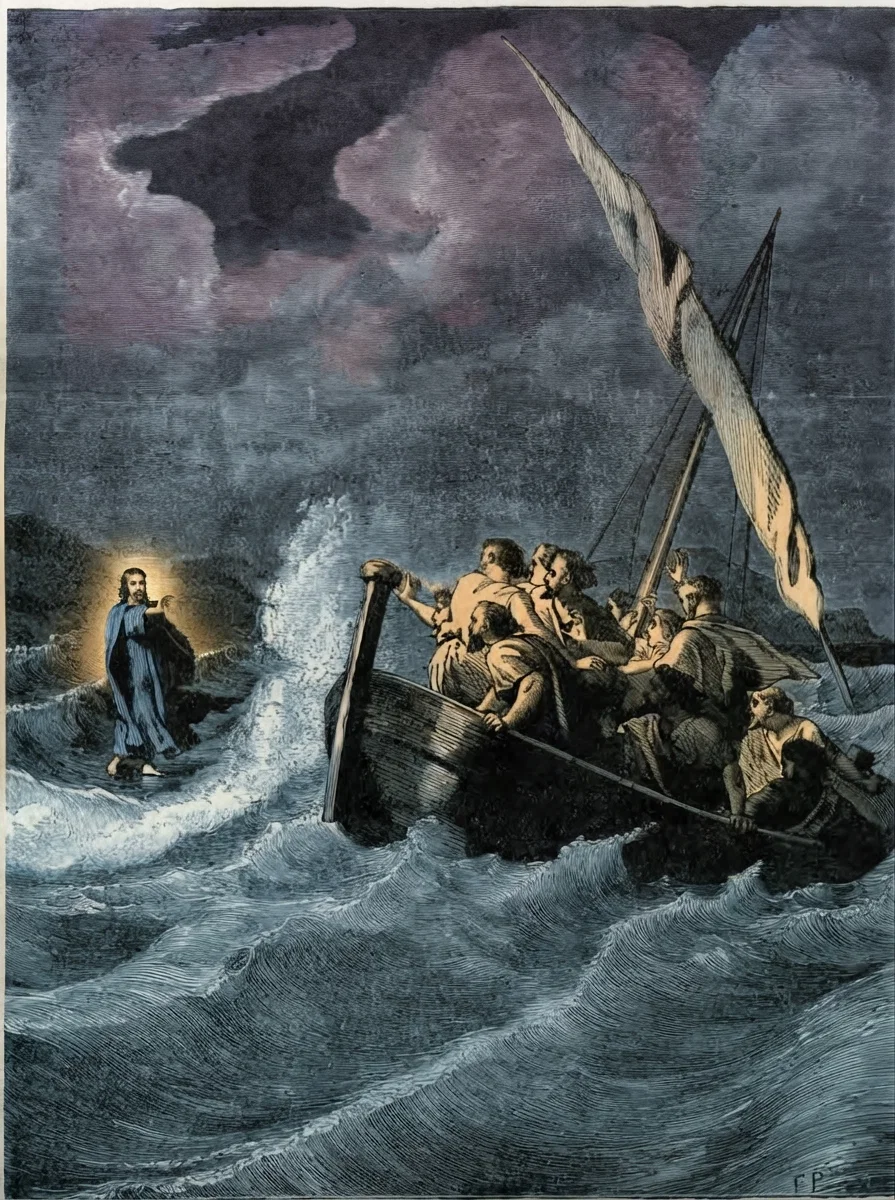
The disciples departed, doubtless disappointed that their cherished hopes had perished. As they proceeded on their journey, the night fell, and a fierce wind, common to the beautiful sea, arose with the deepening darkness. They endeavored to proceed to the other side, but they made no progress; "the wind was contrary." The distance was but seven or eight miles, but in the deep hours of the night, preceding the breaking of the day, the boat was still "in the midst of the sea, tossed with the waves." Their progress on the sea well befitted their disappointed hopes, and their spirits were at low ebb as their physical natures grew more weary with the rowing.

Frightened.—

The weary boatmen were in a proper condition both mentally and physically to give way to groundless fears. The refusal of Jesus to be made king, the sending of them away alone on the stormy sea, the terrible tempest, the swelling sea, made the night one of terror and gloomy foreboding. To cap the climax, as they peered into the darkness they saw a human form walking upon the tossing waves. All the superstitious tales so common among fisher folk invest to them the dread apparition with a deadly meaning. It was to them the storm wraith, foretokening their destruction. Some one whispers, "It is an apparition," and, paralyzed with fear, they cry out in agony.But what joy succeeds the fear as there comes over the waves, through the darkness, from that Being who treads the stormy sea even as on land, the well-known voice, "Be of good cheer, it is I; be not afraid." They receive him into the boat, and immediately the journey is over, the little ship is at the land.
The lessons are obvious to the storm-tossed, disappointed children of earth. First of all, the Lord knows our needs. He knew that the disciples needed not a temporal kingdom in a world of sin, but a spiritual fitting for an eternal and sinless kingdom. Disappointed as they were, he did not utterly forsake them. He noted the storm raised by the prince of the power of the air, he saw them in the darkness of night "distressed in rowing," and he went to their relief. So he sees us. He knows our needs, knows the storms of trial, the furnace heat, the flail of tribulation. He will leave us no longer than is for our best good. He not only desires and purposes our salvation, but he is able to save. "The sea is his, and he made it." No storm-tossed deep can overwhelm him. He treads the rolling waves as tho they were solid rock. And yet our gloomy fears often think his very deliverances to be omens of fearful ill. Like Jacob we will say, "All these things are against me." Like Jerusalem of old, we moan, "Behold, and see if there be any sorrow like my sorrow." Sometimes our eyes are too dim with selfish weeping to discern his form; our ears are too benumbed to hear his voice. But he is there. We may behold him, and "there is life in a look." We may hear him say, "Be of good cheer; it is I; be not afraid." And he will come into our frail boat of life and being if we will let him. But, soul, if you can not see him or hear him, "feel after him and find him," for he is "not far from each one of us." Acts 17:27, R. V.
Jesus alone can save From every stormy wave; Trust in His power, Ever, in dark or day, Ever, in peace or fray, Ever, and all the way, Trust every hour.