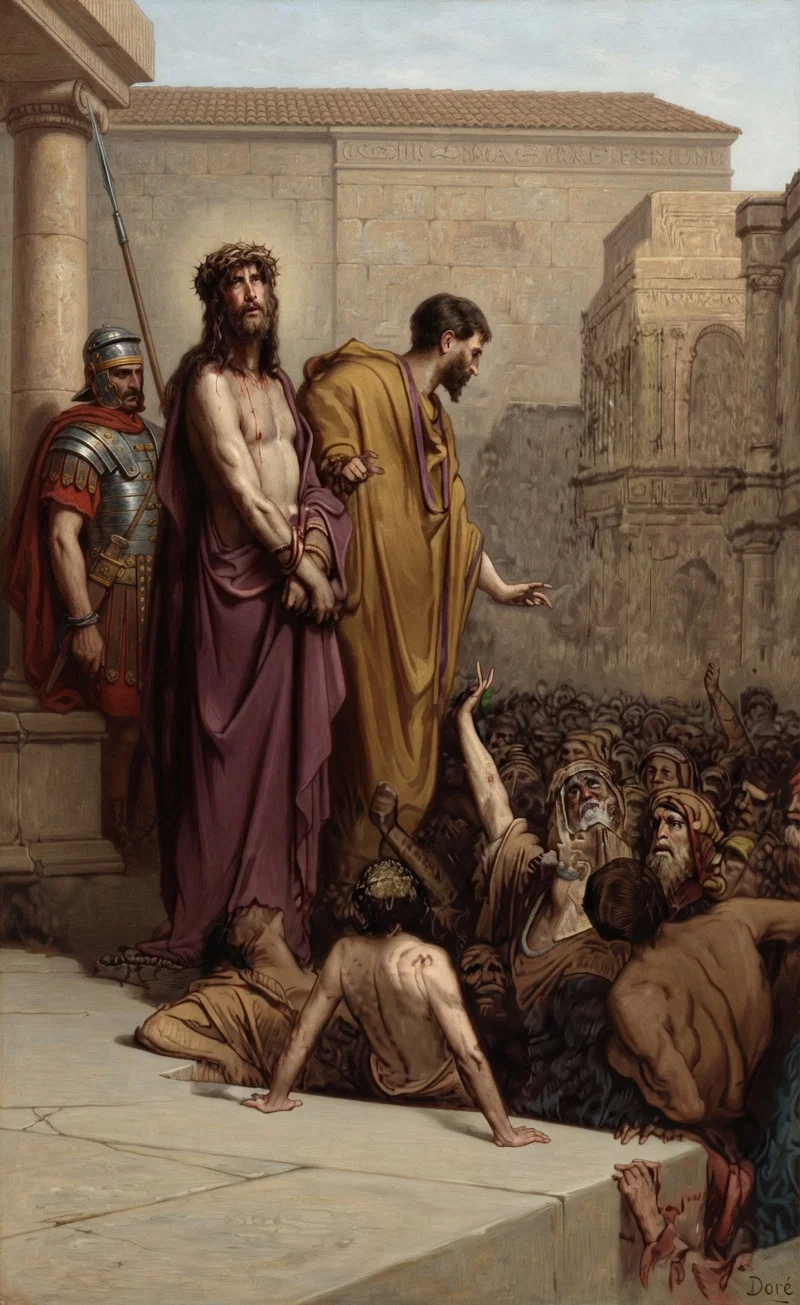
BEHOLD THE MAN!

11%

Pacific Press Publishing Company · Oakland, California · Oct 28, 1897

FromSigns of the Times, Vol. 23, No. 42.

Read the full edition

"BEHOLD THE MAN!"

PILATE little knew the significance of these words as he spoke them to the angry mob that clamored for the Saviour's life. He had been warned not to have anything to do with that just man; and he believed him to be more than ordinary man; but all this did him no good. Pilate's confession is made by many at the present time—"I find in him no fault at all." We are too apt to see Jesus as the Son of God only, and to think of his spotless character during his earthly life as incapable of being marred by sin, and his being kept from the power of sin as something entirely independent of his own will. Thus, to many, Christ becomes a pattern after which we are to cut and fit; and since by all their cutting and fitting they do not succeed in making a perfect fit, they conclude that we are to do only the best we can. To such our Lord becomes an example which it is impossible to imitate, a model after which we can not fashion ourselves.
"Then came Jesus forth, wearing the crown of thorns, and the purple robe. And Pilate saith unto them, BEHOLD THE MAN!" John 19:5.
The latter statement is true. The cutting and fitting and the fashioning are not ours to do. The important part we must act is to "behold the man;" for "we all with open face beholding . . . are changed into the same image." 2 Cor. 3:18.
He was "declared to be the Son of David," "the Son of man," "the Man Christ Jesus." "For verily he took not on him the nature of angels; but he took on him the seed of Abraham;" being made like his brethren in all things, he suffered like them, and was tempted like them. See Hebrews 2. This and the preceding chapter present the mystery of the incarnation. The Son of God, who was above angel, seraph, and cherub, yea, equal with the Father, humbled himself to the estate of sinful man; and the angels, whose work it is to minister to man, were found ministering to him. "What is man that thou art mindful of him?" Being "the Son of man," he became heir to all the temptations and trials common to man, yet "with strong crying and tears" he looked unto Him that was able to save him from death, "and was heard in that he feared." Heb. 5:7.
Now we do not see the Son of God as the Creator, unacquainted with human wo and suffering, "but we see Jesus, who was made a little lower than the angels for the suffering of death, . . . that he by the grace of God should taste death for every man." He is one with us, and therefore he is not ashamed to call us brethren. He was made like us in all points, insomuch that he is touched with the feelings of our infirmities. The word "feelings" conveys much to the human mind. When we consider it in the light of our own experience, we are better prepared to comprehend its significance in the earthly life of the Son of man.
Perhaps we are unjustly treated in some way, and when thus wronged feel inclined to demand justice, but when we heed the instruction of Heb. 12:3,—"Consider Him,"—we are led to see that any and all such feelings are not in harmony with the Master's life and teachings. His persecutors envied him, and plotted to take his life, but he did not fear. They hated his followers, yet he sought the good of his enemies. He was insulted by the professed people of God, still he bore it patiently. And in their hatred they placed the cruel crown of thorns upon his innocent brow, and when they had smitten him upon the head with a reed, and spit in his face, they derided him, bowing the scoffer's knee. All this was done to him "who did no sin," yet he offered no resistance.
If the human mind, inflamed by meditating upon some real or imaginary injustice, could gaze upon the sublime scenes of Calvary, how often would our sorrows disappear behind the wo of the Son of man! Therefore "consider him that endured such contradiction of sinners against himself, lest ye be wearied and faint in your minds." "There's life in a look." This is how our hearts and minds are kept through Christ Jesus. Phil. 4:7. Thus he says to us, "Peace, be still," and there is a great calm. Trivial annoyances no longer provoke; but "looking unto Jesus" we shall endure "as seeing him who is invisible." May our prayer ever be, "We have no might against this great company that cometh against us; neither know we what to do; but our eyes are upon Thee." 2 Chron. 20:12. J. E. EVANS.
New Orleans, La.