Untitled article

8%

Pacific Press Publishing Company · Oakland, California · Oct 28, 1897

FromSigns of the Times, Vol. 23, No. 42.

Read the full edition

"THE MOST HIGH RULETH." NO. 1.

THE Scriptures do not say that the Most High once ruled, or ought to rule, or will rule, or that men should use political power in order to set him up as ruler. The emphatic Word is that he "ruleth in the kingdom of men, and giveth it to whomsoever he will." Dan. 4 : 17, 25, 32. This always has been true since there was a kingdom of men, it is still true, and always will be true. "The Lord hath prepared his throne in the heavens; and his kingdom ruleth over all." Ps. 103 : 19. "He removeth kings, and setteth up kings." Dan. 2 : 21. These expressions show that the phrase "kingdom of men" does not confine God's rule in the earth to any one of the many earthly kingdoms recognized by men. It stands for all of them, for civil government as a whole, throughout fallen man's probationary state, for which time alone such government was instituted.
That class of men who think the Almighty needs the help of human law to establish his authority in the earth would do well to remember these facts. There are a number of "reform" associations laboring under the delusion that men must in some way be compelled to observe "Christian usages" in order that the Most High may be able to rule in the kingdom of men. This delusion causes them much unnecessary trouble, and other people much unnecessary annoyance. It also causes many to be blinded to the real truth and work of the Gospel. Truly the Lord might ask these well-meaning but overzealous people the questions propounded to Job: "Where wast thou when I laid the foundations of the earth?" "Knowest thou the ordinances of heaven? Canst thou set the dominion thereof in the earth?" Job 38 : 4, 33.
God has, in various ways and at divers times, shown his ability to rule by might and power in a physical way, if that were his choice and ultimate design. The deluge in Noah's day, the confusion of tongues at Babel, the destruction of Sodom by fire, the plagues upon Egypt, the defeat of armies and the deliverance of his people by means peculiar to himself, are all in evidence as to his unlimited ability in this respect. But he has given incontrovertible evidence that his great object is a clean universe, including even the earth, ruled by means of his Spirit of love. His "long-suffering to us-ward" is not evidence of his lack of power or resources. "The longsuffering of our Lord is salvation." 2 Peter 3 : 15. The Most High has abundantly shown his power to rule in the kingdom of men in his own way, and at the same time carry on his wonderful work of grace, taking out a people for his everlasting kingdom who will choose to be governed by love. But he has not left man to devise the ways and means. "As the heavens are higher than the earth, so are my ways higher than your ways, and my thoughts than your thoughts." Isa. 55 : 8, 9.
It is a lesson that the professed followers of Christ should hasten to learn, that "all things work together for good to them that love God" (Rom. 8 : 28), and that what he has promised he is "able also to perform" (chapter 4 : 21). If this lesson were heeded by the professed disciples of the Lord, they would better understand the prerogative of God and the duty of following the example of Christ. Then would the world see a different manifestation of Christianity. They would see it in the fruit of the Spirit (Gal. 5 : 22, 23), rather than in efforts to secure compulsory laws. Then would the people of the world be more readily persuaded to become reconciled to God (2 Cor. 5 : 11, 20), rather than to be compelled to make an outward show of religion through the enforcement of human law.
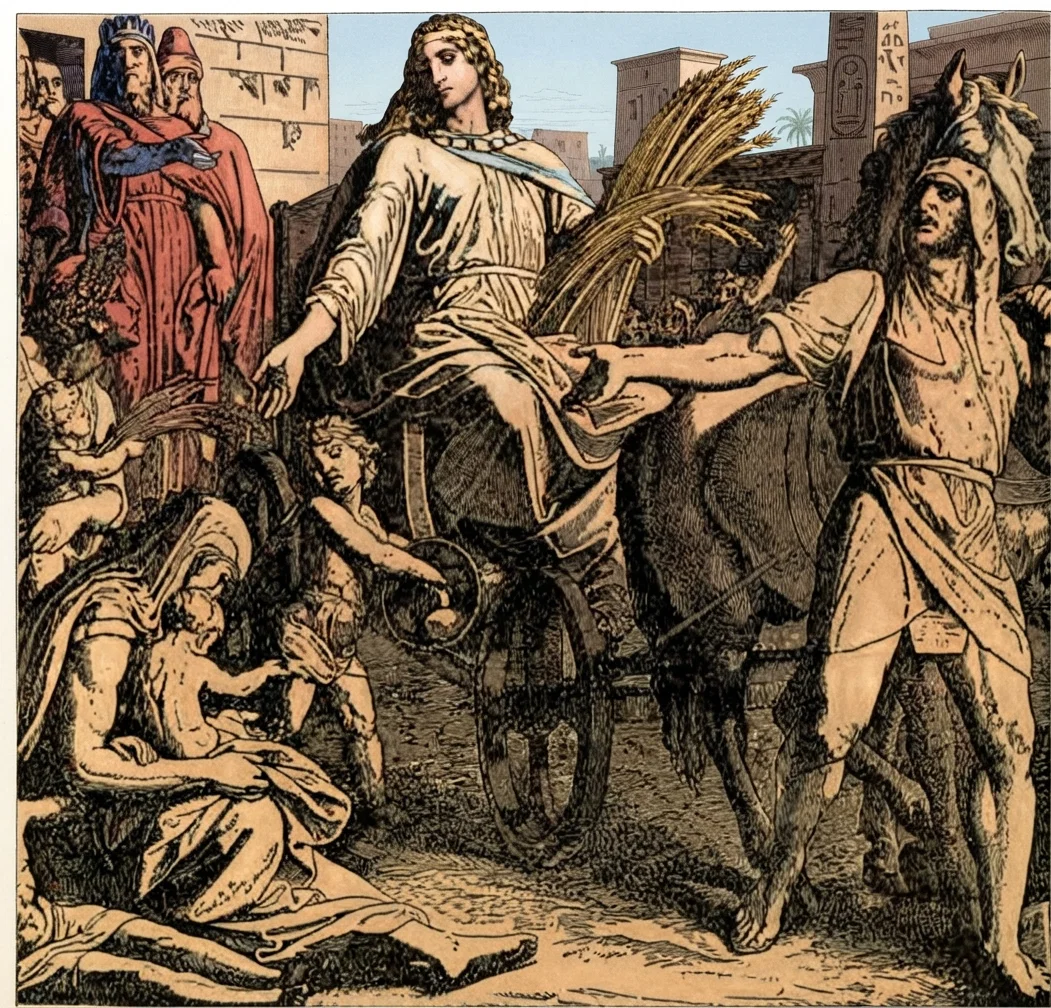
For the purpose of impressing this lesson, and calling to mind the one leading purpose of God in his dealings with the kingdom of men, let us refer to the inspired history, which was "written for our learning." Going back to the family of Jacob, we have the peculiar history of Joseph. Sold by his brethren in his youth, he became first a slave, then a prisoner, in Egypt, which was then the foremost government in the earth. From the prison Joseph was exalted to a position in which he was practically the ruler of the country. An extensive famine, the foretelling of which had been the means of Joseph's promotion, brought his brethren from Canaan to Egypt to buy corn. When they learned that the man with whom they had to deal was the brother they had sold into slavery, they naturally feared the punishment which they no doubt deserved. But Joseph was of a different spirit. He recognized that it was because the Most High ruled even in idolatrous Egypt that he was brought to stand next to the throne. So he comforted his brethren with these words: "Now therefore be not grieved, nor angry with yourselves, that ye sold me hither; for God did send me before you to preserve life. . . . Haste ye, and go up to my father, and say unto him, Thus saith thy son Joseph, God hath made me lord of all Egypt; come down unto me, tarry not." Gen. 45 : 5-9.
JOSEPH RULES IN EGYPT.
In after years, when there arose a king that knew nothing of Joseph, and cruelly oppressed the children of Israel, the Lord again showed that he "ruleth in the kingdom of men." He took Moses, who had been reared for the throne, and made of him a leader to deliver Israel from the bondage of Egypt. And God said to the king, who refused to let Israel go, "In very deed for this cause have I raised thee up, for to show in thee my power." Ex. 9 : 16. Heathen as he was, God had raised him to the throne. The Lord's power might have been shown forth to the king's honor, had he appreciated his privilege and been obedient to the One in whose providence he had been exalted. But as it was, the Lord's power was shown in his judgments, and in the overthrow of the king and his army in the Red Sea. "The Most High ruleth," whether men obey him or not.
When the Israelites had been safely delivered from Egyptian bondage, the Lord showed them further manifestations of his power and glory, notably at Sinai, where he appeared in awful majesty and rehearsed to them his law. Here they were organized into a government, of which God himself dictated the ordinances and regulations. His Angel accompanied them in person (Ex. 23 : 20; 1 Cor. 10 : 1-4), as they went forth to further demonstrate that "the Most High ruleth."
The only condition upon which his continual blessing was vouchsafed was obedience. By them he would have ruled all nations with whom they came in contact, had they been obedient to his Word. See Ex. 23 : 20-33. He gave them victory to the extent of their faithfulness. Not once did they win a victory of themselves; for when they were against God, he was against them in battle. His providence decided every conflict. As long as they were obedient he ruled in their favor; and when they turned after other gods, he gave them into the hands of the nations whose gods they chose to serve.
Never did he compel their service, but he allowed the consequences of their defections to come upon them until they would repent and turn to him for relief. Then he would again overrule in their behalf. He used faithful Israel as a means of executing his judgments upon those nations with whom he had long borne, but whose cup of iniquity at last became full (Gen. 15 : 13-16; Deut. 20 : 16-18), and of showing mercy to all others with whom they should have any dealings (Lev. 19 : 33, 34). On the other hand, he used the heathen nations as a means of chastening his own people when they proved rebellious against his authority. He chastens not to compel obedience, but as a loving reminder that the recreant one is going astray to his own hurt. See Heb. 12 : 6-11.
"God is love," and he doeth all things well. W. N. G.