MY last visit to Constantinople happened to be at the same time as that of the German kaiser. Some time before the advent of the distinguished visitor, the usual cleaning up took place. The streets were cleared of rubbish, and swept, some of the most conspicuous public buildings and minarets were whitewashed, beggars were put under arrest, and some of the streets over which the emperor was to pass were newly paved and sprinkled with clean sand.
In Palestine many of the bridges and roads were repaired, and streets paved and corrected, at the expense of the inhabitants of the locality. In one case where the road was lowered, it caused the collapse of a school building in charge of a lady missionary. When damages were claimed, the lady was informed that she must repair the building at her own expense, and also help pay for lowering the road. To cover the cost of new pavements, etc., in Jaffa, the sultan gave permission to levy a special tax on every box of oranges that should be exported for the next ten years. So much to show what the visit meant to the common people.
This tour of the kaiser embraced much which recalled the accounts of the kings and knights in the days of chivalry. In his train were statesmen, poets, painters, theologians, preachers, and the largest soldier in the German army—a modern Goliath.
The reception at Constantinople was quite enthusiastic. To the zealous Moslem the sultan is in the place of God. From his wishes there is no appeal; and as he received the emperor as his "best friend," every Moslem must treat him with the highest respect; and the kaiser's subjects must be treated in the same manner; hence at present, Germans are a privileged class in Turkey. Doubtless many advantages will be gained by them in commerce and finance. This is what the French foresaw; and, besides, the national enmity was the principal factor in the opposition of France to the emperor's visit, tho the opposition was carried on under cover of the traditional French protectorate of Christians in Syria and Palestine.
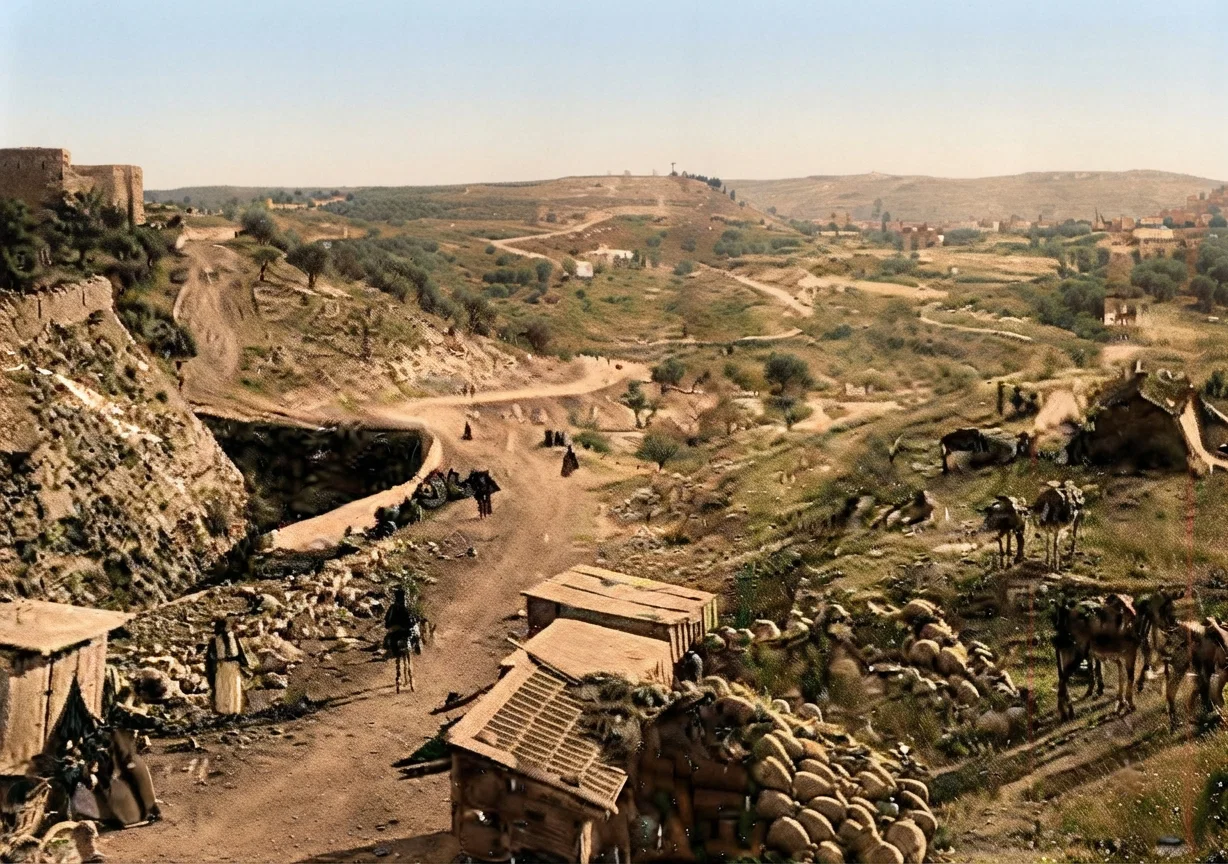
ROAD FROM JERUSALEM TO BETHLEHEM.
In the interests of Germany, the kaiser's tour was a sweeping success; in dramatic effect, it is unequaled in modern times; and it results in making Germany the most prominent and favored nation in the Orient. The emperor showed wisdom in not posing as the champion of Protestants, but as the head of German Christians of every creed, and manifested much tact in the presentation to Catholics of a piece of ground on Mt. Zion given him by the sultan. This not only augmented the rising fears of the French, but did much to make the emperor popular with his Catholic subjects everywhere.
During his sojourn at Constantinople, the emperor was usually active, visiting different parts of the city, the war harbor in the Golden Horn, the Bosporus and forts, and some places in the adjacent country. The sultan himself did not accompany his guest, as he dares not appear in public. His only movements are from his palace to a mosque near by, and from one palace to another, when he has a strong guard all along the line. During his short visit, the emperor doubtless saw more of the sultan's capital than the sultan himself has seen since his accession to the throne. The daily papers of Constantinople contained quite a number of illustrations of the imperial family, German officers, and Turkish dignitaries, but were remarkable for giving an account of the places to be visited by the emperor only after the visit was in the past.
The emperor was enthusiastically received in Palestine, specially by the German temple colonies at Mt. Carmel, Sarona, Jaffa, and Jerusalem. This was a wonderful event for these colonies. They were founded in the belief that in the literal restoration of the land of Palestine the temple would be rebuilt and the temporal millennium ushered in. Hence every move which tends to build up and make Palestine more prominent, is hailed with special joy by these colonists. They almost outdid themselves in their efforts to provide a suitable reception. The emperor's passage through the colonies was like a triumphal entry.
An interesting item in connection with this visit is the fact that Dr. Herzl, of Berlin, president of the Zionist congresses at Basel, and leader of the Zionist movement, met the emperor in Palestine and accompanied him to Damascus. A first step necessary to the success of the Zionists is to obtain permission for the Jews to settle in Palestine. Dr. Herzl sought and obtained promise of the emperor's aid in inducing the sultan to grant this permission. Altho the emperor's influence with the sultan is great, it is doubtful if he and the Zionists will succeed any better than the Roman emperor Julian and the Jews in their efforts to rebuild the temple, because the prophetic Word, which can not be broken, is against them.
To the Zionists, the Templars, and the Temporal Millennialists, the visit of the kaiser to the Orient is regarded as a step in the fulfilment of their hopes; but when read in the true light of prophecy, it only shows how the leading nations are becoming more involved in the Orient, where they will finally be gathered to the battle of Armageddon; and from this standpoint, it is a notable sign of the times, showing how rapidly and openly the way for the closing scene is preparing. H. P. H.