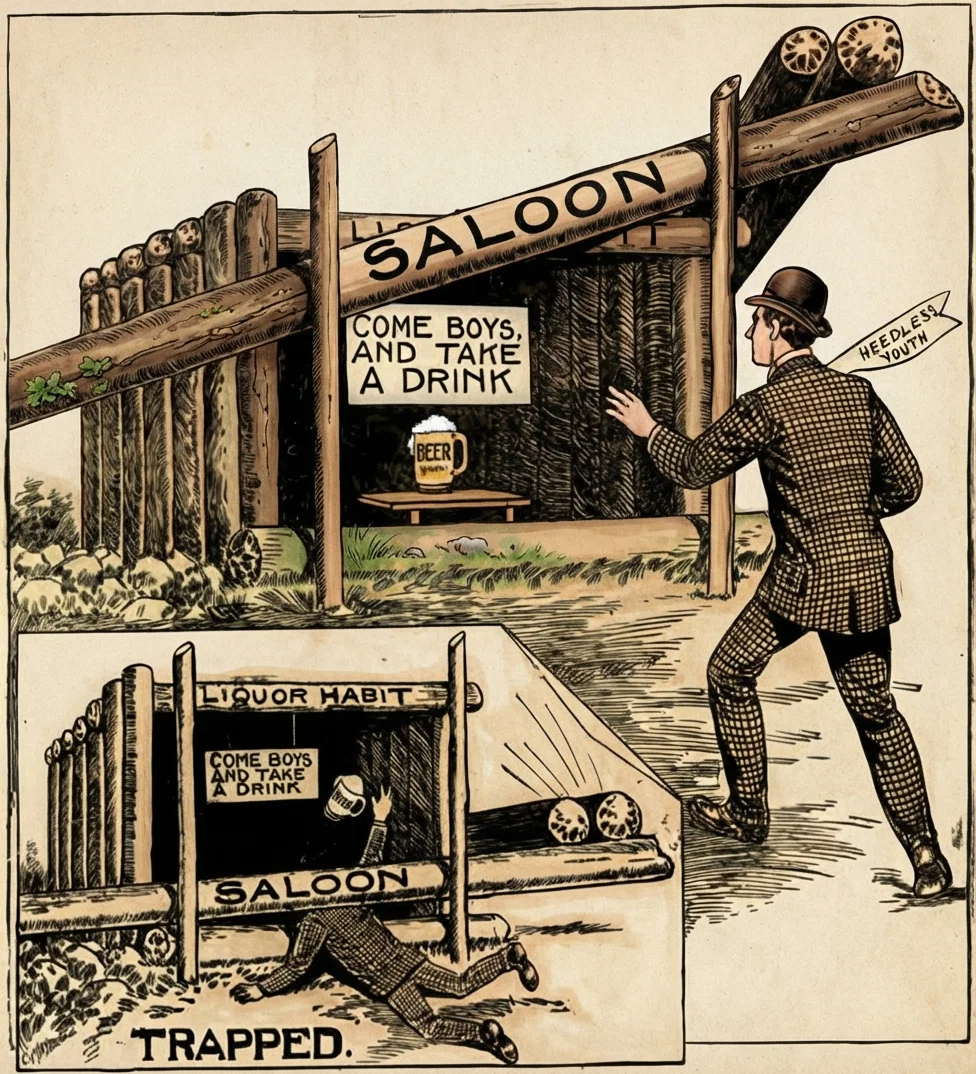
HE road to wealth, in the eyes of King Alcohol, is through the enslavement of the nation. To prey upon the weaknesses of men and to buy and sell them as slaves, is plainly designed or not fully understood by all the advocates of strong drink. The liquor lord intends to buy his automobile by selling to his weak neighbor a potion which impoverishes. And if he can not secure this advantage from his neighbor, he seeks to ensnare his neighbor's child. Thus throughout the land there is formed a great conspiracy against your boy and my girl.
We are informed that on one of the main streets of Chicago there are twenty saloons that have annexes in which to entertain children and teach them to love the liquid that is sold in the main barroom. It has been well said, "Sow a thought, and we reap an action; sow an action, and we reap a habit; sow a habit, and we reap a character; sow a character, and we reap a destiny." It is the business of those men who seek to exploit their fellow men, always to fasten upon their brothers some habit which will turn out to the schemer's advantage.
A street-car company in one of the leading cities of Oklahoma was unable to make the operation of its lines pay. So the company advertised free rides for several months. It was very convenient for the citizens, even if they were only going one or two blocks, to hail a passing car and ride free of charge that distance. But unconsciously to themselves they were forming a habit. At the end of the time advertised, the street-car company announced the end of its free rides, and charged the people the regular fare. The lines ever since have been a success, for the people of the city had formed a habit.
Away down in the tender years of childhood the agencies of the drink traffic are at work.
Neither have the distillers or the brewers forgotten the youth. In the city of Pittsburg, Pennsylvania, it is reported that the brewers have passed out amongst the school children tickets which entitle them to so many glasses of beer free of charge at certain saloons. The church desires to secure the youth; the public schools seek to mold the youth; and the saloon is fastening her ravenous eyes upon the same. The age of youth is the time of life in which to form the sentiments of the growing man; for then the mind is like wax to receive and like marble to retain impressions.
Physiologists tell us that the body is composed of a certain number of cells, which we break down by the millions through every action we perform, and which are built up again during the hours of rest throughout the night, with the tendency to perform the action through which they were broken down. Thus we run the hands lightly over the piano keys in the endeavor to learn how to play the instrument. Countless cells are broken down. As we sleep the following night these cells are restored, with the tendency and the aptitude to pass skilfully over piano keys.
The rumseller knows this. Fix upon the youth, he thinks, an irresistible thirst for drink, and we have secured to ourselves for the future the control of the man. The welfare of our homes is involved in these devices; the future lot, whether for weal or for wo, of wives and children is at stake in the contest against the liquor element. It was related by one we know, that one morning he stood on the platform of a suburban station of New York City. As he was waiting for his train he saw a lady, heavily veiled, come pushing a baby carriage onto the platform, followed by two little children. She appeared to be in trouble. He had only to wait a few minutes to learn the cause of her distress. A big express rolled in, the vestibule doors of one of the coaches were thrown open, and a gentleman came to the bottom step. The lady lifted her veil, and turning to her little children kissed them fondly. As she passed them up one by one to the gentleman, who received them and took them into the coach, she sobbed continuously. The train swept out. The lady drew down her veil, and started to leave the station with her baby carriage.
The gentleman turned to one of his acquaintances and asked if he knew the history of this case. "Why, yes," replied his friend, "of course I do. She married one of the most brilliant lawyers in the place. But the day came when he took his first glass. He became a heavy drinker, and later a pronounced gambler. He lost his practise, his business, and his standing. He consumed all his money, his house and lot, and all his possessions, on his degraded appetite, and finally in despair he committed suicide. The wife endeavored to keep the little family together in order to continue as their mother, but being forced to surrender in the struggle, she was obliged to pass on her children to a friend, who took them this morning to rear them as his own."
Such is the influence of the first drink. Such may always be the outcome of the glass when it is received. But further than that we may note for a moment what is the influence of the drunkard. An inquiry was recently conducted in the United States, relative to the heredity of good and evil qualities, by the superintendent of destitute children in the Province of Manitoba, and the following are the facts concerning the contrast presented by the descendants of two American families named Edwards and Jukes. We quote from a contemporary newspaper:
Jonathan Edwards, an honest, hard working man, was born in Connecticut, in 1703. Research made in 1900 brought to light the record of 1,394 of his descendants. Of these 13 had been presidents and 64 professors of universities, 60 doctors of medicine, 100 ministers of religion, 75 officers in the army and navy, 60 authors, 80 public officials, 3 senators, 1 vice-president of the United States, 1 president of a great shipping company, several were governors of States, members of Parliament, mayors or ministers plenipotentiary. Thirty-three American cities and ninety-two towns, outside of several foreign countries, had profited by the beneficent activities of this family, no member of which was ever sentenced for any misdemeanor.
Max Jukes, born in 1720, was an idle drunkard. Of his descendants 310 died in hospitals, 300 perished during infancy, 440 from venereal diseases, 400 became ill or infirm as a consequence of their vices, 50 were notoriously immoral, 7 committed murder, 60 passed on an average of twelve years in prison, 130 were sentenced for more or less frequent or grave offenses. None of the descendants of Max Jukes contributed to the general prosperity. On the contrary it has been calculated that this family has cost society about $1,200,000.13Happily it appears to be extinct. [It still exists. Ed. S. of T.]
Unfortunately, many times those who love most these tempted ones, unconsciously co-operate with the liquor conspirators. Many mothers, like those of Southern France, believe that their children should begin to drink wine as soon as they are born. "I hate my mother," cried a once promising young man, in one of his moments of sanity, as he was dying of delirium tremens, "for she it was who fed me on liquor from my infancy. And now my life is cursed." This is putting the child on the road to intemperance direct.
But it is in the indirect method that the home coöperates with the saloon. The liquor dealers are seeking to produce in the youth a demand for alcohol. Unconsciously many mothers are doing the same. They load their tables with spices, condiments, mustards, horseradish, and similar fiery articles such as the saloon-keeper works into the food he puts on the free lunch counter near the bar. "We must have something which will give the appetite a twist," cries the one in charge of the cooking. And the appetite gets twisted; it gets crooked. Mothers, clean off your tables of the false appetizers, then your Johns and Henrys will not seek the gilded bar to continue the process of stimulation begun at home.
The shelves of the medicine closet need converting just as much as the shelves of the pantry. You may find the soothing sirup there containing, as soothing sirups usually do, about one half grain of morphin to every two ounces of the drug. Leaving behind the natural use of the products which nature so thoughtfully provided for us in hours of extreme pain, the human race has gone to the intemperate use of cocaine and morphin in the hours of peace. Every tenth person we meet is addicted to the use of these drugs. "If thou hast run with the footmen, and they have wearied thee, then how canst thou contend with horses?"
Many statesmen and temperance reformers cry out against the sale of beer, containing two to five per cent alcohol, and yet are silent regarding those patent medicines which are charged with a greater amount than that. Alcohol coming from the drug store is just as deadly as the alcohol which comes from the dram-shops. One medicine firm is reported to use 450 barrels of whisky each week.
Another feeder to the saloon is the tobacco shop. For tobacco using is just as sure a violation of the principles of temperance as excessive drinking. Many authorities, especially in the case of the cigaret, claim that it is worse. "If ignorant smokers were not permitted," says one writer, "to blow poisonous smoke into the lungs and hearts of dimpled babies, we would save ninety per cent of all that die of infantile paralysis and tuberculosis." Tobacco fumes contain a deadly poison which is destructive to the blood-cell, and in fact to all cell life. "Bees, birds, frogs, and other small animals die when exposed to the fumes of tobacco in a confined place. Tobacco smoke causes Bright's disease, insanity, color blindness, and inclines to drunkenness even those who are hard to poison."
By these and by many other sources, the general tendency of the age is to set man in the path toward intemperance. The whole constellation of rum conspirators seem to stand forth as the one set of pirates who grow big by consuming the people of the earth. Tho they are not the only aids of intemperance which ought to be aggressively assaulted, nevertheless they are a difficult foe to dislodge. Drive the saloon interests from one position, and they soon marshal all their arguments and forces to entrench themselves in another. No license they would like; low license they long have had; and now they are battling hard to maintain themselves under the arguments of high license.
But what is their record? Chief Justice Coleridge, of England, said, "If we could close the dram-shops of England, we should do away with three fourths of our pauperism and nine tenths of the crime."
"If the dram-shop is responsible for three fourths of the pauperism and nine tenths of the crime," says the Rev. H. H. French, "then at its door must be laid the cost of three fourths of the pauperism and nine tenths of the crime. The items of cost are police courts, jails, prisons, almshouses, and asylums. Does any one imagine for a moment that a license fee, however high, meets a tithe of the expense of those items? and even if it did, would you perpetuate an evil on condition that it pay for itself? Apply this principle to murder, stealing, highway robbery, and so on, and the absurdity of it appears at once. . . . The mayor of Philadelphia comes out and declares that the saloons decreased under the high license from 5,789 to 1,340. This seems to be overwhelming. But when we consider that this Brooks law is operative in the whole State, and that there was decrease in forty counties, increase in twelve, and no change in the rest, and that in the whole State aside from Philadelphia the decrease was only 890, the result is not so overwhelming."
No argument whatever can ever justify the existence of the saloon. It is a foreign body which has thrust itself within the living organism of the State. It will never be condemned by its friends. If this foreign body is to be ejected, the work must be done by the energy of those who have been enlightened to the conditions of things.
That work can never be done, however, by easy methods, or by leaving the task to the hands of others. It will need earnest labor, it will need sacrifice, it will mean hard work on the part of those who stand as defenders of the homes and of the future of our commonwealth. But if the people of God, if those who despise the vain things which charm mostly the multitude, are to accomplish this task, they must enter into it with all their heart; they must be enthusiastic; they must bring to bear upon the issue their great moral as well as social weight. They must be in earnest, like the lad to whom a gentleman addressed this question: "How much do you weigh, bub?" "Well," replied the young boy, "ordinarily I weigh about ninety pounds, but when I get dead in earnest I weigh a ton."
Truth forever on the scaffold,
Wrong forever on the throne;
But that scaffold sways the future,
And behind the dim unknown
Standeth God within the shadow,
Keeping watch above His own.