Alcoholic Insanity

7%

Pacific Press Publishing Company · Oakland, California · Dec 16, 1897

FromSigns of the Times, Vol. 23, No. 49.

Read the full edition

Alcoholic Insanity

ALCOHOLISM.
ALCOHOLISM.
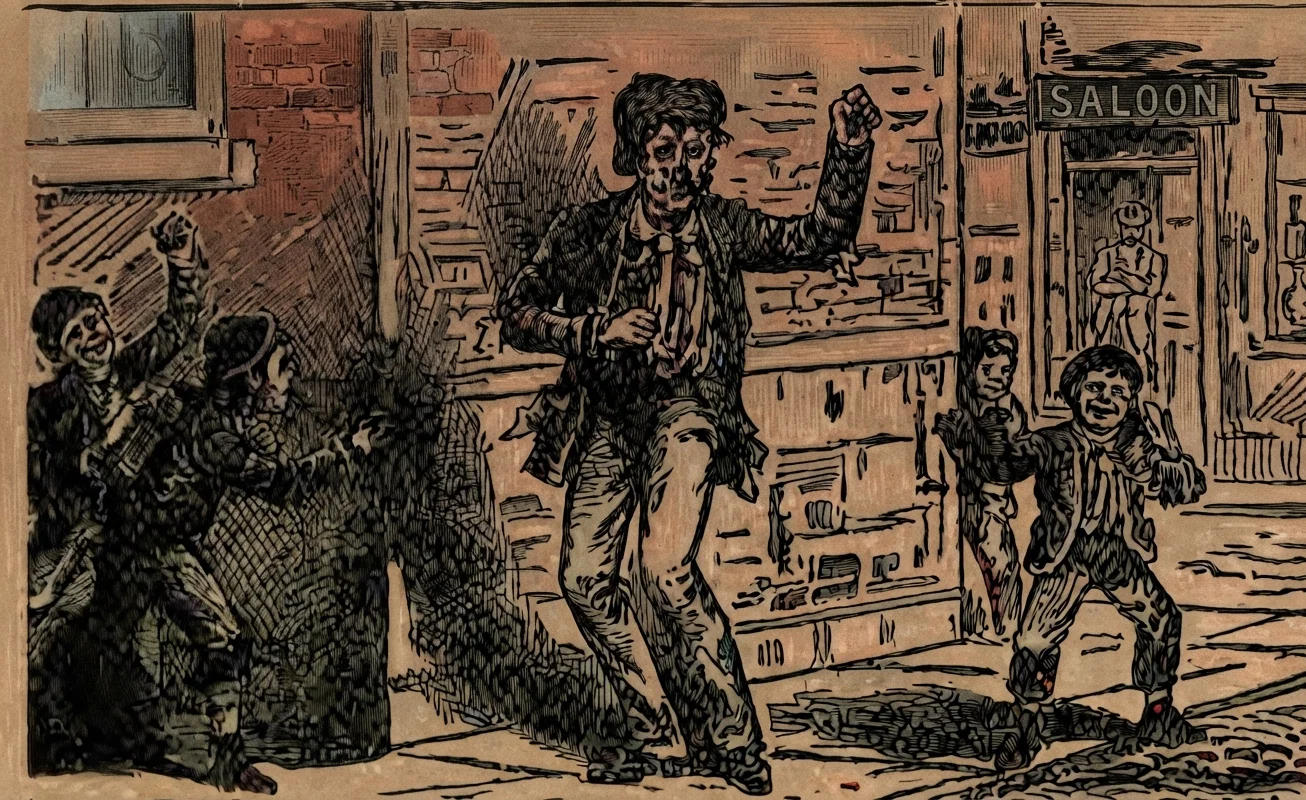
It is not necessary to tell the reader that the above picture is a representation of a drunkard. Such a man is recognized at once as a victim of alcoholism or inebriety, a vice-disease which is scarcely known outside of civilized countries, but which is recognized as a real malady, with symptoms as distinct and characteristic as those of smallpox or cholera.
We recognize the man who is afflicted with this disease by his trembling hand, his tottering gait, his bleared eyes, his haggard or bloated and repulsive visage, and his generally debased and besotted appearance. His muscles are soft, relaxed, feeble, and the subject of fatty degeneration. His stomach, liver, kidneys, heart, lungs, and other "internal arrangements," are all degenerated and demoralized as the result of his long indulgence in the poison of the cup. When he awakes in the morning, he seems to have scarcely power to raise his head from the pillow until he has had an "eye-opener" to whip up his flagging energies and goad them on to the complete exhaustion of his vital stamina. Another glass is needed to wake up his benumbed and crippled stomach sufficiently to produce a suggestion of an appetite. After breakfast, another glass is needed to digest the meal and steady the nerves for work.
So the poor fellow goes on. He may have no liking for the taste of liquor, perhaps he even loathes it; but his long use of the poison has created a diseased condition which nothing but liquor will remove, and to which the accustomed dram gives immediate and complete relief, altho each time the malady is "cured" in this way the disease strikes its roots down deeper into the constitution, and the necessity for the repetition of the remedy becomes more urgent and more frequent.
Thus the malady progresses until the victim of this disease becomes a total physical and moral wreck, and ends his wretched existence with apoplexy or delirium tremens, and is buried in a drunkard's grave.
The effects of alcoholism are mental and moral as well as physical. As the physical tone is lowered, the mental tone goes down also. The will is gradually weakened, until the victim of the disease becomes wholly a prey to the wild caprices of his depraved appetite.
A lowered nerve and mental tone implies a lowered moral tone as well. A benumbed conscience and a paralyzed will are the best possible preparation for all sorts of lapses from morality. Undoubtedly, alcoholism is responsible for a much larger share of the crimes annually committed in enlightened and civilized lands, than the majority of people suspect. A man whose instincts are naturally pure, and who has been previously a law-abiding citizen, under the baneful influence of alcohol gradually loses his respect for morality and his sense of obligation to his fellow-men. His own self-respect is lost, and he becomes an easy prey to temptations and to evil deeds of all sorts.

Alcoholic Insanity.

That inebriates are, of all classes of men, the most subject to diseases of the mind, is a fact which has been long established as a medical and scientific fact. The effect of alcohol is to produce a temporary insanity which does not differ essentially from the condition which constantly exists in the insane person. The different degrees of alcoholic intoxication exhibit in the most perfect manner all the different phases of real insanity. The man who "is fighting drunk" is the maniac. The man who is silly drunk or stupidly drunk, is the pathological analog of that stage of insanity known as dementia. A similar analogy exists between the other phases of insanity and intoxication. It is easy to see how the inebriate becomes insane. The frequent repetition of the temporary insanity of alcoholic intoxication after a time establishes the chronic condition, through impairment of the nutrition of the brain and its functions. The marvel is that a larger number of intemperate men do not become insane. It is highly probable that the forms of insanity produced by drink are far more common than is generally supposed, even by physicians. Many of these persons pass as cranks and eccentric individuals, and are not adjudged insane, simply because their insanity happens to assume some comparatively harmless form, altho they are always just upon the border line of complete mental derangement, and liable to develop the most dangerous forms of lunacy at any moment.

Hereditary Insanity.

Strange as it may appear, the worst injuries inflicted upon the mind by alcohol are not suffered by the intemperate man himself, but fall upon his children. We have in the hereditary effects of alcoholic intoxication the best possible illustration of the truth of the ancient proverb, "The fathers eat sour grapes and the children's teeth are set on edge." The statistics of insanity show beyond the possibility of controversy that the greatest number of recruits for our insane asylums come from the families of drunkards. The temporary physical condition resulting from the use of alcohol and causing temporary insanity in the parent, becomes a fixed and often hopeless condition in the child. Here is the undoubted source of a great share of the notable increase in the number of the insane which has of late attracted the serious attention of many eminent physicians and philanthropists.
The two greatest difficulties which stand in the way of the reformation of confirmed inebriates are the weakened will and the physical sufferingwhich is occasioned by the withdrawal of the narcotic poison which has benumbed the nerves and which is capable of producing a delusive freedom from pain and a seductive comfort for which nothing else is a perfect substitute. Every confirmed drunkard ought to be regarded and treated as a diseased man, a man who is infirm in body and in mind. A cure of the drink habit can not be effected without a cure of the alcoholic disease first, as in all old drinkers the disease is the real foundation of the habit and the chief obstacle to the cure.
Let every young man who has not yet become a victim of the terrible soul-and-body destroying disease, alcoholism, consider well before he exposes himself to the risk of becoming another on the list of so many thousands of victims whom it annually carries into poor-houses, prison-houses, mad-houses, and then at last to that narrow house which bears the ignominious epitaph, "A Drunkard's Grave." J. H. KELLOGG, M. D.