THERE is probably no more striking rebuttal of the claim that "this is a Christian nation" than the Indians. The claim is based on the assumption that the first white men who came from the Old World were professed Christians, and made some pretense of taking possession of the New World in the name of Christianity. But the land was already owned by people whom God had created and for whom Christ gave His life, and those professed Christians who landed on the Atlantic and gulf shores took forcible possession, not only robbing the Indians of their property, but murdering them in "civilized warfare" style when they dared to resist the encroachments of the "Christian" usurpers.
When the first European immigrants landed on the continent there were, it is estimated, about three million Indians within the present territory of the United States. How will this "Christian nation" account for them and their descendants? All that can be said is that they are dead; the powder and ball, the fire and sword, the rum and robbery of the white man have practically annihilated them. To-day there are scarcely a quarter million of them. General Nelson A. Miles, commander of the army—who has had large experience in running them from rock to tree, from plain to mountain—is accredited with saying that "the wrecks of broken promises on the part of the government are strewn all the way from the Atlantic to the Pacific." And it is well known to men of experience in the Indian regions of the West for the last half century that about all the Indian depredations and uprisings have been the result of the white man's treacherous dealings with the red man.
The Indians were noted for hospitality and liberality until the white man's treachery and cupidity destroyed confidence. No more sober people ever lived until the white man's intoxicating beverages were thrust upon them. Their laws against marital infidelity were the most rigid, and their women among the most virtuous to be found in the world, until the white man overcame their scruples by his tempting bribes. After becoming fully imbued with the idea that the white man was their inveterate foe, they deemed it the proper thing to retaliate in kind, with interest added if possible. From the Indian's standpoint it was patriotism to defend his hunting-grounds, it was heroism to kill those who disregarded his rights, and it was justice to steal from those who robbed and swindled him. A certain commanding officer once uttered the sentiment that "the only good Indian is a dead Indian," and he carried on his "protection of the frontier" on that principle. Others followed out that theory, and it was not surprising that the Indian thought the white man bad even after he was dead, showing his contempt by scalping and otherwise mutilating the dead victim of his prowess. The Indians were heathen, the white men represented a so-called "Christian nation"—but the selfsame spirit controlled both.
But the past can not be mended; what is the prospect for the few who are left? What is being done, and what can be done for them? Here is a picture that is worthy of consideration by those who are either nominally or really working for the souls of those who are generally reckoned as heathen. It is told in a paper published in St. Louis, Mo., entitled Everlasting Gospel:—
There are eighteen tribes in Arizona, and in only eleven of them is there any work being done by Protestant missionaries. California has two tribes, with three missionaries; Colorado, three tribes and one mission station; Idaho, seven tribes, with only three missions; Nevada, five tribes and one missionary. There are in California, Colorado, Arizona, Idaho, Nevada, and Utah, forty-seven Indian tribes, with populations ranging from 100 to 20,500. Twenty-seven of these tribes have no Protestant missionary; and when, with these figures, we take into consideration the fact that in the tribes where some work is being done the force is entirely inadequate, and sometimes very little of the real truth of God is preached, we see in some measure the sad condition of this long-neglected people. The United States Indian agent for the Navajos and Moquis, who has traveled extensively over their territory, states that there is not a Christian Navajo on the reservation; and after a careful observation of many months on the field, meeting and talking with hundreds of this tribe, our missionaries have yet to find the first ray of Gospel light. What an awful fact that here in our own so-called Christian land these people have lived for centuries in heathen darkness!
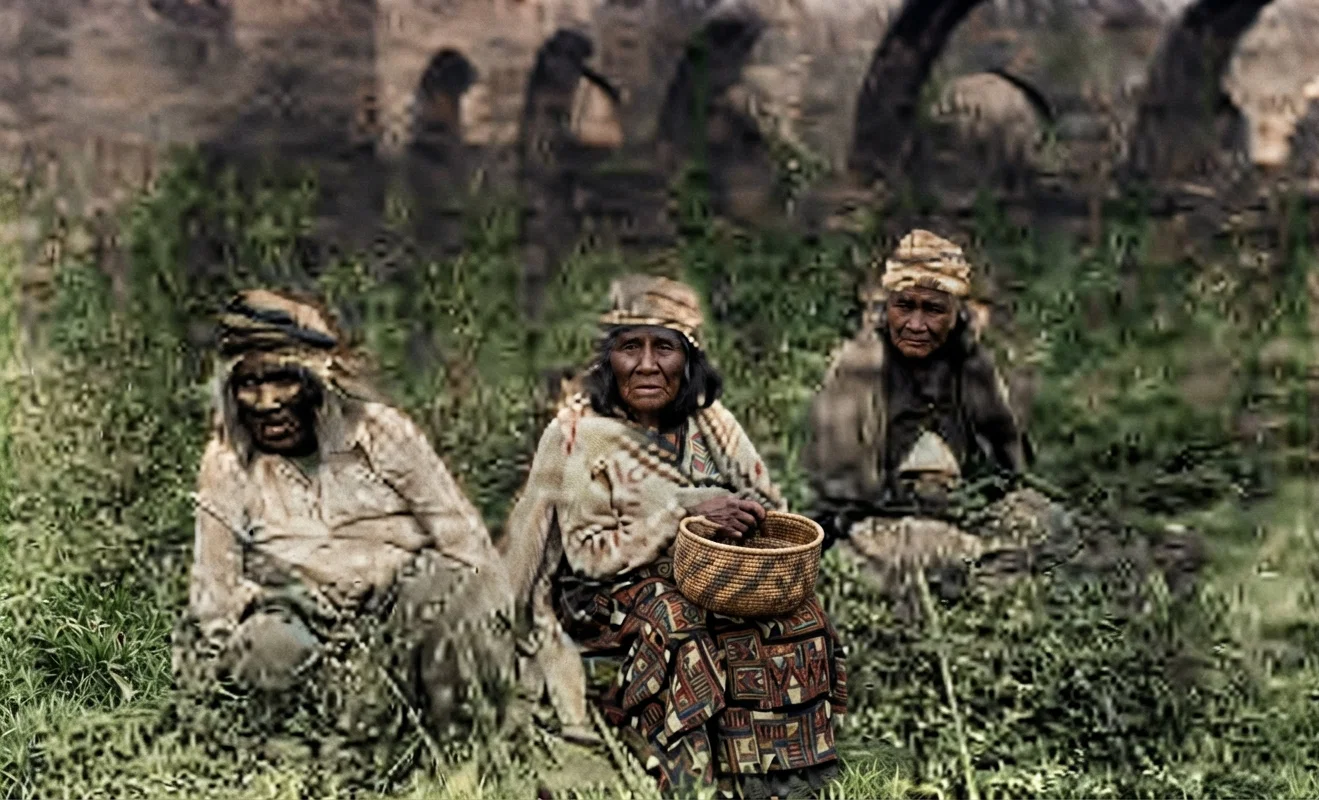
Three of the Oldest Indian Women in the United States.
Many other tribes in the United States present as dark a picture. The Moquis, located on a reservation in Northern Arizona, have three missionaries; this would seem to be an ample supply, but when the real facts are laid before us we see how misleading these figures are. They live in eight villages, ranging from one to fifty miles apart. Three of these villages have missionaries, leaving five villages without the sound of the Gospel.
The Navajos, numbering 20,500, and scattered over a large reservation, have but four missionaries, and not less than ninety per cent. of them have never heard of the provision made at the cross for the believing sinner. Some of them have heard the name of God spoken in derision and profanity, but they have no idea of what the name means, and are surprised when for the first time they have the life-giving Word unfolded to them.
This is a true picture of some of the tribes that have missionaries. What must be the awful condition of the many for whom no effort has ever been made, who for year after year have lived and died having no hope and without God!
It may be added that there are some attempts on the part of the government at conducting schools among the Indians, some of which have been good in a secular way, and some have been bad in every sense,—all of them being subject to the vicissitudes of politics, and therefore the objects of more or less speculation and intrigue. At least such have been the continual reports of men who have been in position to know. From these schools the Indians can not, in the very nature of things, learn much in the way of true Christianity. The schools are almost entirely compulsory institutions; that is, the children are compelled to leave their homes in order to attend them. The idea seems to be that it is necessary to keep them away from their parents as much as possible, until they become as nearly like the white people as is at all practicable. This is the false idea of civilization, as it is also too much the false idea of Christianity in the meager attempts to teach them about Christ and11the Gospel. One of the worst evils of their education is that the white man is made the standard, and the pupils come too near the goal in its worst features. The results of such work are to lead the young away from their parents, with their minds imbued with feelings of superiority. They are fitted to take advantage of the uneducated ones in their tribes, rather than to be to them examples of profitable progress. And whatever of religious instruction comes to them through the medium of government support or control can hardly fail to be mixed with the Church-and-State spirit.
If there is a class of people, at home or abroad, to whom those priding themselves on their American citizenship are indebted, it is the Indian class. And as Christians, there are none who have higher claims upon our Christian charity than those who have fallen among thieves in our very midst. W. N. GLENN.