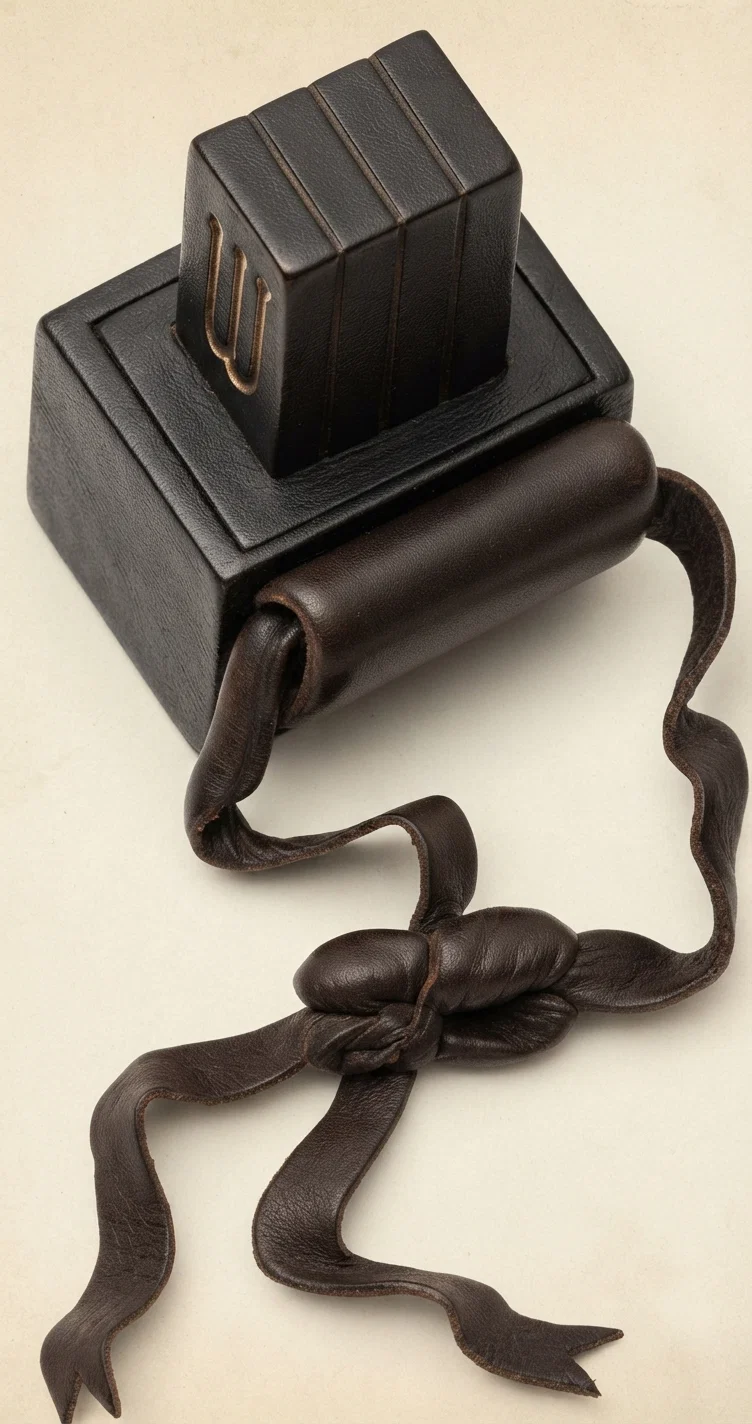
THE Saviour not only branded the scribes and Pharisees as hypocrites for widening the borders of their "garment," but included the broadening of their phylacteries as hypocrisy also. There is no scripture for this latter custom, neither does Jewish literature mention it till the existence of tradition and rabbinism. The rabbis based their claim for this custom from the following scriptures: Ex. 13 : 9, 16; Deut. 6 : 8; 11 : 18; and since the law of interpreting the Bible was committed to them only, their decision as to the meaning of these texts was final.
After protracted disputations in the various schools as to what should compose these objects, as well as their usage, the Pharisees and Sadducees agreed upon the material, tho they differed somewhat as to the manner of wearing them. The phylacteries were made of two parts, one for the head, one for the hand, to fulfil the literal meaning of the Scriptures. Their composition was from the same kind of leather as the animals used for sin-offerings. The leather had to be spotless, as these things were largely designed to take the place of the offerings in those days, and since the time of Christ they are altogether used as substitutes. To make these, special men, who were more holy than the rest of the people, and who supplied themselves with special tools, were chosen. If, after the leather was cut, and the strap rounded, the least imperfection should be discovered, it was pronounced defiled, and must not be worn. They strained at a gnat.
For the one worn on the arm a strip of parchment was taken, and with special ink four passages of Scripture were written thereon. These were Ex. 13 : 1-10; 11-16; Deut. 6 : 4-9; 11 : 13-21. In all these passages, it will be observed, the four texts are found which mention the binding upon the hand, as it is written, and as the frontlets to the eyes. This was inclosed in a small square case of thick parchment, which was covered with a black preparation, and to which6was attached this leather strap, to be fastened around the arm, between the biceps and the fingers. The one for the head was arranged differently. Instead of the parchment being of one piece, the case was divided into four partitions, each one having one of the above-mentioned passages of Scripture. This was also covered with the preparation, and fastened with the leather straps on the forehead between the eyes and at the base of the brain; or, as the rabbis say, "at the pulse of the infant's brain."
These things were worn by males only, after reaching the age of thirteen. They were used in connection with the garment at the morning service, hence are called "tephillin, or prayer-fillets." They are used every morning, save upon the weekly Sabbaths and the annual or festival sabbaths. The reason for this is because the rabbis teach that these are used as a "sign." See the first four verses mentioned. But the Lord also gave them the Sabbath to be a "sign." Ex. 31 : 13, 17. Since he designed the Sabbath to be a sign for a special purpose, and these things to be a sign for another special purpose, it is not necessary to have two signs at the same time. Hence the phylacteries are for a sign the six working days; the Sabbath, a sign for the seventh day, the birthday of creation.
The importance and significance attached to these was in the manner of their use. First the "garment" was to be worn. After this was done, then prayer was offered for the wearing of the phylacteries. A long prelude being ended, the left coat sleeve is removed, the following prayer made:—
Blessed art thou, O Lord, our God, King of the Universe, who hath sanctified in his commandments, and hath commanded us to wear tephillin, or prayer-fillets.
When the square case parchment is placed upon the biceps, inclined toward the heart. The reason for wearing this upon this place and in this position is recited as follows:—
And commanded us to wear upon the hand (or arm) to remember the outstretched arm, and the giving of our strength; and the reason for it being opposite the heart is to indicate by this that the desires and thoughts of our hearts are to be dedicated to his service, blessed be his name.—Daily Prayer Book.
The strap then fastens the parchment, and is folded around the arm seven times, from the elbow to the fingers. The reason for this number is because it represents perfection. The one for the head is next worn, and the following prayer offered:—
Blessed art thou, O Lord, our God, King of the Universe, who hath sanctified in his commandments, and hath commanded us concerning the good deed of tephillin.
And the reason for their position is stated as follows:—
And upon the head, opposite the brain, because the soul which is in my brain, with the rest of my faculties and their strength, all shall be placed upon thy service, blessed be his name; and the merit of the good deed of the prayer-fillets shall be effectual to me, bringing to me length of days, the merit of holiness, holy thoughts without the curse of sin, nor the abundance of iniquity. . . . And the evil imagination shall not have dominion over us, but will give us rest and comfort, to serve the Lord as it were, with all our hearts. And let it be as acceptable in thy sight, O Lord, our God, and the God of our fathers, that the worthiness of the good deed of wearing the prayer fillets, as tho we had established every point in all the teaching, . . . and as tho the whole six hundred and thirteen commandments hung upon it. Amen.
By this prayer will be seen the amount of merit attached to the wearing of these man-made objects. First, they are claimed to be given from heaven, hence the prayer for them must come as a command of God. Then the arrangement is so ordered as to indicate every step of the way one feature of righteousness is added. To illustrate: The garment is first put on to cover the man with righteousness. The phylactery is then placed upon the biceps, facing the heart, to show that it is with the whole strength the worship is performed, as well as coming from the heart. Such worship, if rightly performed, ought to bring perfection. Hence the straps are wound around the arm seven times. But, in order this latter trait may be obtained, knowledge is necessary, hence the position on the seat of the brain. This, however, must not be done for a short time only, hence it is tied to the forehead to always keep the things in remembrance. Thus the man is clothed with all things necessary to make him a righteous, holy, and perfect man.
We will now notice where the hypocrisy came in that the Saviour condemned. The rabbis reasoned this way: These things are designed to make men good, righteous, holy, etc. Now, if a man should wear only narrow strips of leather and small cases of parchments, it would indicate that he was not a very righteous man, but was simply doing those things because he had to. But if he really is a very good and pious man, he will make the squares large, and the cases broad. We then shall know who are the very righteous and who are not. Hence the terrible condemnation of Jesus against these things.
It is doubtless partly to these things that the apostle Paul has reference when he says that the Jews were ignorant of God's righteousness, and went about establishing their own righteousness, at the same time thinking they were having the righteousness of God. But Christ is the end of the law for righteousness to every one who believes; and in him we find our all in all things, for in him we are complete. Rom. 10 : 1-4; Col. 2 : 10.