LIQUID AIR

5%

Pacific Press Publishing Company · Oakland, California · Apr 12, 1899

FromSigns of the Times, Vol. 25, No. 15.

Read the full edition

LIQUID AIR.

What It Is and What It Does.
IT has been left for the closing years of the nineteenth century to see the discovery and application of one of the greatest, the simplest, and most abundant forces that the storehouse of this world has ever yet unlocked to us. It is a hitherto unsuspected and untamed power of the air. Its discovery is recent, and the taming and harnessing process is going rapidly and successfully on. I refer to the latent power of liquid air.
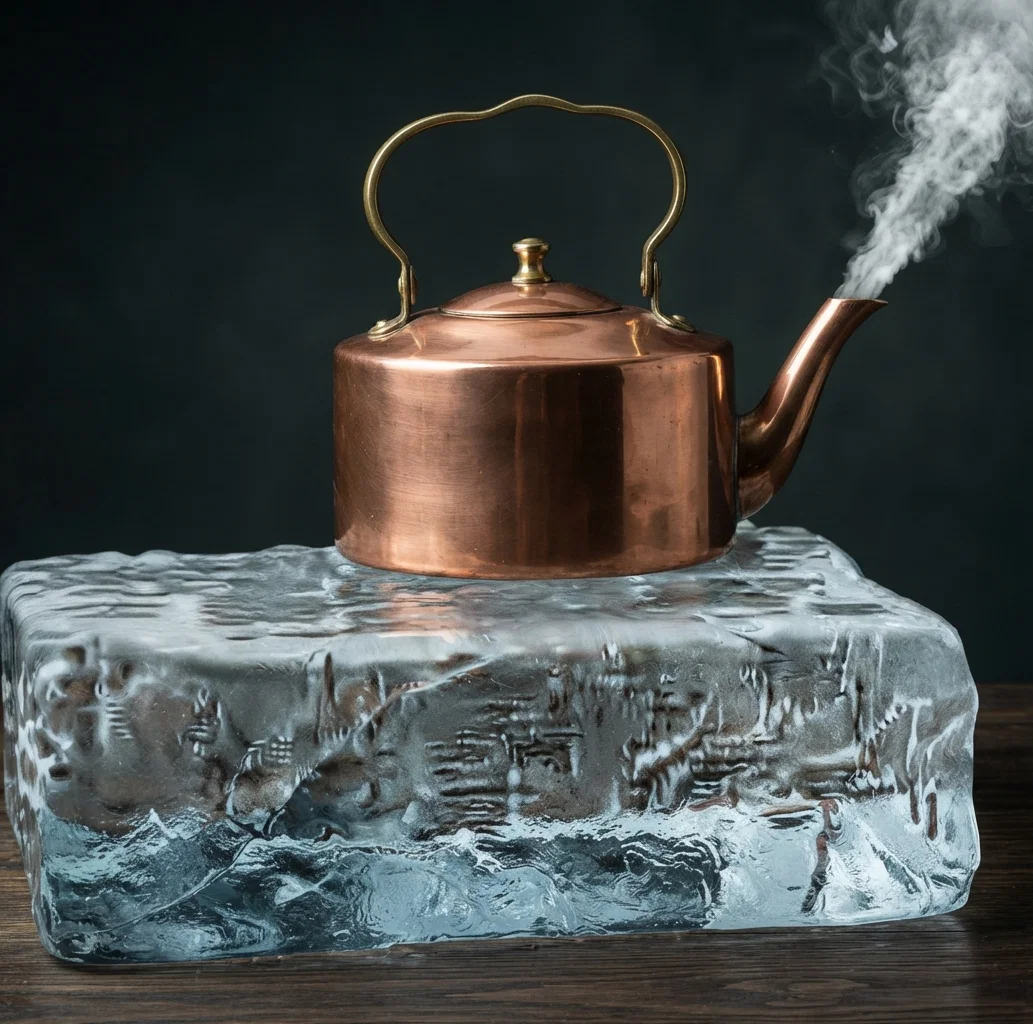
A kettle containing liquid air at 312° below zero, boiling on a block of ice. The temperature of ice is 32° above zero. There is therefore a difference in temperature of 344°.
The world, which is supposed to be extremely wide-awake at the present time, is just now really waking up to the immense possibilities in the application of this marvelous force. Had it been discovered a century ago, the world could scarcely have made any use of it whatever. No machinery was at that time in use, or in process of construction, in which it could be used. It would have been a case of a great power entirely inert on account of the deficiency of mechanism. The taming and utilizing of the power of steam and of electricity have caused that marvelous advancement in the field of mechanics which has made this century the peer of all others, and given to liquid air the opportunity required to make manifest its power and its possibilities.
Among the interesting things science has revealed within the last five years in regard to our atmosphere are the number of gases it contains; its mechanical utility when under high pressure, and the fact that it can be transformed into a liquid with marvelous inherent power. It was only a few years ago that the air was supposed to contain but two gases, oxygen and nitrogen, with the occasional accidental presence of carbonic acid gas. Chemists have since discovered that it contains the gases known as argon, helium, krypton, metargon, and neon, and a trace of other gases. Twenty-five years ago scientists taught that air was a gas and could be made nothing but a gas. They had subjected it to enormous pressure, but they could not transform it into either a solid or a liquid. In 1877 Raoul Pictet, after many experiments, succeeded in obtaining a few drops of liquid oxygen. In 1892 Olzewski, a Polander, succeeded in liquefying nitrogen, the other principal element of air, but only in very small quantity. Prof. James Dewar, of England, succeeded about the same time in reducing both these gases to a liquid form, the first that he produced costing about $3,000 per ounce. Its manufacture at this time, however, was only a costly experiment, so costly, indeed, that it could be of no commercial use—the experiments simply proving that air could be liquefied.
For a number of years past, air under pressure has been a serviceable agent in the operation of certain machinery in workshops and elsewhere, also for the propulsion of vehicles to a limited extent. In machine shops compressed air operates steel drills, lifts heavy castings and cumbrous rolled sheets of steel and iron, runs calking machines, and heads heated rivets; but for this purpose it has to be compressed by powerful engines, sent through strong tubes to the machine it operates, and must be entirely dependent upon the compressor of the steam engine.
But air is destined to be of more independent utility to man; and this comes about through its transformation into liquid form, which was not possible, except at great expense, until within the past year. Chas. E. Tripler, of New York, who has been studying and experimenting along this line for the past eight years, has so perfected his liquefying apparatus as to be able to produce, from a single machine, liquid air at the rate of five gallons per hour. When it is understood that it requires eight hundred cubic feet of ordinary air to produce one cubic foot of liquid air, one can realize something of the problem involved in its manufacture. In other words, the atmospheric contents of a room ten feet square and eight feet high are cooled, compressed, and condensed into one single cubic foot, and that is liquid air.
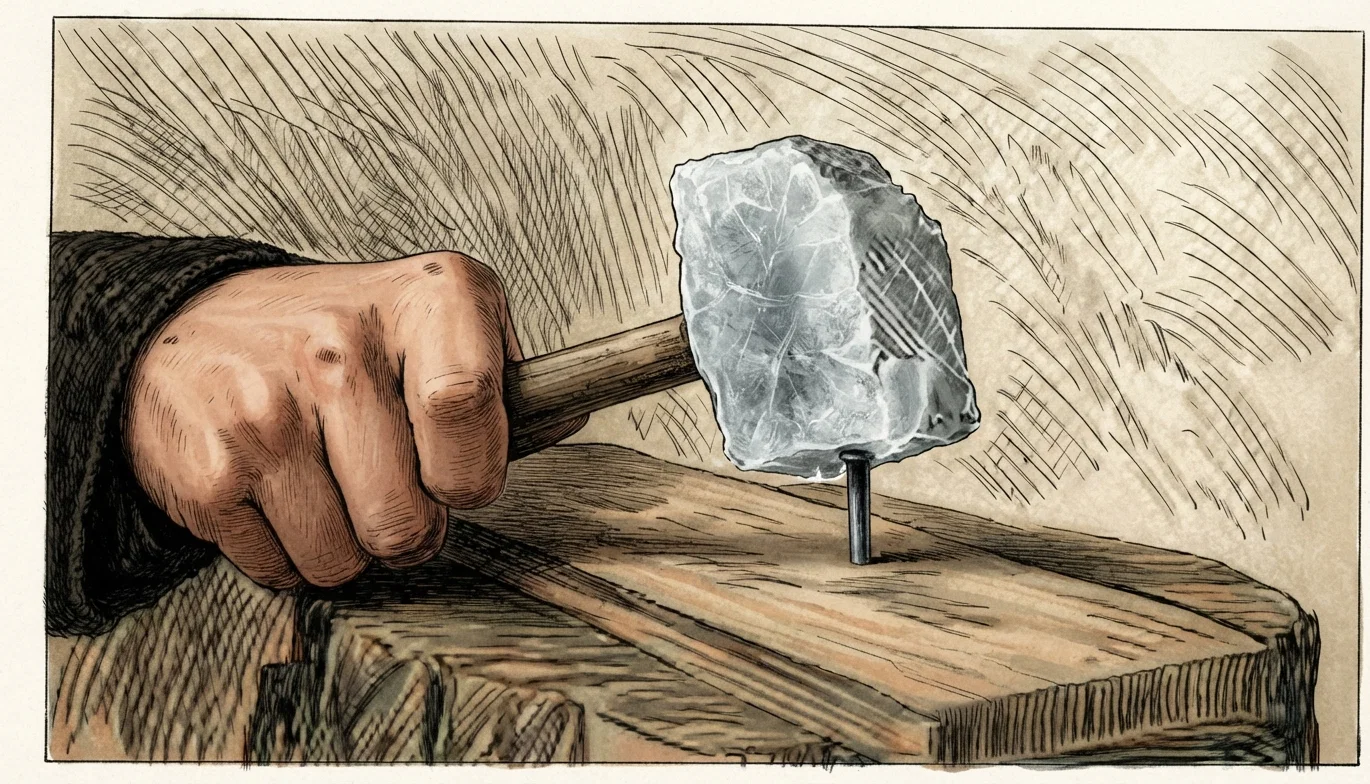
The temperature of air when thus transformed is 312° below zero, or 344° colder than a block of ice. One is not able to comprehend the intensity of such cold. Mercury, which freezes at only 40° below zero, becomes as hard as iron after being immersed for a few seconds in liquid air. Mr. Tripler has fitted a handle into a block of mercury thus frozen, and driven nails with it. Alcohol, which freezes at 212° below zero, becomes solid ice when poured into a tumbler of liquid air. It is so cold that it will even freeze iron, and make it as brittle as glass. Gold and silver, after immersion in this liquid, become soft and pliable in the fingers.
Driving a nail with a hammer made of mercury frozen in a dish of liquid air. Mercury freezes at 40° below zero.
It is difficult to think of ice as being hot, and yet in comparison with liquid air, ice is as hot as a glowing furnace. A kettle containing liquid air is placed upon a block of ice, and thekettle sends forth a jet of 'steam-air' with as much force as real steam is ejected from the spout of a teakettle placed over a blazing fire. The temperature of the ice is so much higher than the liquid air that the ice actually compels the liquid air to boil.
Liquid air can not be confined. Its expansive force is so great that it must have vent as it is gradually boiled away by the heat in the surrounding air. Herein lies the secret of its utility in operating machinery. Its gradual transformation back into gas (or ordinary air) is to-day driving successfully the piston of a ten horse-power engine, and at the same time operating machinery to produce more liquid air. Three gallons of liquid air will operate an engine a sufficient length of time to produce ten gallons, thus leaving a surplus of seven gallons from each three gallons used.
The power of liquid air as an explosive has not yet been definitely determined, but enough has been learned about it in this line to show that its force is tremendous. It can be seen that this must be so from the fact that as a gas it occupies eight hundred times the space it did as a liquid. Ordinary felt or wool saturated with liquid air and ignited explodes with the force of guncotton.
An icicle of alcohol frozen in a cup of liquid air. Alcohol freezes at 212° below zero.
All these experiments and findings are interesting from the standpoint of curiosity; but the progressive man of this practical age asks, 'Of what service is it?'
The inventor of the liquid air engine asserts that what it has accomplished on a small scale in operating his ten horse-power engine it will do on a larger scale with engines of the greatest horse-power; and there seems no real ground for denying his assertion. It is within the realm of the most apparent possibilities to anticipate that erelong it will be driving the propellors of ocean liners, the pistons of locomotives, factory engines, and pumping plants, and turning the wheels of street-cars and other forms of horseless vehicles. The inventor's claims may yet be realized in the matter of being able to supply war ships with plants for making their own liquid air to propel themselves from port to port, to use it in the place of powder for firing their guns, and in the place of dynamite, guncotton, or powder in the shells themselves, which would explode with terrible force against the sides of an opposing war ship. In addition to this service it would be used for cooling the guns in action, which would be one of its most important features in connection with the business of war.
Its use is not restricted to the field of mechanics and explosives. The intensity of its cold makes it exceedingly valuable as a refrigerating agent, and it is being used for that purpose. It will freeze a slice of beef so solid that it will ring like metal when struck with a hammer, and can be ground up into a fine dust. As liquid air is absolutely pure, physicians will use it extensively for cooling and purifying the air of sick-rooms and hospitals. No germs will be able to live in its freezing temperature. Surgeons are already making use of it in cauterizing sores and wounds, for which work it is much better than ordinary cauterizing fluids, as its action can be more easily controlled. It will eat out diseased flesh quickly and safely.
It seems evident from the progress thus far made that liquid air is to be the power of the future; and the simplicity of the apparatus required for its manufacture will make it almost an inexpensive power. Imagine the saving of expense in the production of power when neither coal nor wood are used
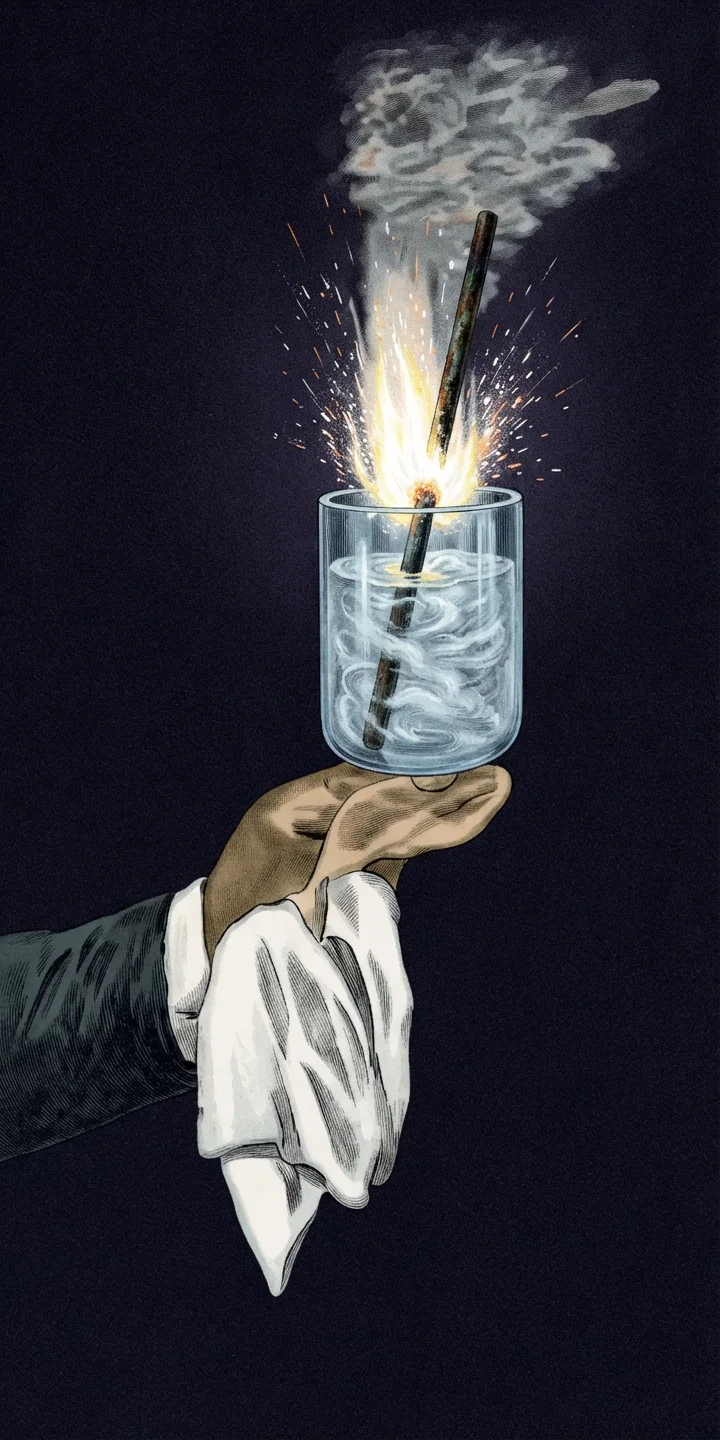
Steel rod burning in a cup of liquid air. Steel burns at 3,500° above zero. This great temperature is obtained by having a lighted match attached to the steel rod when it is immersed in the liquid air.
—liquid air producing liquid air, and that in turn furnishing power to drive all our machinery, propel our vessels, drive our carriages, cool our rooms, furnish our electric lights, freeze our food, and fire cannon. Verily, Roentgen rays, wireless telegraphy, and liquid air have crowned the brow of this miracle-working century, and are fast fulfilling the prophecy of God's written Word that at 'the time of the end many shall run to and fro, and knowledge shall be increased.'
C. M. SNOW.