ABOUT THE ISLAND OF JAMAICA

4%

Pacific Press Publishing Company · Oakland, California · Aug 23, 1899

FromSigns of the Times, Vol. 25, No. 34.

Read the full edition

ABOUT THE ISLAND OF JAMAICA.

JAMAICA is not a large island; its greatest length is only 150 miles; while the greatest breadth is 50 miles. It is 90 miles south of Cuba in a direct line from the point of Florida. The area is 6,400 square miles, it is traversed from east to west by a heavily-timbered ridge of mountains, called the Blue Mountains, the highest of which is 7,000 feet. From this range seventy streams descend to the north and south shores; only one of the rivers is navigable, the Black River, being navigated by small craft thirty miles into the interior. Excellent harbors are everywhere.
The climate varies considerably—the torrid belt of the coast gradually merging into the temperate of the central heights. The population has doubled since 1861; over one-half of the births are illegitimate. Within a few miles of each other are the principal towns, Port Royal, Kingston, and Spanish Town, which contain the larger portion of the population. Twenty miles in the interior there are many settlements without any married people,—both sexes associating together indiscriminately; this accounts for the large number of illegitimate births. The children go about nude. The religion of the natives is favorable to the above manner of living.
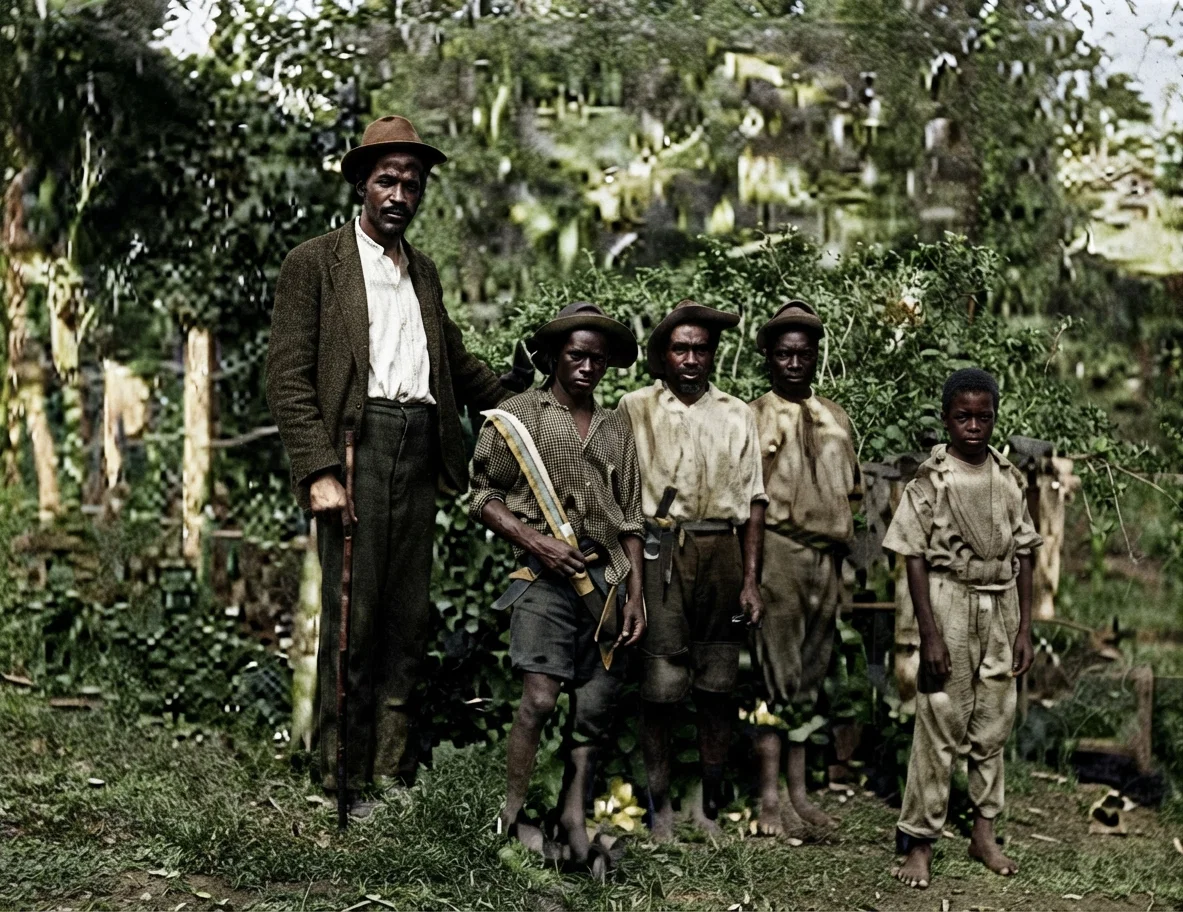
Typical Natives of Jamaica.
It is said that it is not safe for a white man to penetrate to these localities, principally on account of the prevalence of drunkenness. The natives come into possession of but very little money, but what they do get finds its way immediately to the liquor dealer; they will barter anything for the accursed drink.
Jamaica is the most important of the British possessions in the Antilles, but there is a growing sentiment that the United States' control of the island would be more in harmony with their wishes in the matter. The Church of England is the church of the island.

Products.

In the products of a country we see God's most munificent endowment to mankind. And as nature regulates the products of all countries, the products of Jamaica would consist of what was peculiar to all tropical climes, such as the mango, guavas, tamarinds, oranges, figs, bananas, coconuts, lemons, peppers, and spices. Pimento, or Jamaica pepper, a well-known spice, is the dried fruit of a tree, which grows twenty to thirty feet high, and has oblong leaves four inches long, of a deep green, and numerous white flowers, followed by berries. The pimento tree is much cultivated, and, with its straight trunks and branching heads, covered in July with an exuberance of flowers, which diffuse a rich aromatic odor, is very beautiful. The leaves and bark partake of the aromatic property for which the fruit is valued. The fruit, when ripe, is filled with a sweet pulp. The berries are gathered and dried in the sun. When dry they are packed in bags for the market, and so we have what we call "all-spice." Pimento, or as we call it, allspice, is not alone used in cookery, but also as a medicine, classed among the stimulants. Oil of pimento is used to relieve toothache.
We often hear of lemons from Sicily and oranges from the Antilles; Jamaica oranges are the finest in the world.
The name "Jamaica" is a translation from an aboriginal word meaning "land of wood and water." I can faintly picture Columbus as he sails up to this beautiful tropical garden in mid-ocean in the quiet evening, beautified by the hush of the slowly-sinking sun in the hazy west, on that memorable spring day of May 3, 1494. How the hearts of all that were housed by the narrow confines of his olden-time caravels must have leaped for joy at the sight of such luxuriance! Its wild jumble of mountain ranges, separated by pleasant valleys, epitomizes all that makes Jamaica the land of beauty and romance.
The dominant feature of this corner of the world is its tropical growth. The mystic hues of Jamaica's wooded slopes, shifting from steel gray to delicate amethyst, are most enchanting. To stand on the summit of the graceful forested mountains and view the environment of rounded mountains, or towering bluffs, which seem to meet the sky, would be indeed a pleasure we would all enjoy; but however wild and noble the mountains, however graceful their rounded contours or abrupt their formidable cliffs, the scene presents no feature so charming, so full of grace and matchless finish, so warm with that quality which only the human touch can give as the homes and plantations and towns of the people who have sought their fortunes here. The people cultivate their provisioned grounds with care, and produce for sale enough sugar to obtain a considerable supply of imported and manufactured articles. Extreme poverty is unknown.
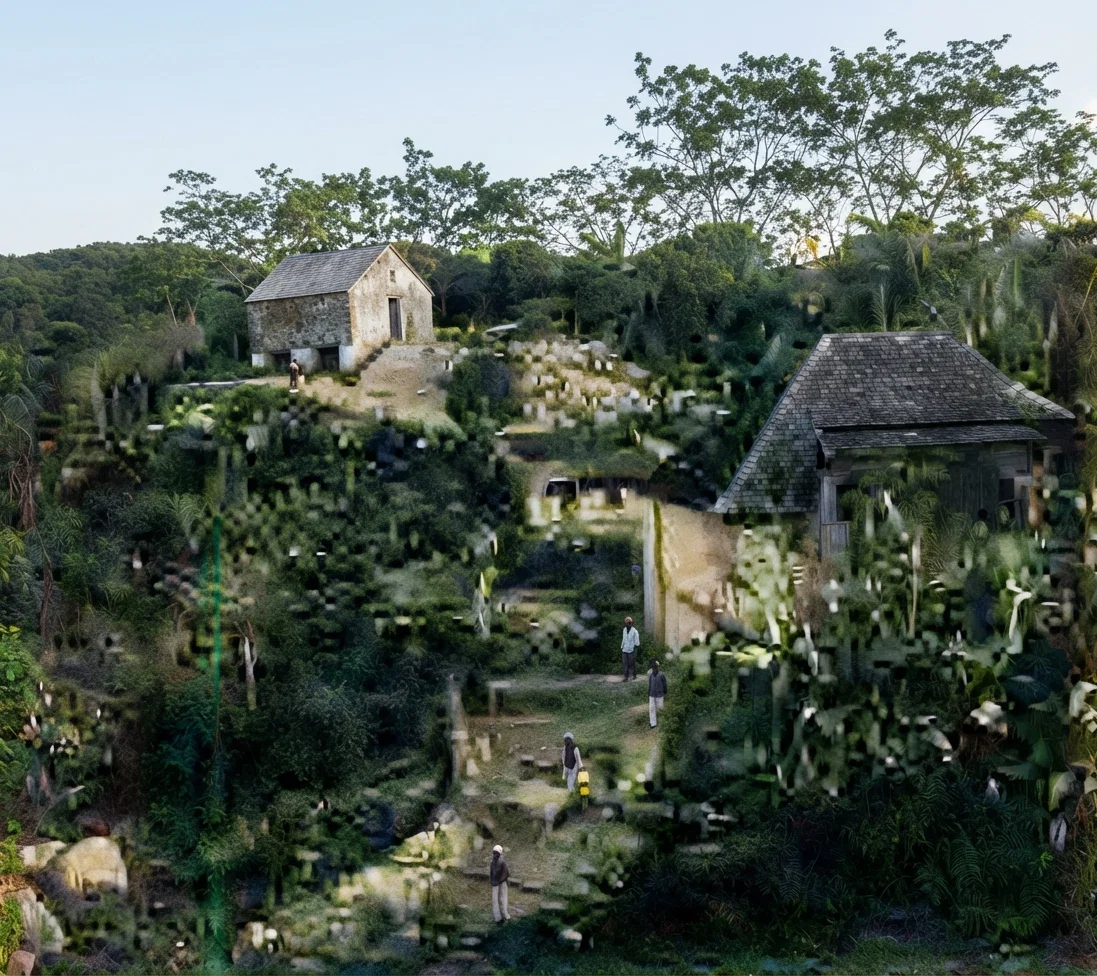
The First Chapel in Jamaica, built under the supervision of one of our missionaries, Brother C. A. Hall, lumber for which was carried by natives over the mountains. Below the chapel is a shop, once the home of Brother Hall.
Well-informed and experienced visitors to the island have strongly recommended energetic young Englishmen to take their capital to the highlands of Jamaica.
The pineapple—the flavor of which we Americans like so well,—must come in for its share in this paper. Strange it is, indeed, that the natives have what we call a boycott on the fruit. I suppose they have learned what we should, that it is very indigestible.
The country is well watered; the soil is rich, even in the hilly districts. It yields bounteous crops of sugar-cane, coffee, tobacco, maize, and sweet potatoes. The forests produce palms, mahogany, ebony, cedar; in short, Jamaica produces all the fruits and vegetables of a tropical climate. Live stock is profitably raised also. Salt to the extent of 2,000,000 bushels is annually raked. In 1890-91 the products of Jamaica amounted to $9,514,000.
A collection of Jamaica's products was exhibited at the Philadelphia exposition, thirty-one awards being obtained by the island.
The country has had some reverses, notable among which was the cyclone, which swept the island in 1880, doing damage of upwards of $5,000,000. The tendency of these was to check the cultivation of its natural fruits. The island is, however, resuming its old-time luxuriant appearance. Indeed, the Antilles are the gardens of the Atlantic. Since Adam's sin in the Garden of Eden the earth has been losing its beauty in landscape, and the quality of its productions. In some parts of the world the image of God is entirely blotted from the face of the earth, but we know from the Word that the kingdom is to be restored. The West Indies are a faint example of what the earth restored will be."The wilderness and solitary place shall be glad for them; and the desert shall rejoice, and blossom as the rose. It shall blossom abundantly, and rejoice even with joy and singing; the glory of Lebanon shall be given unto it, the excellency of Carmel and Sharon, they shall see the glory of the Lord, and the excellency of our God. . . . Then shall the lame man leap as an hart, and the tongue of the dumb sing; for in the wilderness shall waters break out, and streams in the desert. . . . And the ransomed of the Lord shall return, and come to Zion with songs and everlasting joy upon their heads; they shall obtain joy and gladness, and sorrow and sighing shall flee away." Isaiah 35.
Thank the Lord for these promises! how they cheer our hearts! In that glad day may it appear that we have acted well our part here in this world, and may the blood of Jesus our Saviour cleanse us from all sin, and we at last reach that beautiful land.

Our Mission Work.

Considering that our work started in Jamaica in 1893, encouraging results are manifest. At the present time there are sixteen churches, with a membership of 500, and there are several church buildings erected and occupied by Sabbath-keepers. There is also a school in operation at Bonacca; there are many openings for school and church work. Our work is facilitated by having the little ship Herald.
The first Seventh-day Adventist chapel on the island was made in the primitive fashion, that is, with wattled walls, made of bamboo split and woven together. The roof was thatched with coconut leaves; an enemy set this on fire, and it was burned. They erected a more commodious and substantial chapel on the same spot, but it is now far too small, and they expect to erect a larger one soon. At Spanish Town there is a brick Seventh-day Adventist church.
The Sabbath-school membership for the island is 646. Four ordained ministers, one licentiate, and one native Baptist minister who received the message, are engaged in the work. Canvassers are having good success. It seems that the harvest is ripe in Jamaica, as well as elsewhere, but where are those consecrated to reap?
HERBERT LESLIE CARLISLE. Oakland, Cal.