Liberty

2%

Pacific Press Publishing Association · Mountain View, California · May 21, 1912

FromSigns of the Times, Vol. 39, No. 20.

Read the full edition

Liberty

A Most Valued Right

By W. A. Colcord
Questioner.—“Why do you make so much of the subject of liberty?”
Answer.—Because liberty is the natural and most desirable condition of life. As regards itself, every created being loves liberty, and is naturally restive and unhappy under restraint. The Bible has much to say on the subject of liberty, and speaks of “the glorious liberty of the sons of God.”
Questioner.—“What is the opposite of liberty?”
Answer.—Bondage, servitude, slavery, intolerance, persecution, and oppression.
Questioner.—“Did God intend that this condition of things should exist in the world?”
Answer.—No; God is everywhere in the Bible represented as opposed to bondage, slavery, and oppression. He sent His Son into the world to set men free, and to all believers in Christ comes the exhortation, “Stand fast therefore in the liberty wherewith Christ hath made us free.”
Questioner.—“What then brought about all the bondage and oppression that have been in the world?”
Answer.—In a word, sin. Sin is a violation of right principles; an infraction of the rules of right and justice; a transgression of the royal law, “the law of liberty.” Sin means selfishness, and selfishness is responsible for all the intolerance and oppression there have been in the world. To the extent, therefore, that sin is eradicated or subdued, intolerance and oppression cease.
Questioner.—“What is the cure or antidote for sin?”
Answer.—The Gospel. The Gospel is the power of God unto salvation from sin. It is the antidote for sin. It crucifies self, and thus uproots and destroys selfishness. In the place of selfishness the Gospel implants in the soul the principle of love,—supreme love to God, and equal love to fellow men. The Golden Rule becomes the governing rule of conduct, and equality of rights an axiomatic law and a universally recognized principle.
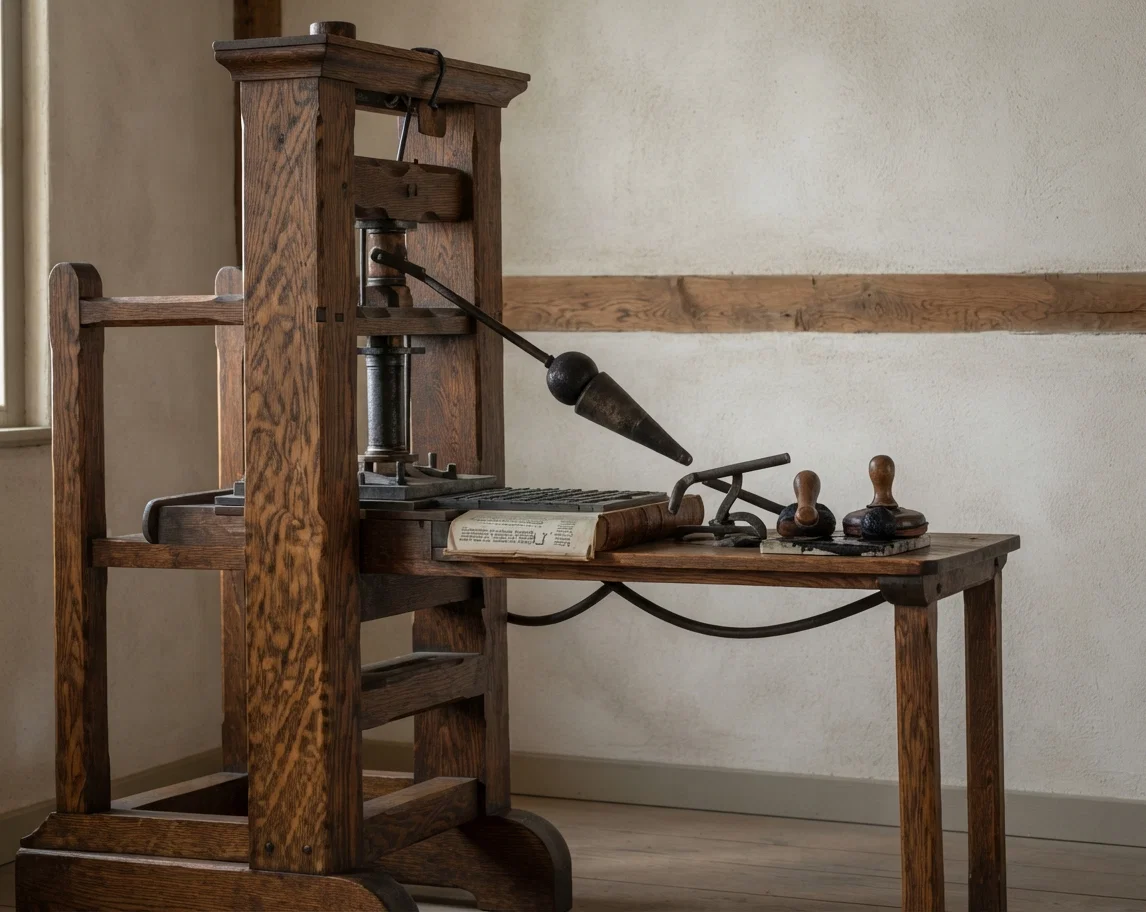
The old Ephrata Press, owned by German Seventh-day Baptists, on which the Declaration was printed
Questioner.—“Where has there been the most liberty?”
Answer.—Where the Gospel has been most accepted.
Questioner.—“How, then, do you account for the fact that where there has been the greatest profession of Christianity, there has been the most persecution and oppression?”
Answer.—This has been well answered by the following from the Christian Oracle of July 20, 1893: “Civil liberty springs from religious freedom. Christianity tends to make men gentle and obedient, patient and forbearing, willing to concede to all their just rights; and it employs persuasion and truth to accomplish its ends. But A PERVERTED CHRISTIANITY stirs up envy and rivalry among the clergy, who contend for precedence and power. Under such influences, they impose shackles upon men’s minds by decrees of councils; they abridge the rights of private judgment, make civil government the subservient instrument of spiritual tyranny, and thus destroy civil liberty.
“It should be remembered that these efforts to make the State subservient to the interests of the church, have always proceeded from the clergy and from politicians, and not from the people. At the same time it is remarkable with what readiness the people often fall in with the propositions of their religious leaders. People seem to forget that Christ’s kingdom is not of this world, that the weapons of our warfare are not carnal, and that neither Christ nor His apostles ever once appealed to Caesar for power to enforce or protect anything that belonged to the kingdom of Christ.”
It is not Christianity, but the perversion of Christianity, therefore, that is responsible for the persecution in so-called Christian lands. Christianity never persecutes. It restores to man the character of God, and recognizes in all their God-given rights.
Questioner.—“What is a right?”
Answer.—A right is a just claim. We have a right to whatever has been given us of God. We have a right to what we have acquired by honest toil or by other lawful means, because we are justly entitled freely to use and enjoy it. We have a right to our lives, and to our freedom,—freedom to do whatever we think necessary for our sustenance, safety, and happiness, provided in the exercise of this right we do not trespass upon the equal rights of others; because it would be unjust to deprive us of our lives or freedom.
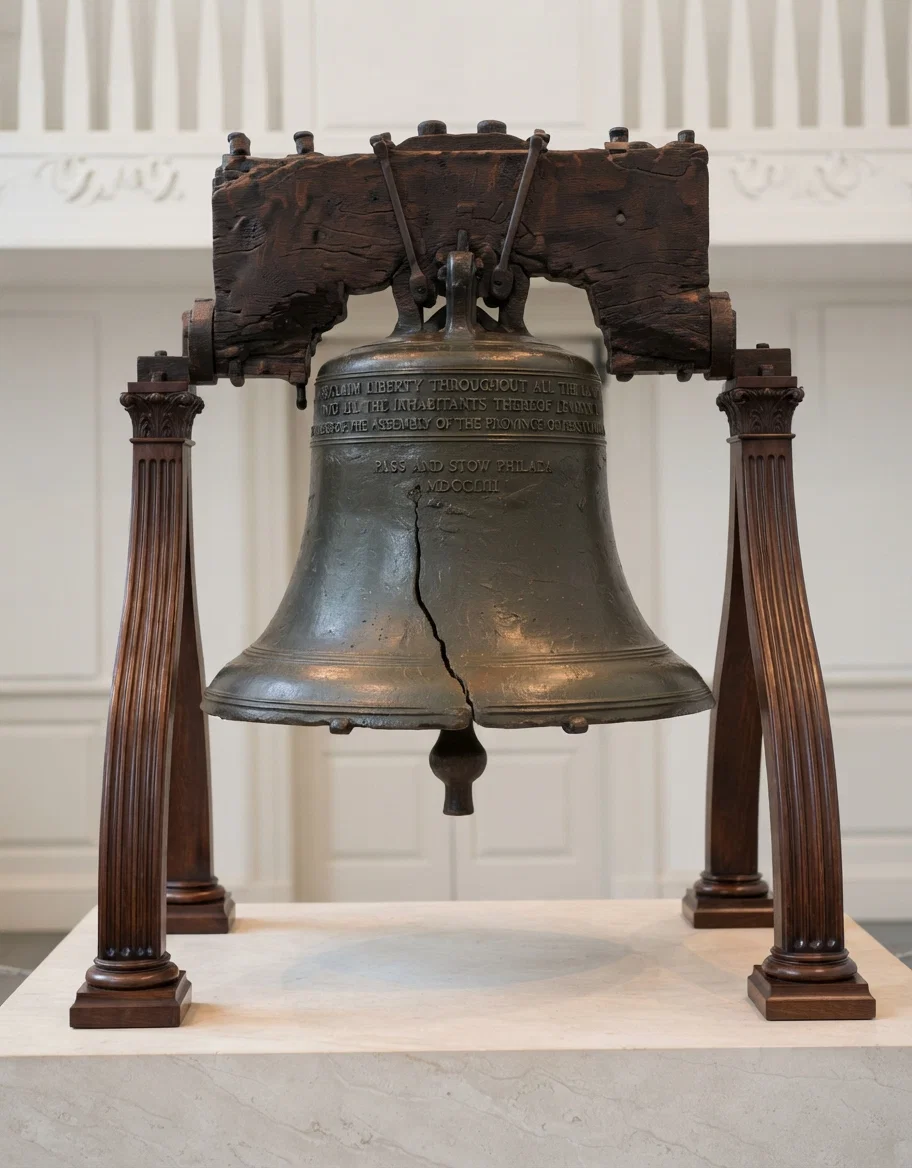
The old Liberty Bell, cast by Pass & Storr, Philadelphia, 1753; weight 2,080 pounds. Its very making seemed to be prophetic of the results of the Revolution that followed. It bore the inscription, “Proclaim liberty throughout all the land unto all the inhabitants thereof,” from Lev. 25:10. It was cracked July 8, 1835, while being tolled in memory of Chief Justice John Marshall. It is now in Independence Hall.
Questioner.—“What have you to say regarding the equality of rights?”
Answer.—All men in society have the same rights. This fact is recognized in the opening words of the Declaration of Independence: “We hold these truths to be self-evident, that all men are created equal; that they are endowed by the Creator with certain unalienable rights; that among these are life, liberty, and the pursuit of happiness.” Christ taught this same truth when He said to His disciples, “All ye are brethren.”
Questioner.—“How would you define religious rights?”
Answer.—Religious rights consist in the right to worship God in whatever way one thinks best, and to make known and maintain his religious beliefs. They are indicated and safeguarded in Jefferson’s “Bill for Establishing Religious Freedom,” which passed the Virginia Assembly December 16, 1785, in the following words: “All men shall be free to profess, and by argument to maintain, their opinion in matters of religion.” Every State constitution in the United States recognizes these rights.
Questioner.—“Is religious liberty confined to the right to choose among the different religions, or does it involve the right not to be religious at all if one so elects?”
Answer.—So far as civil government or the right to use coercion in religion is concerned, a man has the same right not to be religious that he has to be religious. To say that a man may be free to choose his own religion, but that he must choose some religion, is a denial of the principle of religious liberty. The power that would havea right to compel one to profess some religion, would have the same right to say what religion he must profess.
Questioner.—“To whom, then, is one responsible in matters of religion?”
Answer.—To God, and to God alone. To this truth the Bible abundantly testifies, “Who art thou that judgest another man’s servant! to his own master he standeth or falleth. . . . So then every one of us shall give account of himself to God.” Rom. 14: 4, 12. The memorial of the presbytery of Hanover to the General Assembly of Virginia, dated April 15, 1777, recognizes this great truth in these words: “The duty which we owe our Creator, and the manner of discharging it, can only be directed by reason and conviction, and is nowhere cognizable but at the tribunal of the universal Judge.”
Questioner.—“What is liberty?”
Answer.—“Liberty,” according to Andrew W. Young’s “Government Class Book,” page 15, “is the being free to exercise and enjoy our rights, and is called natural, political, civil, or religious, according to the particular class of rights referred to.”
Questioner.—“How would you define personal liberty?”
Answer.—Personal liberty consists in the freedom to exercise and enjoy personal rights—the rights of “life, liberty, and the pursuit of happiness.” Illustrating this liberty, Mr. Young says: “Every person has the right to go wherever he pleases, free from restraint on the part of others. If any one restrains him of his liberty even for a very short period or without violence, as by locking him in a room, he may recover damages. This is one of our most valued rights, and is forfeited only by crime.”
Questioner.—“What, then, is religious liberty?”
Answer.—From the standpoint of civil government, religious liberty is freedom in matters of religious opinion and worship. This need not be confounded with that soul liberty, or freedom from condemnation and sin, which the Gospel, or religion itself, brings. Religious liberty not only implies the absence of laws interfering with this freedom in matters of religious opinion and worship, but requires protection in the exercise and enjoyment of religious rights. “To protect liberty of conscience,” it has been well said, “is the duty of the State, and this is the limit of its authority in matters of religion.” In prohibiting Congress from making any law “respecting an establishment of religion, or prohibiting the free exercise thereof,” the Constitution of the United States recognizes the right and justice of religious liberty, or freedom in matters of religion. This, with the similar prohibitions in the State constitutions, stamps this country as a land of religious liberty.
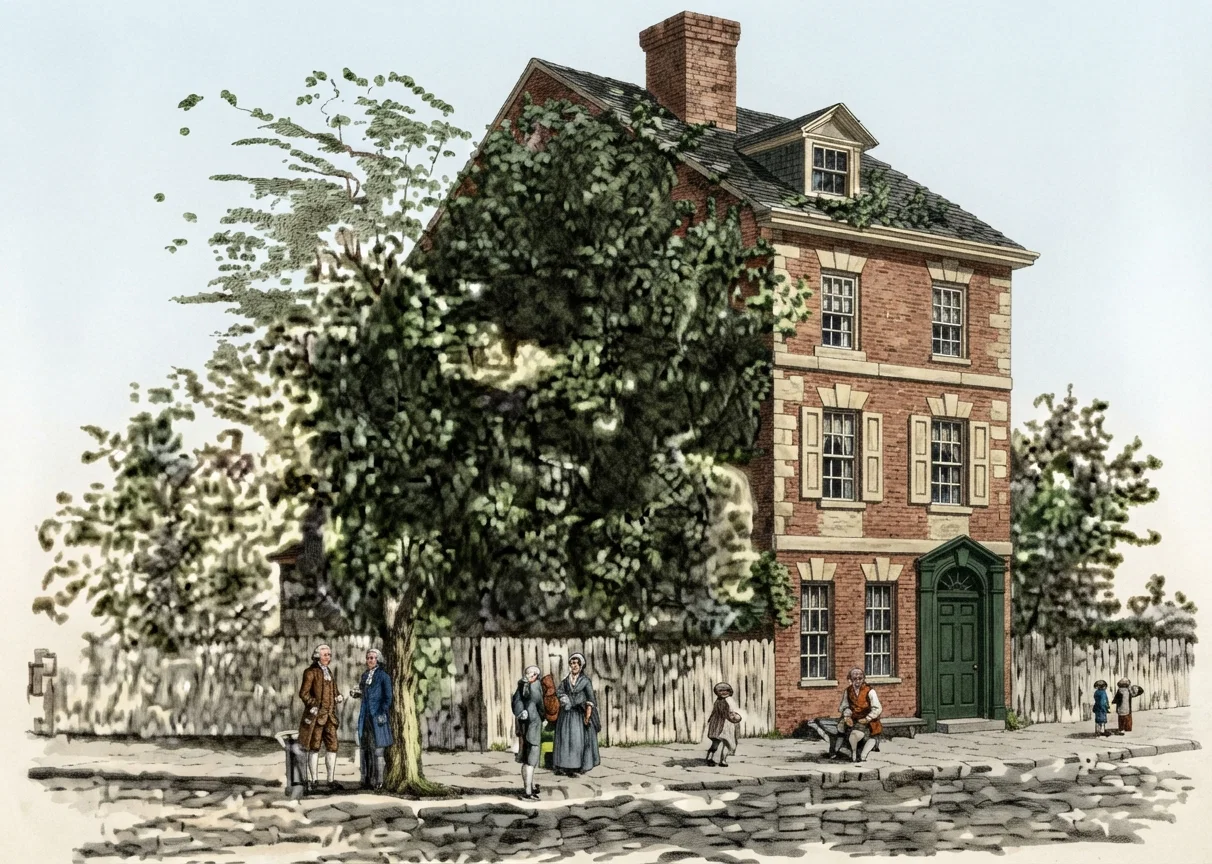
The house where Thomas Jefferson lived, who is said to have written the great Declaration
Religious legislation in the United States, therefore, is unconstitutional, as well as unchristian and tyrannous.
W. A. COLGORD.
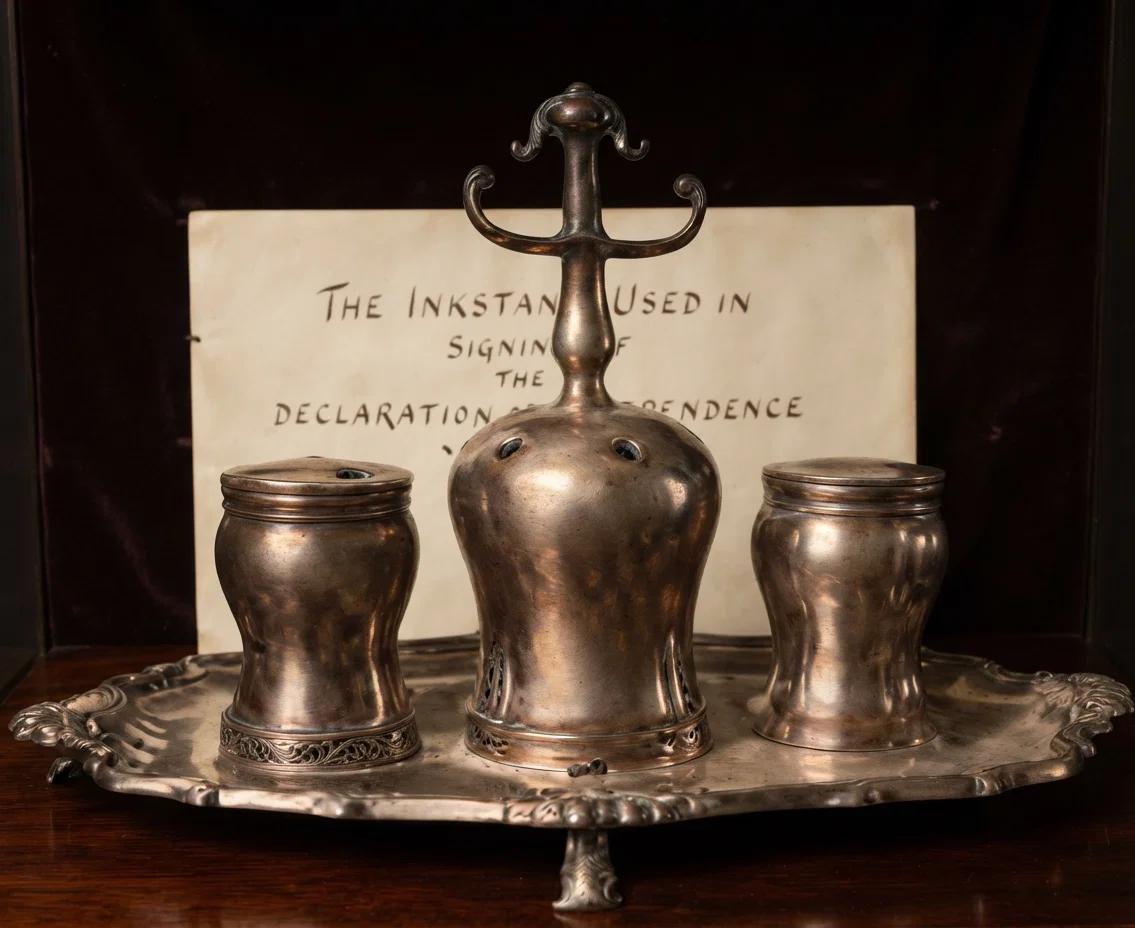
The inkstand used in the signing of the Declaration of Independence
The Old Witch House, Salem, Massachusetts, now a pharmacy. Here Roger Williams lived; here men and women were tried and condemned for witchcraft. See note on last page.