Two Great Charters

3%

Pacific Press Publishing Association · Mountain View, California · May 21, 1912

FromSigns of the Times, Vol. 39, No. 20.

Read the full edition

Two Great Charters

By Charles Miles Snow, Editor of "Liberty"
MAGNA CHARTA and the Declaration of Independence mark the beginning of two of the most important epochs in the history of the world. The Declaration of Independence is a true lineal descendant of Magna Charta, and the events which took place at Runnymede in 1215 were the logical precursors of Bunker Hill and Yorktown.
Centuries of oppression of the English people, the denial of their rights and the confiscation of their property at the whim of their rulers, had kindled in their souls a smoldering fire which needed but a stiffer breeze to fan it into flame. That breeze began to blow when John Lackland came to the throne of England as King John. Had he been as wise and far-seeing as he was ingenious and self-serving, he might have read in the eyes of his people the doom of unrestrained royal prerogatives. Already, at the time of his accession to the throne, the people had attained to a limited degree of representation. The "first faint glimmerings of parliamentary representation" were seen in the reign of Richard I (1189-1199), the immediate predecessor of King John. "Chosen bodies of knights, or other lawful men, acting in characters which become more and more distinctly representative, were summoned for every kind of purpose," says the historian. ("Historians' History of the World," volume 18, page 328.) It is not clear that they were always elected by the people; and yet, whether appointed or elected, it was recognized that they represented the people, and the various parts of the realm, and that, in their persons, the people laid their wishes before the sovereign. A chosen body of knights had authority to assess taxes, and the next step in the march toward liberty and equality was the acquisition by this body of men of the right to vote the taxes or to refuse so to do.
In 1213 another step was taken when the sheriffs were empowered to summon four discreet men from each shire to come and speak with the king concerning the affairs of the realm. And it may be justly inferred that this step was not taken on the initiative of the king; for the king now was John Lackland, and the events of Runnymede were only two years in the future. Out of this grew the English Parliament—and representative government. "From this era," says Hallam, "a new soul was infused into the people of England." As the acts of the king could no longer be governed merely by his arbitrary will, and as even he, the king, must have regard to the rights of the people, he was brought down nearer to the plane upon which they lived, and they were correspondingly elevated; or rather, they came nearer to the real enjoyment of that which was justly theirs. That document (Magna Charta) became, in the language of another, "the keystone of English liberty, so that all that has since been obtained is little more than confirmation or commentary."—Hallam.
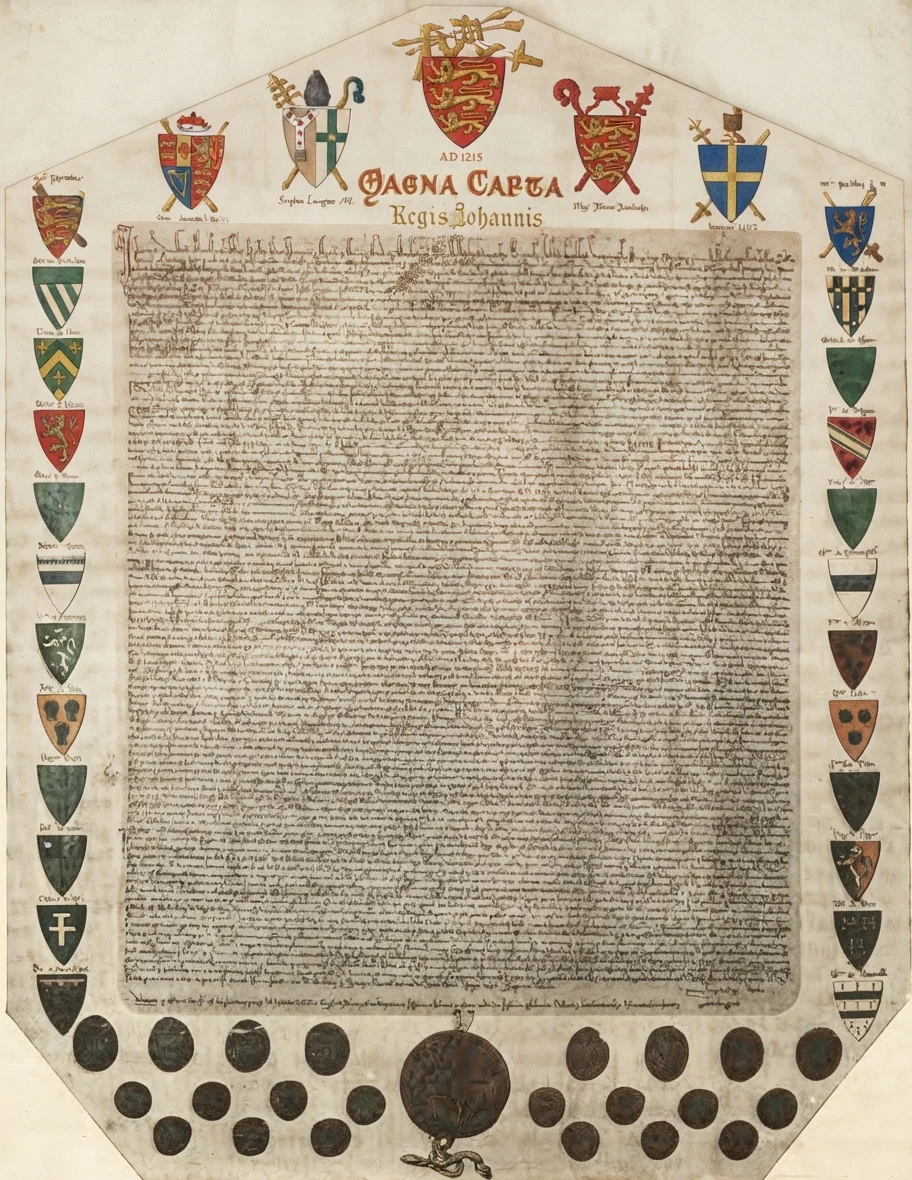
A photo reproduction of the Magna Charta, the copy of which is taken from the original document in the British Museum. The shields at top and side are of the barons, and at the bottom are the seals of the king's securities.
While Magna Charta did not guarantee the equality of all men, it was a long step toward that goal, and in it slumbered the principles of the Declaration of Independence and the Constitution of the United States. And inasmuch as the religious liberty which Americans enjoy to-day, temporally speaking, grew out of that Declaration and that Constitution, we may say that our religious as well as our civil liberties were, in a measure, bound up in that ancient British document. It is true that a considerable portion of the people, the villains and serfs, had little or no participation in the rights which it asserted, but "the very assertion hastened the period when all should be equal before the law." So also the righteous principles of the Declaration of Independence and of the national Constitution did not prevent in America the slavery of a race; but the very assertion of those principles did finally crystallize into the thirteenth amendment to the Constitution. By a study of the acts which Magna Charta condemned, we may learn something of the oppressions of the people before the time of King John.
We summarize some of the more important concessions:
The ruler had required of his vassals that they render a certain amount of service in his armies at their own charges. This, Magna Charta practically abolished.
Courts of common pleas were to be established in certain definite places for the more speedy and convenient adjustment of difficulties, and were not required to follow the king's court.
A freeman could no longer be arbitrarily fined at the discretion of a judge, and no amerciament (fine imposed at the discretion of the court) could be imposed upon any one save upon the oath of honest men of the neighborhood.
Earls and barons could be amerced only by a jury of their peers, and this must be in harmony with the degree of their offense.
No constable or bailiff of the king must take corn, horses, carts, carriages, timber, or other chattels from any man without paying him for them.
No bailiff was to be permitted to bring any man to trial upon his own testimony or without credible witnesses.
No freeman must be taken, or imprisoned, or disseized, or outlawed, or banished, or in any way destroyed, save by the lawful judgment of his peers, or by the law of the land.
Justice was not to be sold to any man, nor was it to be denied to any man.
Whatever the king had taken without right, was to be returned to the owners.
In addition to all this, a court of five and twenty barons was appointed with authority even to call the king to account for infractions of the law, and, if necessary, take his property to satisfy justice.
The last section of the charter opens with this declaration: "Wherefore we will and firmly enjoin, that the Church of England be free."Notwithstanding King John had sworn that all things contained in Magna Charta should be observed "on our part as on the part of the barons," "in good faith and without evil intent," yet the ink of his signature was hardly dry before he was plotting its revocation with the aid of foreign mercenaries. The pope excommunicated the barons for inducing the king to sign it, and declared they were "worse than the Saracens for molesting a vassal of the holy see." A second sentence of excommunication was promulgated on December 16 of the same year, and the city of London was laid under interdict. This interference of the pope in the temporal affairs of the kingdom was deeply resented by the people. It is recorded that the citizens of London despised the interdict, and boldly asserted that the pontiff had no right to intermeddle in their worldly concerns. In spite of the interdict, they kept open their churches, rang their bells, and celebrated their Christmas with unusual festivity. When the barons appealed to France for aid against their perjured king, the pope's special envoy threatened the king of France with instant excommunication if he should take up arms against King John and in favor of the barons who were fighting for the principles of Magna Charta. This threat did not deter the king of France from entering upon the undertaking. The sudden death of King John on October 18, 1216, the accession of his son Henry III to the throne, and the defeat of the French prince the following year, left Magna Charta still in force and England still under her own king. The people had chosen rather to live as subjects of a foreign prince, with their rights guaranteed, than to live under their own king, with their rights trampled under his feet. But with the tyrant out of the way, and a king on the throne who would abide by the principles of Magna Charta, they rallied against the French prince who sought the throne of England, and forced him out of the country.
Imperfect and transitory as many of its provisions were, the influence for good which Magna Charta has exerted upon the world is beyond the power of man to compute. It has had a mighty influence in more nations than one. Slavery, serfdom, involuntary servitude, and legal distinction between classes, have melted away before its influence; and mankind to-day throughout the world is enjoying rights and privileges, immunities and guarantees, that would be still unrealized but for that memorable document.

Another Charter of Freedom

An oppressive king riding ruthlessly over the rights of his subjects, hastened the day when those subjects rose up on their own behalf to insist upon a recognition of the rights of man. That was the birth of Magna Charta.
But another day came when another king refused to recognize the rights of his own subjects across the sea. That king was George III, and those subjects were the people of the American colonies.
The barons and people of England had suffered through arbitrary taxation on the part of the king, and they abolished it in the adoption of Magna Charta, and obtained a measure of representation. The American colonists also suffered under an unjust and arbitrary system of taxation, and representation in the legislative body was denied them. When they came to a place where they felt free to express their opinion of that condition, they called it "taxation without representation," and declared it to be "tyranny." We find these two great charters to be at the same time a protest against tyranny and a provision for protection from tyrannical rulers. The recitation of the wrongs complained of in the Declaration of Independence, and the enumeration of the rights demanded in the Magna Charta, show unmistakably that they were born out of the same conditions, that the same stress of tyranny was urging the people out into the light of liberty.
As the acts of King John and his predecessors fanned into a flame the smoldering discontent of his people, and produced the conditions which made Magna Charta inevitable, so the acts of George III against the British people in America fanned into a flame the discontent of the colonists, and produced the conditions which made inevitable the Declaration of Independence and the establishment of a new nation. Magna Charta was the British people's declaration of independence, and the American Declaration of Independence and national Constitution compose America's magna charta.
These documents are not for these two nations alone. They are as applicable in one part of the world as another, and are really doing their work wherever nations exist. The American document declares that "all men are created equal; that they are endowed by their Creator with certain unalienable rights." The British document does not make this declaration in words; but it does emphasize the fact, nevertheless, and specifies requirements which prove it. The American document declares that governments derive "their just powers from the consent of the governed." The British document does not state that fact, but it incorporates the idea and acts upon it vigorously.
It is not too much to say that the equality and liberty of the individual, almost universally recognized to-day throughout Christendom, has come as a result of the principles enunciated in those immortal documents. It was 561 years from Magna Charta to the Declaration of Independence; but the world had made more progress during those 561 years than during the 1,200 years which preceded that date. It has been 136 years from the signing of the Declaration of Independence to the present time; but the world has made more progress during these 136 years than during the 1776 years which preceded the signing of that document.
With the civil liberty which those documents brought, there was bound to come in time liberty in matters of faith. The one was involved in the other and could not long exist without the other. With the mind of man imprisoned behind the bars of a State religion, eking out a miserable existence under the thrallom of a spiritual tyranny, progress and development were impossible. With those handicaps shattered and the mind and soul free, there is light and life and progress for the race. We can not too greatly esteem the principles enunciated in those two great charters, or place too high a value upon the liberties which they guarantee.
C. M. SNOW.