HISTORY attests nothing more fully than the strange fact that not infrequently some of the best of men espouse and champion principles essentially pernicious in their outworking. Prominent among these vicious principles that have had, and still have, some of the most virtuous of men for their sponsors and advocates, is that of the enforcement of religious dogmas by civil pains and penalties.
Until the latter half of the eighteenth century the vast majority of men were obsessed with the delusion that the tenets of religion should be written into the civil codes of the State. Altho this hoary delusion was almost entirely dissipated into limbo by those grand manifestoes, the Declaration of Independence, the Constitution of the United States, and that similar French charter of human liberty, "the Rights of Man," there are not a few persons of undoubted probity who, in our day of light and knowledge, are still the victims of the same world-old obsession. It has been said that human life teems with paradoxes; and surely one of the most inscrutable of these is, that so often very good men are found identified with very bad causes.
It is therefore urgently important to remember that those who, in keeping with the teachings of the New Testament and with the genius of the American Constitution, antagonize the efforts of misguided men to promote religious legislation, are in no wise hostile to those men, but to the unchristian and uncivil principles for which they stand. Hence those of us who love and work for religious and civil liberty are not warring against men, but against a dangerous and therefore pernicious propaganda.
A Notable Pagan Example
One of the most upright and exemplary emperors that ancient Rome ever had was Marcus Aurelius. His studies and his writings won for him the title of "philosopher." His famous literary work, "Meditations," breathes the finest and loftiest sentiments of devotion and benevolence, and makes the nearest approach to the spirit of Christianity, of all the literature of pagan antiquity. He personally prosecuted not a few benevolent enterprises. But some of the wars of his reign drew after them a series of terrible calamities. The superstitious people believed that it was the Christian cult that had called down upon the nation the wrath of the gods. Accordingly, Aurelius permitted one of the most cruel and bloody persecutions to be instituted against the Christians that can be found in the annals of Christian martyrdom. The famous Christian bishops, Justin Martyr and Polycarp, were among the victims of that "good" emperor’s wholesale judicial massacre.
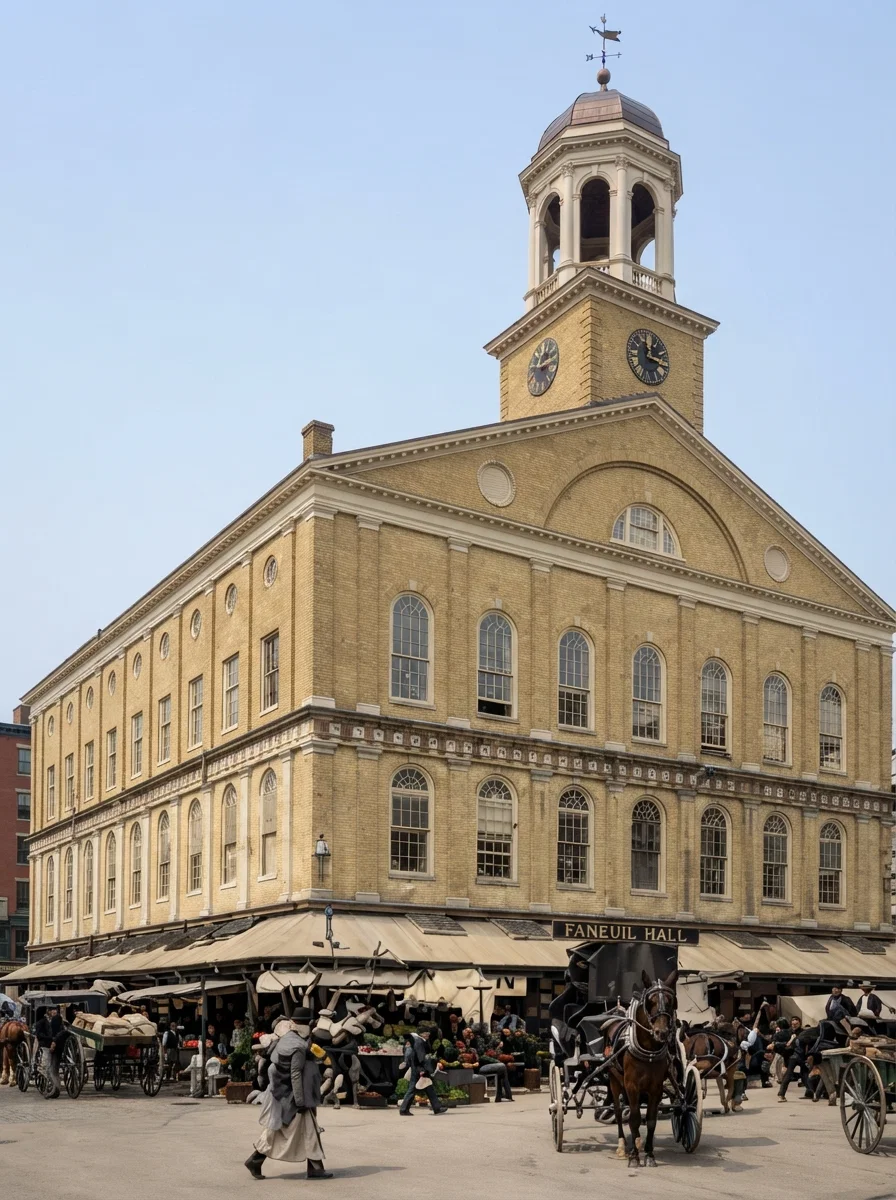
Faneuil Hall, where public meetings and discussions of great moment were held previous to and during the Revolution; called “the Cradle of Liberty.”
A Catholic Example
Mary Tudor, the Catholic queen of England, 1553 to 1558, was scrupulously punctilious in the observance of all the rites of her faith. She could not have been more rigidly regular in her eating and sleeping than she was in the hearing of mass, the worshiping of the Virgin, and in attendance at the confessional. Yet during her reign of only five years, more than three hundred men, women, and even children, were burned to death for no offense other than that they were, by virtue of conscience, Protestants. Now, it was not wanton cruelty that prompted the "Bloody Mary" to the commission of those awful atrocities; no, it was religious bigotry. Mary was sternly virtuous and almost ascetically religious, yet she was the victim of the most cruel and unchristian delusions to which the human heart is susceptible.
In Protestant Ranks
History affords no example of a more austerely religious man than was John Calvin. His name has come down to us as a synonym10of robust virtue and virile godliness. And yet it was at the instigation of John Calvin that the scholarly Michael Servetus was burned at the stake, in Geneva, October 27, 1553. The offense (?) in expiation of which Servetus was forced to give his life, was his disagreement with Calvin as to the nature of the Trinity. Nobody doubts that Calvin was a good man; but who can believe that the immolation of Servetus was a good deed?
Perhaps no people ever lived who surpassed the Puritan settlers of New England in robustness of character, in depth and fervor of religious conviction, or in moral prowess and initiative. The Puritan ministers who came to the New World were not only among the most ardently religious men of their age, but among the most learned as well. But it was these same uncompromising saints that, especially in Massachusetts, erected a rock-ribbed theocracy, to the end that they might dominate the religious as well as the political life of the people. They erroneously believed it to be their duty not to brook any religious opinions which might be in the least unlike their own. Persons who held such opinions were deemed inimical to the established religio-political order, and were, accordingly, promptly punished with banishment from the colony, and in some cases the penalties of whipping, cropping of ears, and confiscation of property were added.
Not only was citizenship based upon church-membership, but the Bible was the only law book recognized by the priest-controlled courts. As the ministers were considered the infallible interpreters of the Bible, all offenders against their interpretation were adjudged to be not only sinners but criminals, and their offenses ranged from those who wore long hair to such as dealt in witchcraft and sorcery. We all know the pitiless rigor with which Anne Hutchinson was banished to the savage wilds of Rhode Island simply because she alleged that the regular ministers and their followers were under a covenant of works while she and her followers were under a covenant of grace.
Criminals by Law
The Anabaptists, or Baptists, made their appearance in Massachusetts soon after the banishment of Anne Hutchinson. They were promptly seized by the Puritan rulers, and whipped, fined, imprisoned, and they barely escaped with their lives. The cruel banishment of the celebrated Roger Williams was prompted by the simple fact that he denied the right of magistrates to punish for the violation of the first table of the Decalogue, and denied the existence of any warrant in the New Testament for the union of Church and State.
Finally the Friends (Quakers) found their way to the Puritan colonies of Massachusetts, and began to teach their peculiar tenets. As they persisted in teaching their faith, they were banished, but promptly returned. Driven to exasperation, the Puritan authorities passed a law pronouncing the death penalty upon all Quakers who, having been once banished, had the temerity to return to the colonies. A number of exiled Quakers returned, and four of their leaders were actually hanged.
Among those austere and apparently merciless inquisitors were such notables as Governors Endicott, Winthrop, and Winslow.
They were as famous for their moral depth and fervor as they were for their intellectual culture. In short, they were pre-eminently good men. Yet they cherished the terrible delusion that they were doing God's service when they persecuted even to the limit of inflicting death upon such as dissented from their own religious opinions and practises.
A Bible Example
Before his conversion to the cause and faith of Christ, the apostle Paul was an ardent devotee of the antichristian theory of law-enforced religion. It was with all an inquisitor's zest that he devoted himself to the business of persecuting the followers of the despised Nazarene. He was conspicuous among those who shed the blood of the first Christian martyr. In the pride of his Pharisee's heart he conceives the idea to reverse the maxim of the crucified Jesus, and go into all the world and suppress the Gospel in every creature. We know how relentlessly he prosecuted his cruel and inhuman mission. He was "exceedingly mad" against the Christians, and when they were put to death he gave his voice against them. And when he finds in Jerusalem no fuel to feed the martyr's fire, he applies to the high priest for authority to go to Damascus to make havoc of the little Christian band that worshiped there. How his Christless mission was arrested by the intervention of the saving mercy of God, is well known.
Now, the point to be noted is, that Paul had been thoroly conscientious as an inquisitor and persecutor. Long after he had found Christ he bore the following testimony as to the motives that had actuated him in his bitter warfare against the church of Christ: "I verily thought with myself, that I ought to do many things contrary to the name of Jesus of Nazareth." In fighting against the cause of Jesus, Paul thought himself in the line of duty. He was genuinely scrupulous. Touching the law he was blameless. No man took his place more regularly in the temple, or observed the Sabbath with more scrupulous care, than Paul. No one could have surpassed him in religiousness. Yet in the face of all this, he had been fighting against God, he had been a "blasphemer and a persecutor," according to his own subsequent testimony. But as he had persecuted "ignorantly in unbelief," he "obtained mercy."
The True Principle
Yet it was our Lord Himself, the founder and fountain of our holy religion, who declared unequivocally, "If any man hear My words, and believe not, I judge him not: for I came not to judge the world, but to save the world." Again He said, "I, if I be lifted up [upon the cross], . . . will draw all men unto Myself." He would not coerce or drive men to God, but by the irresistible wooing of His love, expressed in the tragedy of Calvary, He would draw sinners to Himself, the fountain of cleansing.
It was the Master's beloved disciple who wrote, "Whosoever will, let him take the water of life freely." There is no love of power in the Gospel of Christ, but it throbs and brims with the power of love. It is the uniform testimony of Holy Writ that the only weapon admissible in the Christian warfare is the "sword of the Spirit, which is the Word of God."
Hence those of us who labor and contend for the complete separation of religion and politics, for the principle that religious belief and practise are matters that concern only the individual and his God, are in no wise antagonizing men, but principles — principles hostile to the whole tenor of the Christian faith as enunciated in the Christian Scriptures. GEORGE W. RINE.