Editorial

5%

Pacific Press Publishing Company · Oakland, California · Dec 23, 1897

FromSigns of the Times, Vol. 23, No. 50.

Read the full edition

Editorial

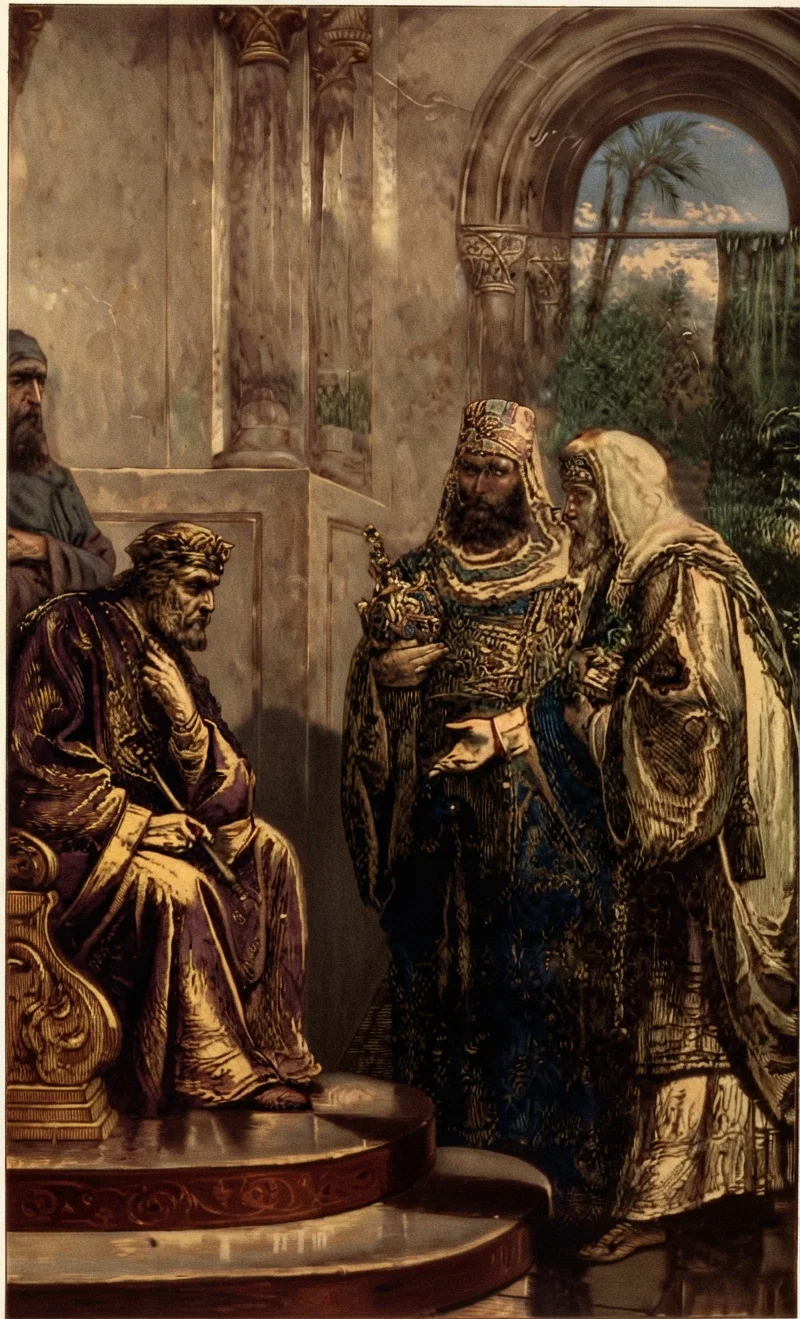
"Where Is He?"—This is the question asked by the searchers of light of Herod of old. "Where is He that is born King of the Jews? for we have seen his star in the east, and are come to worship him." Matt. 2:2.

Who Were They?

Who these wise men, or magi, were we need not now stop to inquire. Suffice to say they were searchers after truth; they were looking for the Truth, Jesus, the Son of God. Following perhaps the light of Balaam's prophecy (Num. 24:17), and other predictions of Holy Writ, they became convinced that the coming of a Saviour (Isa. 9:6), the Anointed of God, the Messiah (Dan 9:25), "the Desire of all nations" (Hag. 2:7), was at hand; and following the supernatural light, doubtless a cohort of shining angels from the courts of glory, they were led to Jerusalem. They represent seekers for light in all ages.

To Whom They Came.

Where should they come save to those in the providence of God high in authority? Herod had greatly enlarged and beautified the earthly temple of the Jews; why should he not know of Him who was coming to that temple to glorify it with his own presence? Yet he did not know. Was it a mistake that the magi were led to him?—Not at all; for God wanted Herod to know and receive Jesus. He gave him the privilege of finding and worshiping with the learned wise men. So also Naaman the Syrian was in the providence of God sent to the king of Israel to find divine deliverance from the leprosy. (See 2 Kings 5:1-8.) The king could not do it; moreover, he was ignorant of God or his prophet. The Lord wanted to teach the king that God yet lived to deliver, and so lead him to turn to the one only true God. To high and low God gives light and the privilege of choice.

The Result of the Inquiry.

Herod was troubled; his throne he thought was in danger.
Not knowing in himself the principles of the divine government, he feared the government itself and hated its Ruler, as subsequent events demonstrated. Matt. 2:16. Yet he manifests a show of interest. He feigns loyalty to God. He calls those who are versed in the prophetic writings, and asks where the Messiah should be born. They tell him in the little city of Bethlehem, and Herod tells the magi, bidding them when they had found the young child to let him know that he might "come and worship him also." And this Herod might have done if that Child had come in transcendent glory and mighty power. But his submission would have been feigned; for immediately after he sought the young Child to destroy him. He could brook no rival to his plaything of a throne, and he bartered the eternal reign with Christ, and shed we know not how much innocent blood, that he might retain his brief place. A high position and great opportunity do not make men divinely wise, but it leaves them without excuse before the bar of God.
THE WISE MEN BEFORE HEROD.

The Finding of Jesus.

But the magi found the infant Saviour. When priests and rulers will not guide the earnest searcher, God will send his angels. When the magi departed from the king, the star went before them and stood over the place where the young Child lay. They found him hemmed in by no earthly guard. He was surrounded by no insignia or tokens of royalty. He came to be one among his brethren, Divinity vailed in humanity; and before him these learned men bowed in humble adoration, feeling themselves honored with the privilege. They then opened their treasures, and poured out gifts fitted for a monarch, gold and frankincense and myrrh. It did not seem to surprise them that they found Jesus so humbly situated and so meanly environed; they were not looking for outward pomp or glory, but for truth and holiness, and they found both in the Babe of Bethlehem. They did not come to receive honors from him, but to give him themselves, to acknowledge his right to rule.
"Where Is He?"—Men are asking the same old question to-day, "Where is Jesus?" Thousands are pointing at this season of the year to a day called Christmas. Is Jesus in the festival? We have no objection to the telling on December 25 of the sweet old story of God's love in giving his Son for the children of men; let it be told on that day and all days. But this is not the lesson which Christmas teaches, as it is generally, almost universally, observed. There are several reasons why the festival can not teach the true lesson, and it will not hurt the Christian readers of the SIGNS OF THE TIMES to pause for a moment in the mad rush of the world to inquire as to the truth of the matter, and to learn whether or not a day should be set apart for such service.

Not Born on That Day.

In the first place, Jesus was not born on December 25. This is shown from two facts: (1) The shepherds were watching their flocks in the field (Luke 2:8); which they would not have been doing in the cold days of midwinter. (2) The ministry of Jesus lasted three and one-half years. Dan. 9:25-27. He began his public ministry according to the law when thirty years of age. Luke 3:23. He was crucified at the last Passover he attended, in A.D. 31. Matthew 27 and "Hale's Chronology," vol. 1, pp. 69, 70; vol. 3, p. 230. He therefore began his ministry six months before the first Passover he attended, John 2:13. At this time he was thirty years of age. The Passover occurred probably about the last of March in the month Abib. Six months previous to this would be at that season of the year indicated by the month Tisri, probably in our September. Christ came in "the fulness of the time" not only as regards the time of the ages, but the time of the year. His birth was in the season of fruitage, and he the most precious fruit of the earth.

Not Remembered by a Day.

God has not revealed to us the day of Christ's birth either in the week or month or year. He reveals the great fact that the Word was made flesh; that God became incarnate in Christ Jesus; and he did this that through Christ he might become incarnate in every one of us. He was the Son of man, as well as the Son of God; and God would through him have us become the sons of God as well as the sons of men. "But when the fulness of the time came, God sent forth his Son, born of a woman, born under the law, that he might redeem them which were under the law, that we might receive the adoption of sons. And because ye are sons, God sent forth the Spirit of his Son into our hearts, crying, Abba, Father." Gal. 4:4-6, R. V. But this great and blessed truth is not for one day in the year, but all days, and all hours of all days. And for that reason God never designed that the remembrance of his great gift should in any sense be confined to a day.

The Origin of Christmas.

"But what is the origin of Christmas?" asks one who has come to think the day is almost holy. "Did it not come down from Christ and the apostles?"—No, it did not. We have not even the slightest trace of it in the Scriptures. Its first mention in "Christian" literature is said by Schaff to be in Clement's "Miscellanies," written about A.D. 200. But Clement was a half-converted heathen philosopher. Says Neander, in speaking of the second century of the Christian era: "The idea of a birthday festival was foreign to the Christians of this period generally; they regarded the second birth as man's true birth. . . . It was, in truth, unknown at what definite time the celebration of the remembrance of Christ's birth should be placed, as nothing definite was ascertained respecting the date of his birth."—Vol. 1, p. 301 (Houghton and Osgood). The simple fact is that teachers like Clement, Eusebius, and others wished to conform to heathen customs as much as possible, so as the more easily to convert the heathen. For every heathen festival of note they invented a corresponding festival in the Christian church. For the pagan Easter festival the apostatizing church set apart a yearly day in remembrance of our Lord's resurrection, but retained many pagan customs and the pagan name. For the day or the customs they had no Scripture.
Christmas, first called "The Nativity," was the counterpart of the great day of the Roman Saturnalia, a feast connected with the grossest sun-worship, connected with which was the giving of gifts, feasting and revelry, and the grossest licentiousness. About December 20 the Saturnalia began, when the days were the shortest, and life in the vegetable world least manifest. Beyond that the days lengthened, the sun seemed to smile with favor upon the world, and the heathen celebrated the lengthening day with the wild orgies and indecencies of nature-worship. The giving of gifts, the Yule-tree and Yule-log, the holly berries and evergreens, are all of pagan origin, and certainly no one can deny but that the day is frequently kept in a purely pagan spirit, ministering only to selfish pleasure.

The Spirit of Christianity.

The Spirit of Christianity is a spirit of self-denial for others' good; and there is much of this manifest, especially among the poor, at this season of the year. Children deny themselves for parents, and parents for children, or both for some poor unfortunates of earth, expecting nothing again. This is the true Christ-spirit. But how much more frequently persons give that they may receive! They receive oftentimes selfishly, enviously. They purchase and prepare and feast gluttonously, and gorgingly, to minister to the lusts of the flesh, and the gluttony is not infrequently followed by drunkenness and licentiousness. How many during this festival season would be glad to have the holy Christ as a guest, a personal witness to all the doings of the day or night—to not only know that he was looking upon all outward acts, but that he saw deep down into the secret recesses of the heart! This question, dear reader, may be a good test of how much of true Christian motive is in your celebration of the day. Would you welcome him with a glad heart? Would it make any difference in your preparations and expenditures if you knew that he was going to be there personally? But he will see it all, tho you may not see him. More than this: Are you looking for Jesus on that day? If you have found some of his sweetness and light, are you still seeking for more? Are you inquiring, "Where is he that is born King of the Jews, my King? for I would worship him." And then are you ready to pour out before him, whether you find him in a hovel, a stable, a prison, or anywhere in need, the heart's best homage and your stewardship's best treasures? If you are, you will find Jesus, not only on December 25, but on all days of the year, precious to your soul, and you will receive from him more than you gave, even life, joy, and salvation.