THE MOTHER'S MOODS

6%

Pacific Press Publishing Company · OAKLAND, CALIFORNIA · Jul 1, 1897

FromSigns of the Times, Vol. 23, No. 25.

Read the full edition

THE MOTHER'S MOODS.

THE household barometer is always to be studied in the mother's face. Others in the home may have moods, but she can not afford to indulge in such a luxury; for her province is to regulate not alone the weather, but to fix the climate, and ordain the atmosphere which shall prevail in the nursery, at the table, in the parlor, and over the whole house. "What is mother about?" inquired a big boy of his sister, as he came home from the shop where he was learning how to be a business man. "Making sunshine for everybody, as usual," was the reply.
When we think how the mother's looks and tones affect the babies, how early the little ones begin to reflect her in that soul-likeness which shines out in the face, we can not overestimate the importance of her self-control. She must be amiable, whoever else frets. She must be brave, whoever else is cowardly. She must be tender, tho others are brusque. Because she is a mother, and, therefore, the arbiter, under God, of her children's destinies, the former of their characters, she must abide with Christ, deriving daily strength from communion with him.—Christian Intelligencer.
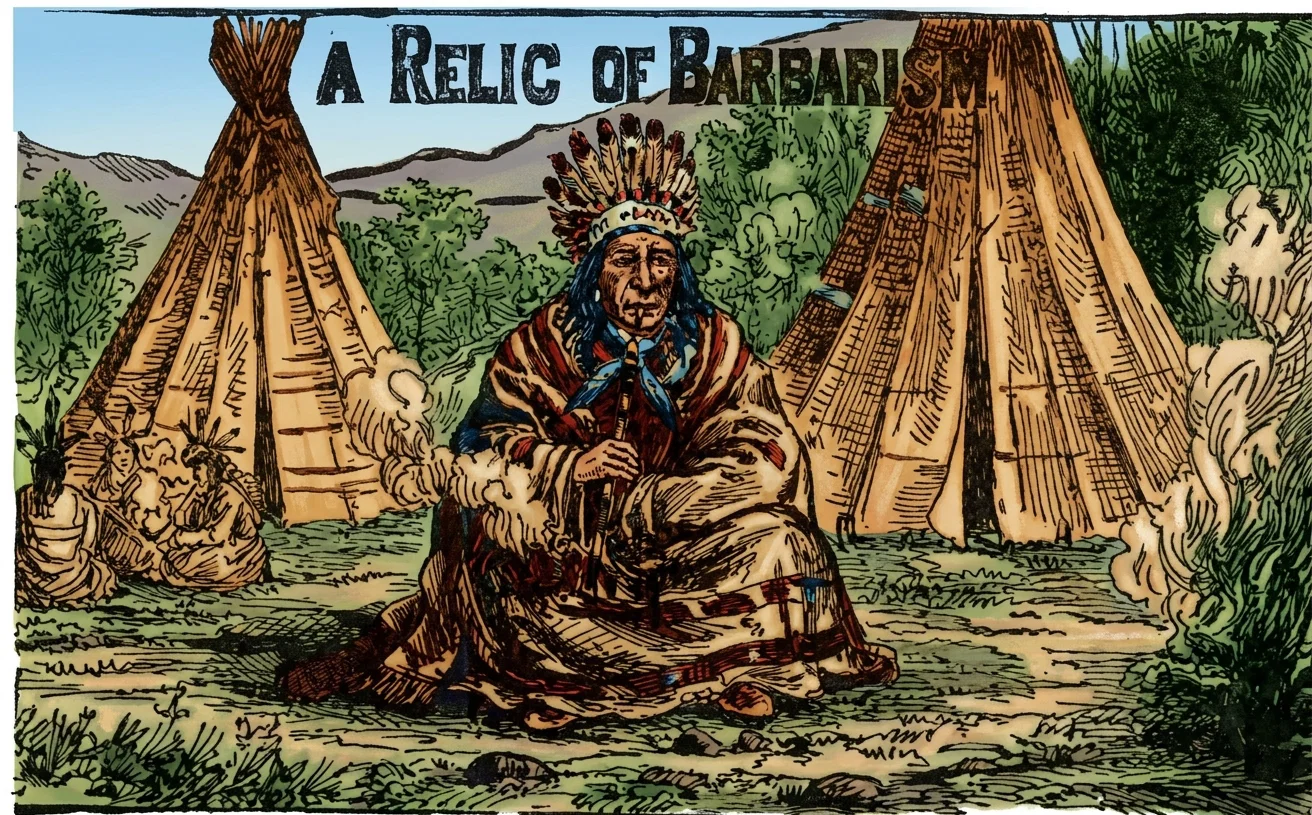
A RELIC OF BARBARISM
THE origin of a custom which has enslaved many millions of human beings in its toils, which has within a few centuries fixed itself so firmly upon the race, and become so widespread as to be practically universal among mankind, whether civilized or savage, can not be without interest to those who are users of the weed, as well as to those who wage war against this evil practise. The latter, especially, will find in the ignoble origin of tobacco-using an argument of no little force against this pernicious habit; and it is for this purpose that we write.

Tobacco-using Discovered.

In the month of November, 1492, when Columbus discovered the island of Cuba, he sent two sailors to explore it, who reported, when they returned, among many other strange and curious discoveries, that the natives carried with them lighted firebrands, and puffed smoke from their mouths and noses, which they supposed to be the way the savages had of perfuming themselves. They afterwards declared that they "saw the naked savages twist large leaves together, and smoke like devils."
To civilized human beings this was the first sight of the vile habit which has become so common that every city, town, and village is actually perfumed, or more properly befouled, with the vile stench of the poisonous weed. The impression made upon the unsophisticated Europeans was evidently not greatly in favor of the custom, since they compared the smoking Indians to devils.
Originating with the wild barbarians of America, the smoking habit was after some years introduced into Europe, and, receiving the sanction of physicians, who just at that time chiefly occupied themselves in searching for new nauseous compounds with which to experiment upon the lives of their patients, it was rapidly adopted, not only by the lower classes, but by those in high authority, even princes and nobles participating in the new intoxication.

Origin of Snuff-taking.

It appears that the taking of tobacco in the form of snuff was also discovered among the savage natives of this continent upon the second visit of Columbus to America, in 1494. A Roman friar, named Pane, who accompanied the expedition, thus describes the custom as it then existed among the Indians: "After reducing the leaves to a fine powder, they take it through a cane half a cubit long. One end of this they place in the nose and the other upon the powder, and so draw it up, which purges them much."
The purging referred to evidently describes the violent sneezing which resulted from the inhalation of the powdered poison. If the sailors thought that the smoking savages appeared "like devils," they certainly must have been ready to compare a party of sneezing Indians to a group of lunatics.

Origin of Tobacco-chewing.

In 1503, when the Spaniards landed in Paraguay, the natives attempted to repulse them, and came out against them in large numbers, beating drums, throwing water, and "chewing herbs and spurting juice toward them." The herb employed was tobacco, and the object of its use in the peculiar manner indicated was to get the poisonous juice into the eyes of the intruders and thus disable them by depriving them of sight. We have seen modern tobacco-chewers whose copious expectoration made it next to impossible for any one to approach within several feet without being soiled by the juice. In the days when warfare was carried on by hand-to-hand combat, we can very readily understand that a wild Indian filling the air about him in all directions with poisonous, irritating, filthy tobacco juice, would be a very formidable object.

Origin of Pipes and Cigars.

The first smokers employed what was practically identical with the modern cigar. Dry tobacco leaves were made into rolls and wrapped with the leaves of Indian corn, one end being lighted, and the other placed in the mouth. Pipes were also employed, those used in North America being shaped almost exactly like the letter Y, except that the stem was longer and the forked end was symmetrical. In use, the forked end was placed in the nostrils, and the other end in the dense smoke arising from tobacco leaves placed on glowing coals. In Mexico and South America, pipes almost precisely like those now in use, with numerous other forms, were employed in the same way in which pipes are now used.
Thus it appears that tobacco-using, together with the implements of its use and all the different modes of taking it, originated wholly with the heathen barbarians who roamed like wild beasts over the plains and through the dense forests of this continent four centuries ago. Civilized men have made no improvements or discoveries of any account in connection with its use; they have simply followed the example of those naked savages whom the discoverers of America saw chewing, snuffing, and smoking "like devils" almost four hundred years ago. It is evident, then, that tobacco-using is a barbarous custom in the fullest sense. In this habit we may unquestionably find one of the causes which have reduced the American savage to his present degraded and deteriorated condition.
Reader, if you smoke, chew, or snuff the filthy weed, we would ask you to pause for a moment between your whiffs, or before you renew your quid or take a new pinch of the delectable poison, and consider whether it is worthy of the dignity of an intelligent, enlightened, cultivated human being to spend his money, waste his time, and squander his health in imitating a vice which originated with ignorant, degraded savages, and remains a relic of barbarism which has been engrafted upon civilization. J. H. KELLOGG, M.D.