Untitled article

11%

Pacific Press Publishing Company · OAKLAND, CALIFORNIA · Nov 1, 1899

FromSigns of the Times, Vol. 25, No. 44.

Read the full edition

FROM NAZARETH TO BETHLEHEM.

MARY had been told by the angel Gabriel that she was to give birth to the Saviour of the world: "And, behold, thou shalt conceive in thy womb, and bring forth a Son, and shalt call His name Jesus. . . . The Holy Ghost shall come upon thee, and the power of the Most High shall overshadow thee; wherefore also that which is to be born shall be called holy, the Son of God." Luke 1:31-35, R.V. Joseph also, to whom Mary was betrothed, had received like information: "And she shall bring forth a Son, and thou shalt call His name Jesus; for He shall save His people from their sins." Matt. 1:21.
BOTH Mary and Joseph accepted the angel's words—she so far as to rejoice over the honor bestowed upon her (Luke 1:46-55), and he to the extent of marrying Mary after deciding not to do so on learning of her condition (Matt. 1:18-25). But faith requires more than this; faith calls for a belief of the Scriptures, which are given by the Spirit of Christ (1 Peter 1:10-12), as well as the words spoken by angels; and if there should be a conflict of testimony, the Scriptures are the guide (Gal. 1:6-8).
Now THE angel did not tell either Joseph or Mary that the Child Jesus must be born in Bethlehem; the Scriptures contained that information (Micah 5:2); and faith would have searched the Scriptures for every bit of information concerning the One thus intrusted to them, and of whom all Israel professedly expected so much. But time passed by, and there seems to have been no thought of moving to Bethlehem before the birth should take place. Had Joseph and Mary been left to themselves, the Child would have been born in Nazareth. Such was the stupor that had come over them, in common with the Jewish people, through adhering to the traditions of their teachers instead of the Scriptures. However, God, who knoweth the future as well as the past and present, provided for the emergency. He did not send an angel to hasten them on their prospective journey when they might have gone more comfortably. Having evidently neglected the precaution which faith would have suggested, they had to go under the pressure of human decree.
And Joseph also went up . . . to the city of David, . . . to enroll himself with Mary.
"God works in a mysterious way His wonders to perform."
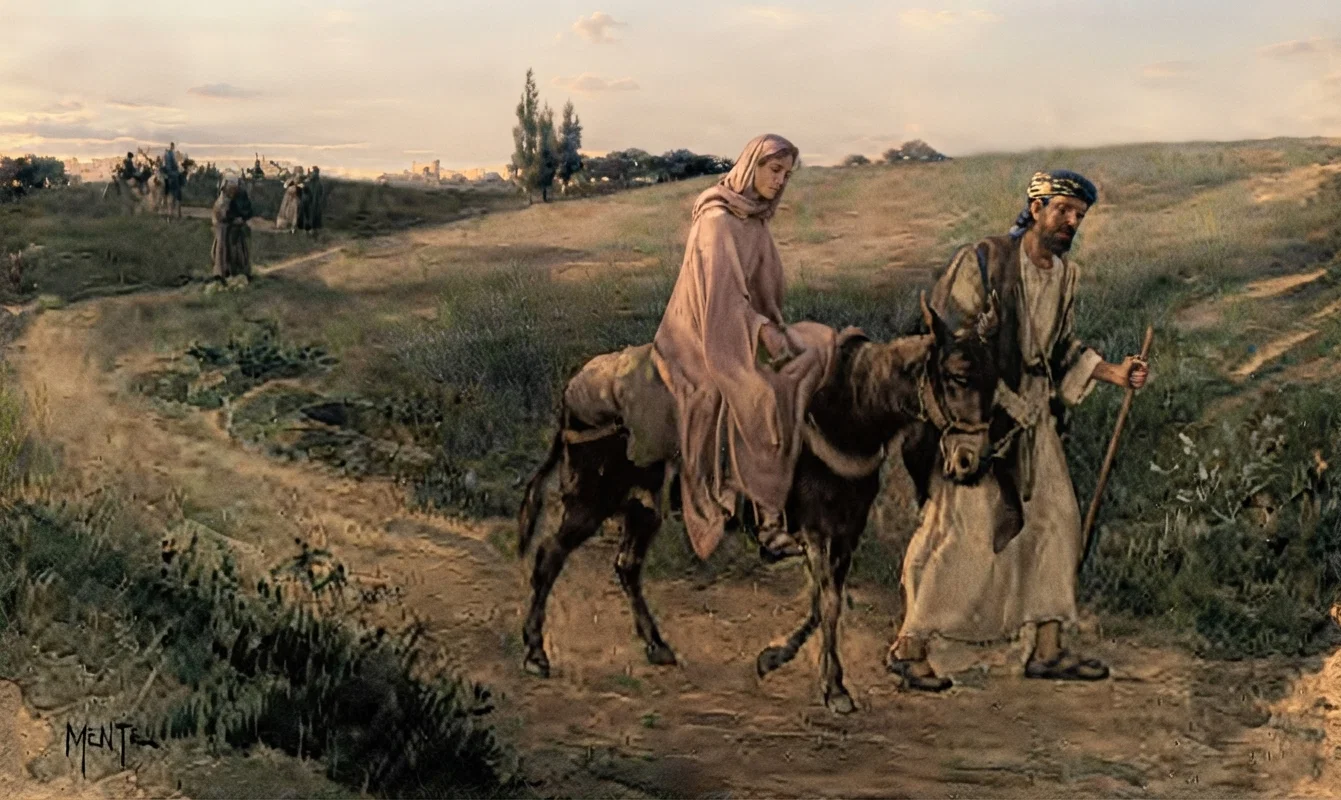
"Now IT came to pass in those days, there went out a decree from Caesar Augustus, that all the world should be enrolled. . . . And all went to enroll themselves, every one to his own city. And Joseph also went up from Galilee, out of the city of Nazareth, into Judea, to the city of David, which is called Bethlehem, because he was of the house and family of David; to enroll himself with Mary, who was betrothed to him, being great with child." Luke 2:1-5, R.V.
No ONE anticipating such a journey would have deferred it until such a late day under such delicate circumstances. The distance was not less than seventy or seventy-five miles—at least three or four days' journey at the rate they must necessarily travel. Arriving at Bethlehem, a new and most embarrassing difficulty meets them,—they can find no stopping-place. They are too late to secure even the ordinary accommodations provided for travelers and temporary sojourners. Others, with no reason at all for being there but the enrolment decree, are ahead of them. Faith would have brought them there and settled them before the decree went forth; but lack of it necessitated their seeking the shelter provided for the beasts.
AND so it ever has been,—lack of faith defers the work of the Lord that might have been done under more favorable circumstances, until the pressure of human decrees renders it embarrassing and oft extremely difficult and dangerous. But, somehow or other, the people of God are slow to profit by the experiences of those who have gone before, altho 'whatsoever things were written aforetime were written for our learning.' When the Lord is obliged to use the heathen (as in the case of Caesar Augustus) as instruments for carrying out the purposes that should have been accomplished by His own people through faith, the end is invariably brought about through much tribulation and bitter experiences on the part of those who ought to have known and performed the Lord's will by faith in His Word.