THE group of islands forming the archipelago in that part of Oceanica called Malasia, is called the Philippines, so named after Philip the Second, then king of Spain.
This group of tropical islands lies between 4° 45' and 21° 17' north latitude, and 120° 5' and 129° 8' east longitude. On the north and west lies the China Sea; on the east, the Pacific Ocean, and on the south, the Celebes Sea.
The total number of islands comprising this group is about fourteen hundred, varying in size from a body of land with an area of over forty thousand square miles to a mere speck in the sea.
The Philippines are divided into three general groups, the Mindanao group being the southern, Vasayan the central, and the Luzon the most northern.
Luzon, the largest island in the Philippines, is about four hundred and eighty miles in length and has an area of forty thousand nine hundred eighty-two square miles. It is the richest, most densely populated, and one of the most fertile islands in the group.
The population of the Philippines is made up from all nations of the globe. At present it numbers about nine million, sixteen thousand of these being Europeans, not including the United States soldiers. There are also a large number of Chinese, and one of the southern islands is inhabited by a tribe of Mohammedans.
There are over thirty different dialects spoken on the islands; the Vasayan, being the most general, is spoken by more than two and one-half millions of the population. In the central part of Luzon, around Manila and Cavite, Tagalog is spoken. Around the seaport towns and where the Spanish have been garrisoned, all can speak Spanish; but very few speak the English language.
The climate of the Philippines is quite healthful compared with that of other tropical countries of the same latitude. This is especially so along the northern coast of Luzon and in the small coast islands.
Corregidor, a small island about five miles long and one mile wide, situated at the mouth of Manila Bay, some thirty-three miles from Manila, has a most delightful climate, the thermometer rarely going above ninety degrees, and seldom below sixty-five.
During the months of December, January, and February, the cool monsoon blows off the China Sea, bringing health and vigor to all on the island.
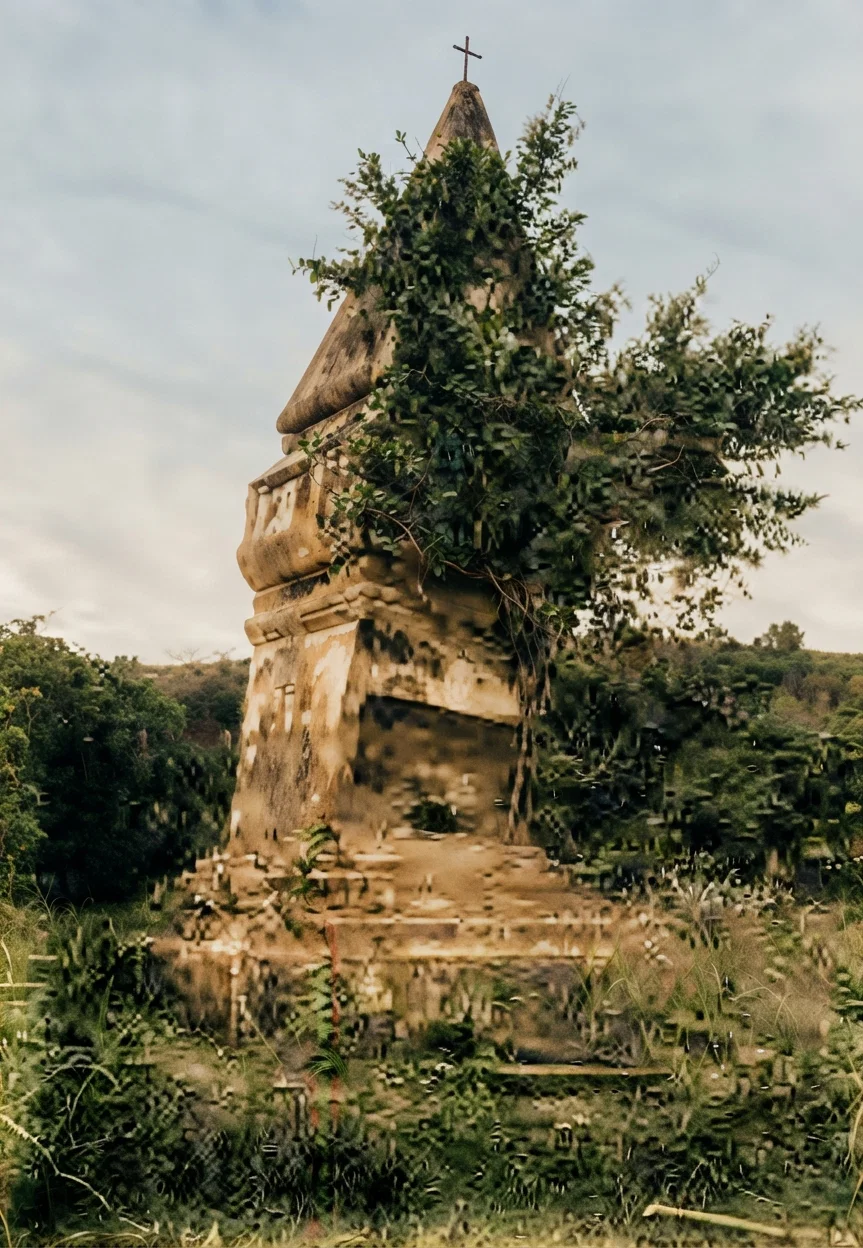
A Monument and Vault Erected in Honor of the First Mayor of Corregidor Island.
In the Philippines they have three seasons, the cool season beginning the latter part of November or the first of December and extending to the middle of March, during which time they have very little rain; then the dry season, continuing until the first part of May. After this comes the wet season, with an occasional shower until June, and then it is not an unusual thing to see it rain and clear up three or four times in one day. When it rains, the water comes down in torrents, and it is not an uncommon thing to see it rain without a cloud in sight. And the way the sun comes out the next few moments, the atmosphere being so humid, makes the heat almost intolerable for a white man. This is most noticeable in the interior of the islands. This wet season continues until October.
In the mountains it is said to be quite pleasant. Some have cool, fresh-water springs in abundance. Many of the mountains reach an altitude of several thousand feet. They are very rugged and steep, many of them being extinct volcanoes. Fire and smoke were seen to issue from one last November.
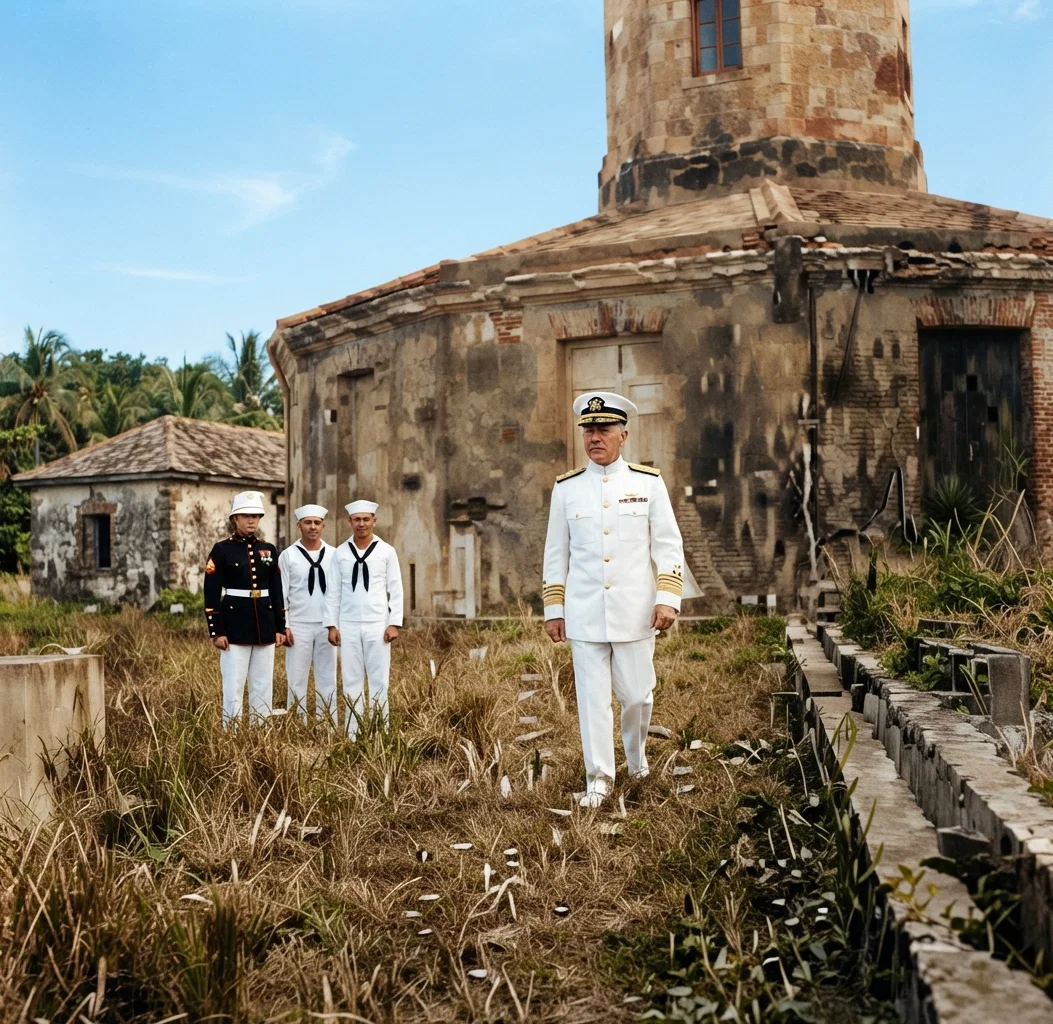
Admiral Dewey at Corregidor Island Lighthouse, Manila, P. I.
The largest river in the Philippines is the Pasig, in the island of Luzon. It is a swift-running stream, rising in the Laguna de Bay, some thirty miles above the city of Manila. It, with its many small tributaries, forms excellent thoroughfares for traffic between the small villages which are scattered along its banks and Manila. It is also deep and wide enough to allow the Hongkong steamers to come up to the docks and quays and discharge their cargoes.
Laguna de Bay, a large fresh-water lake, is about thirty or forty miles wide. Its margins are thickly covered with bamboo and other tropical foliage, many places being a dense jungle. Wild duck and other aquatic fowl abound.
The native Filipino does a thriving business during the fishing season, as the waters abound with a great variety of fish. Many villages are located on the banks of this lake, some of them quite picturesque in their tropical fastnesses.
In the interior, along the rivers, lakes, and low hills, a great variety of most valuable timber abounds. It is all of the hard-wood variety. Many of their stately trees reach six or eight feet in diameter. They consist of mahogany, ebony, madara, narra. Also the cinnamon, clove, and many other spice trees abound. The gentian, sarsaparilla, and soap-root plants of the finest quality are plentiful.
Strange to say, with this almost inexhaustible supply of valuable timber, there is not a steam saw in the archipelago. All the lumber that is used and exported is sawed with what is called a whip-saw, and by Chinese labor. Quite often it takes one day to saw out a single piece of lumber. This lumber is brought into Manila on rafts and small schooners from the interior and adjacent island. It is used for furniture, building purposes, and exported to China, Spain, and the United States.
The bamboo tree is used to great advantage. It grows from forty to sixty feet high, and from six to eight inches in diameter. The Filipino builds his house out of it, with the exception of the nipa thatch of the coconut tree for the roof and sides. He uses the large poles for the frame and rafters and splits them for the floor of his casa.
Many excellent quarries afford an unlimited amount of stone for building purposes, which is used for the building of quays, warehouses, massive cathedrals, the paving of streets, etc.11
At the present time all traffic with the interior is cut off. Lumber is scarce, and it is not safe to go into the interior after it. Consequently all building is at a standstill.
Agriculture is in a backward state in the Philippines. Of the one hundred and twelve thousand square miles of areable land in the archipelago, scarcely eight thousand square miles are under any kind of cultivation. This is largely due to the fact that the natives are very indolent. They will not exert themselves beyond obtaining the bare necessities of life. Many English and German capitalists have opened up plantations around Manila, Cavite, and Malabon within the last few years, and several sugar and other factories have been established. At the present time the agricultural industry is on the retrograde; the rice, sugar, and tobacco fields are barren, and the rich, fertile valley land around Manila Bay is desolate. May the time soon come when war will cease, that the land may be tilled and bring forth her fruit, and the factory wheel turn again.