THE LAMB OF GOD

14%

Pacific Press Publishing Company · Oakland, California · Sep 30, 1897

FromSigns of the Times, Vol. 23, No. 38.

Read the full edition

THE LAMB OF GOD.

JOHN THE BAPTIST was baptizing in Jordan, and the people were flocking to him to be baptized for the remission of their sins. Suddenly One appeared among the crowd, and John, seeing him, pointed him out and exclaimed, “Behold the Lamb of God, which taketh away the sin of the world.”
John had been preaching for some time. He was a faithful preacher; he did not excuse or palliate sin. To those who came to him and asked what they should do, he was able to point out their especial duties in an unmistakable manner. When he saw coming unto him to be baptized many of the Pharisees and Sadducees, knowing the spiritual pride of race which dwelt in their hearts, and the little fruits of true holiness they manifested, he said to them, “Bring forth therefore fruits meet for repentance; and think not to say within yourselves, We have Abraham to our father; for I say unto you, that God is able of these stones to raise up children unto Abraham.” Publicans, whose business it was to collect taxes for the Romans, came to his baptism, and said, “Master, what shall we do?” and John, who knew of their unlawful exactions to secure money for themselves, replied, “Exact no more than that which is appointed you.” Roman soldiers, whose hearts had been touched by his preaching, also came to him and said, “What shall we do?” And when one has read Roman history, and knows how the Roman soldiery often put even their commanding officers in fear, and demanded a fresh donation upon every change of emperor or governor, how striking are the words of John in reply, “Do violence to no man, and be content with your wages.” By this just discrimination of the failings and needs of all those who came unto him, John laid the ax at the root of the tree. The Spirit of God enabled him always to say the right word to the right man.
But while he was thus able to specify the peculiar failings of all who came to him, and point them out for their benefit, there was only one sovereign remedy, which was alike efficacious for every one. All had some peculiar form of sin which they were particularly liable to commit; for sin has a multitude of forms, but one remedy suffices for all. So to every one,—to all within the hearing of his voice, scribe, Pharisee, soldier, publican,—he exclaimed on sight of Jesus, “Behold the Lamb of God, which taketh away the sin of the world.” The Pharisee and scribe must take their ugly pride of birth to Jesus to have it taken away. The publican could only get rid of his selfishness, which led him to make unjust exactions, at the foot of the cross. The soldier must lose his violent character by the help of Him who is all love and tenderness. In Jesus is the one and only salvation for sin, no matter in what phase it presents itself. He takes it away, and lets the sinner go free.
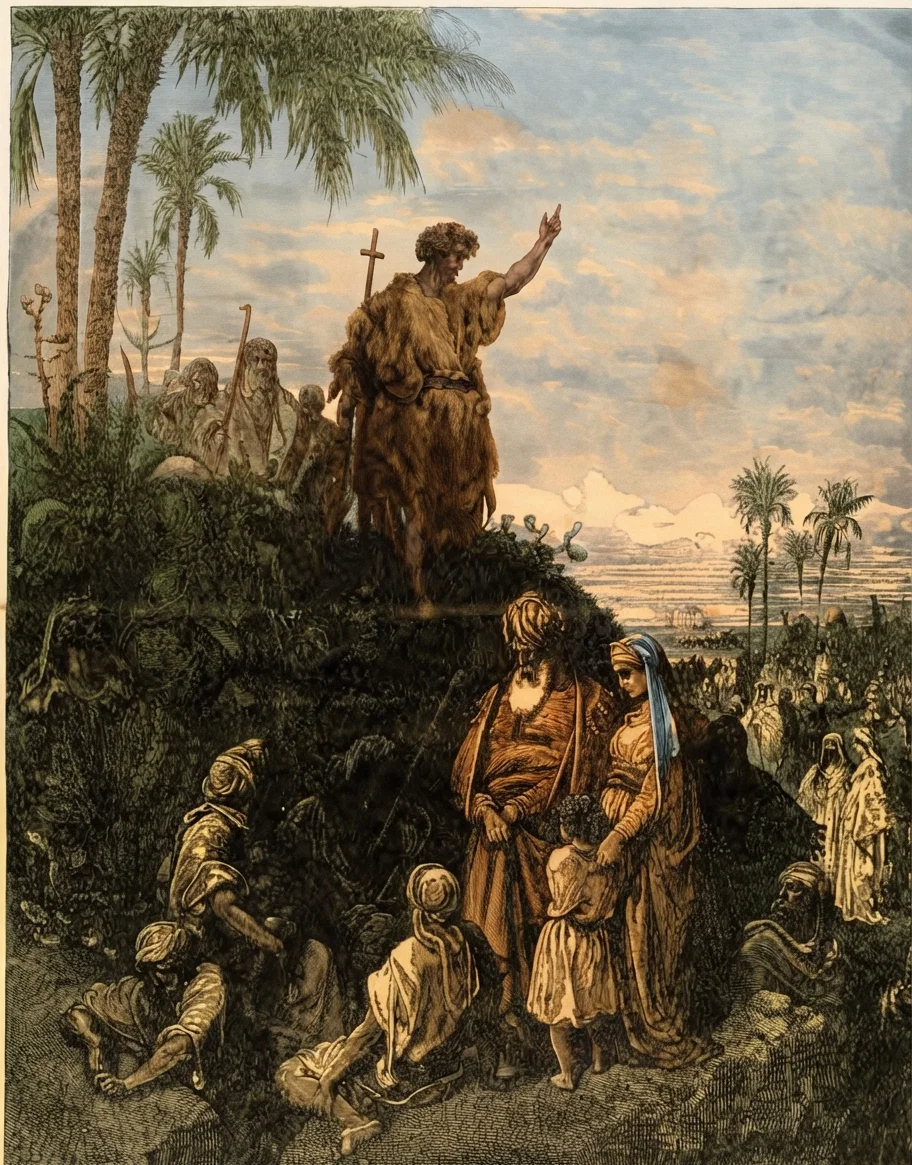
JOHN THE BAPTIST PREACHING.
How is it taken away?—By the “Lamb of God.” In these words the idea of a divine sacrifice for sin is clearly set forth. Under the sacrificial system, offerings were required. Of these, the lamb, token of innocence and gentleness, and thus a fitting representation of Christ, was the most conspicuous offering. Under that law, the penitent sinner brought a lamb as an offering for his sin. Another life was taken instead of his, other blood fell on the earth, while his still coursed through his veins. In this action the idea of substitution of the innocent for the guilty, and the transfer of the punishment due for sin from the sinner to the sinless, was plainly taught. Thus the idea of a sacrifice for sin had been before the people of Israel from the most remote times. Abel offered an acceptable sacrifice; Noah made sacrifices to God upon emerging from the ark after the deluge. Abraham, Isaac, and Jacob, wherever they journeyed, built an altar unto the Lord, and made offerings thereupon. Moses, under God’s direction, promoted a system of such sacrifices. And so it had come down to the days of John the Baptist. But now the typical was to give way to the real, the shadow to the substance. The lamb of Abel, the lambs of Noah, Abraham, Isaac, and Jacob,—the lambs of every penitent sinner, in all those preceding ages,—had been brought to the sacrifice, and men had beheld them; but now the Lamb of God, God’s Lamb, had come, and in the fulness of time was to be offered as a final and complete sacrifice for sin. Men had looked over their flocks, and sought out the fairest and best for sacrifice, and now the best of heaven,—the most precious Lamb in all God’s great fold, he that was “holy, harmless, undefiled, separate from sinners, and made higher than the heavens,”—was come to earth, to be “brought as a lamb to the slaughter.” The words of Abraham to Isaac, in their deep prophetic meaning, were now to be fulfilled: “My son, God will provide himself with a lamb.” That lamb was Christ, the altar upon which he was offered was Calvary, and he is the sacrifice for every penitent sinner in the world. In the olden time, each sinner brought a lamb for himself, but God’s Lamb is for all. “All we like sheep have gone astray; we have turned every one to his own way; and the Lord hath laid on him the iniquity of us all.”
Sinner, behold God’s Lamb, which he gave up as a sacrifice for you. Is he not a perfect sacrifice? Can you find one blemish in his character? Was there ever such humility, pity, love, mercy, goodness, and holiness as his? God has made no mistake. The Lamb he has provided is “without blemish and without spot.” Behold him,—the Son of the infinite God,—a babe in the manger at Bethlehem, a child in a humble home in Nazareth, a teacher of righteousness by the shores of Galilee, in the synagogue and streets; listen to the gracious words that fall from his lips, and see the miracles of healing which evince at once his divinity and his love. Behold him in the supreme hour of sacrifice. “He was led as a lamb to the slaughter.” Calvary is the altar of sacrifice for all the world, the place where the heart-aches of all humanity may be cured. Blood has flowed in thousands of places, but the blood that trickled from the temples, hands, and feet, and poured from the pierced side, of Jesus, means more to you and me than all that was ever poured out on Jewish altars, or crimsoned the world’s battle-fields, because Christ’s blood was the price of our redemption. He bore our sins in his own body on the tree, reconciling the world to himself.Lastly, behold him come forth from the tomb, a conqueror, and ascend to heaven, from whence he will come again to judge the living and dead. Tho in heaven, he is our Saviour, and if we confess and forsake our sins, he will take them away. He taketh away the sins of the world—all sins that are confessed—and, if we desire to have our sins taken away, they should be confessed while he pleads. Jesus, the Lamb of God, stands ready to bear our sins. Will we give them up to him, and receive therefor his forgiving smiles and the life everlasting? M. E. K.