The Open Church

11%

Pacific Press Publishing Association · Mountain View, Cal. · Feb 6, 1912

FromSigns of the Times, Vol. 39, No. 6.

Read the full edition

The Open Church

AN open church is declared in the little town of Los Gatos, California, and worse than all, a Baptist Church. That Baptist Church has a minister with a record. He is known in time past as an "insurgent," and one who has given his brethren more or less anxiety. On January 14 he induced his church to pass, by a practically unanimous vote, a resolution to the effect that "there ought not to be, and from henceforth there is not to be, any ritualistic barrier to membership in this church;" thus "making the basis of membership wholly spiritual, as we believe it ought to be." This is similar to the position taken by the First Christian Church of Berkeley, and yet it is independent of it. Mr. Whitaker, the pastor, declares, "I made the statement some five years ago before the Baptist ministers of San Francisco that open membership ought to come, and would come, before American Baptists;" and that he has been strengthened in this belief by his recent trip to England, and contact with leading Baptists there; and to his surprise and pleasure he found that his own people had grown into the same conviction, and were ready to take the step. This is the resolution which was there passed, and which the pastor thinks is to spread throughout the Baptist denomination:
"The First Baptist Church of Los Gatos, California, with increased loyalty to the fundamentals of our denominational faith, to the heroic witness of our denominational history, and to the serious call of our present denominational opportunity, hereby records the conviction and the determination that there ought not to be, and from henceforth there is not to be, any ritualistic barrier to membership in this church. Believing the proper form of baptism to be immersion, and the proper subjects of baptism to be believers only, this church will so continue to teach, but we shall leave the observance or the non-observance of this, and every other ritualistic act, to the individual conscience, without anything that savors of coercion on our part, thus making our membership requirements entirely spiritual, as we believe they ought to be."
Now if that resolution expresses loyalty to the fundamentals of the Baptist denomination, we have not read Baptist history aright. If baptism itself is to be utterly set aside as this resolution does set it aside, then the inquiry may well be made, Of what use is the Baptist denomination at all? Of course the resolution says, "We will continue to teach that baptism is immersion;" but why continue to teach such a thing as that, if it is not considered essential? Continuing to teach that, and yet utterly ignoring it in practise, will only stir up polemic strife for nothing. Nor have we ever heard that any coercion has ever been used in connection with Baptist membership. One is entirely free to join the Baptist Church and receive immersion, if he so desires, and he is entirely free to go to any other denomination, if he so desires. But if one joins the Baptist Church, he certainly ought to be so fully persuaded in his own mind, that he would be willing to receive the tenets of the denomination, and yield to the baptismal ordinance. In fact he ought not only to yield to it, but he ought fully to desire it. This resolution opens that Baptist Church to every man, woman, or child, without regard to creed.
Will Mr. Whitaker’s prediction prove true, that it will be generally accepted by the Baptist denomination? There are some Baptist papers, like the Word and Way, which believe in the old landmarks. It so thoroly believes them that it holds that the liberals and insurgents like Mr. Whitaker are about as worthless as can be, to Christianity. Some time ago it said:
"What of the men who have left their pulpits to proclaim their discovery of some improvement on the old Gospel? There have been a good many of them, first and last. What has become of them? What monument have they left? Usually they have gone forth from the church with power, followed by a goodly congregation, and for a time have attracted the notice of the world; but what becomes of them and their churches, and the denatured gospel that they preach? No one knows. They themselves are sure only whence they came. They believe they are on the way to something, but they do not know what. Once a dog was thrown out of the baggage-car onto the station platform; and the station master, failing to find a way-bill for him, asked, "Where is he going?" "I don’t know where he is going," responded the trainman, "and he don’t know, and there don’t nobody know. He has chawed up his tag."
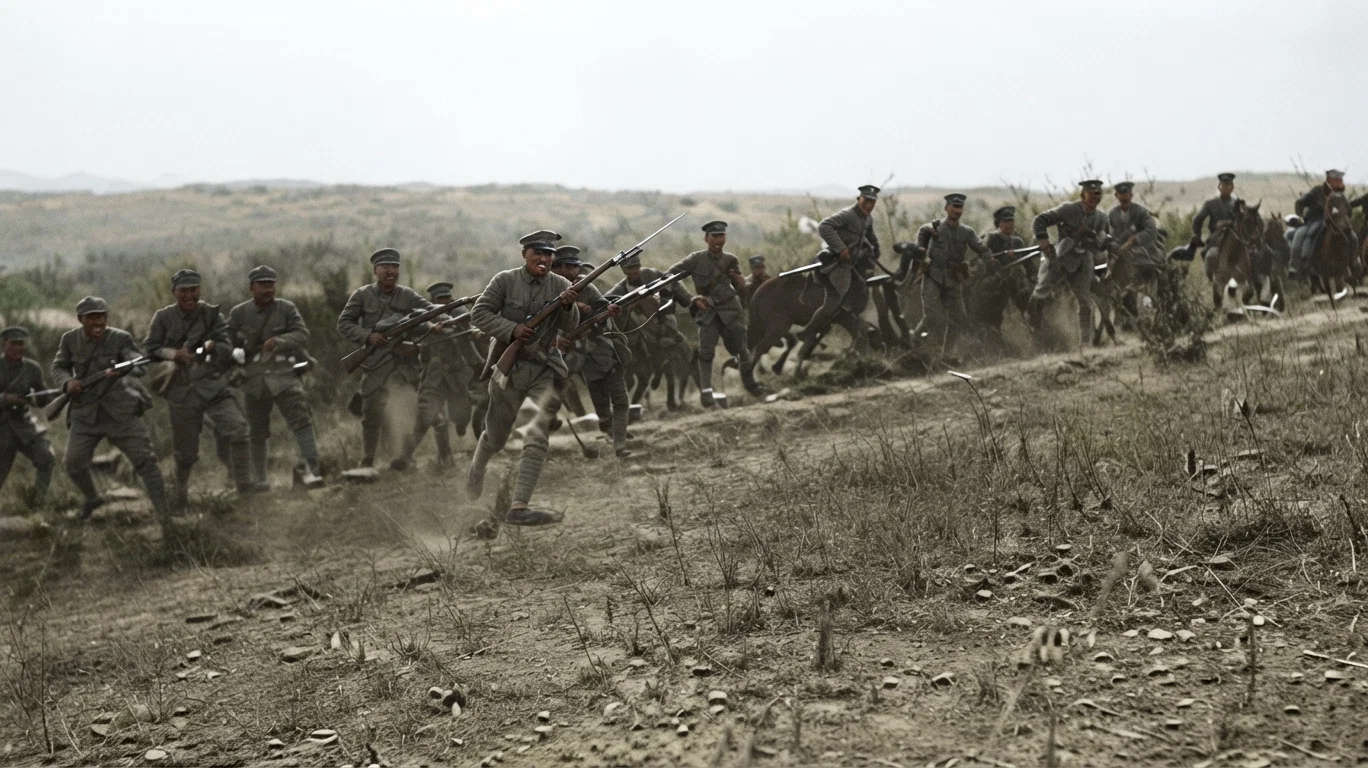
Rebels charging Purple Hill, Nanking
But this is a Baptist matter, and probably we ought to keep out of it. We mention it only to show the tendency and drift of present-day religion.
— —