By Charles Miles Snow, Author of "Rise and Fall of Religious Liberty in America"
VI—Great Forces Uniting for the Enforcement of a Sabbath
IN the Gospel of Jesus Christ there is set before the world the principle of the equality of men and the right of choice in religious things. In the great Charter of Civil Rights which the barons of England forced King John to sign, men began to put into legal phraseology the first of those two Gospel principles. In the Constitution of the United States, the second of those principles began to receive legislative recognition.
In the famous Congressional Sunday Mail Reports, submitted in 1829 and 1830, the Congress of the United States, in most emphatic language, warned the people of the United States against "religious combinations to effect a political purpose," and pointed out in no uncertain language the disastrous result of any attempt by Congress to decide a religious controversy, such as the enforcement of a sabbath would be.
Progress of "National Reform"
Nevertheless, in spite of the terrible object-lessons of history, and despite the faithful warnings of our own national legislature, an organized movement has been in progress in this country for nearly half a century, whose success means the rejection, by the people and by the Government, of those principles so vitally inherent in the Gospel, and so necessary to the freedom, prosperity, and happiness of mankind. The leaders in that movement have been sowing broadcast among the people, for forty-eight years, the seeds of national disaster and of intellectual and spiritual bondage. Many of those seeds have fallen in receptive soil, and have begun to produce their baneful harvest. During those years, we have seen denomination after denomination throwing its influence in favor of religious oppression by favoring legislation of a religious character. We have seen also, as pointed out in a previous article, how the great body of united Protestantism—the Federal Council of the Churches of Christ in America—has definitely pledged itself to that policy of retrogression against which the Gospel protests, and against which our national Congress has warned us so faithfully and so eloquently. United Protestantism, as represented in that body, stands committed to that most dangerous principle, which would overturn the very basis of American liberties, and start the nation on the backward track toward the intolerance and religious oppression of colonial days and of the Dark Ages. For it must be admitted that when the door is opened to admit the evil principle of the control of conscience by law, there is no other goal at which to stop than the goal of persecution, and every human right is liable to invasion.
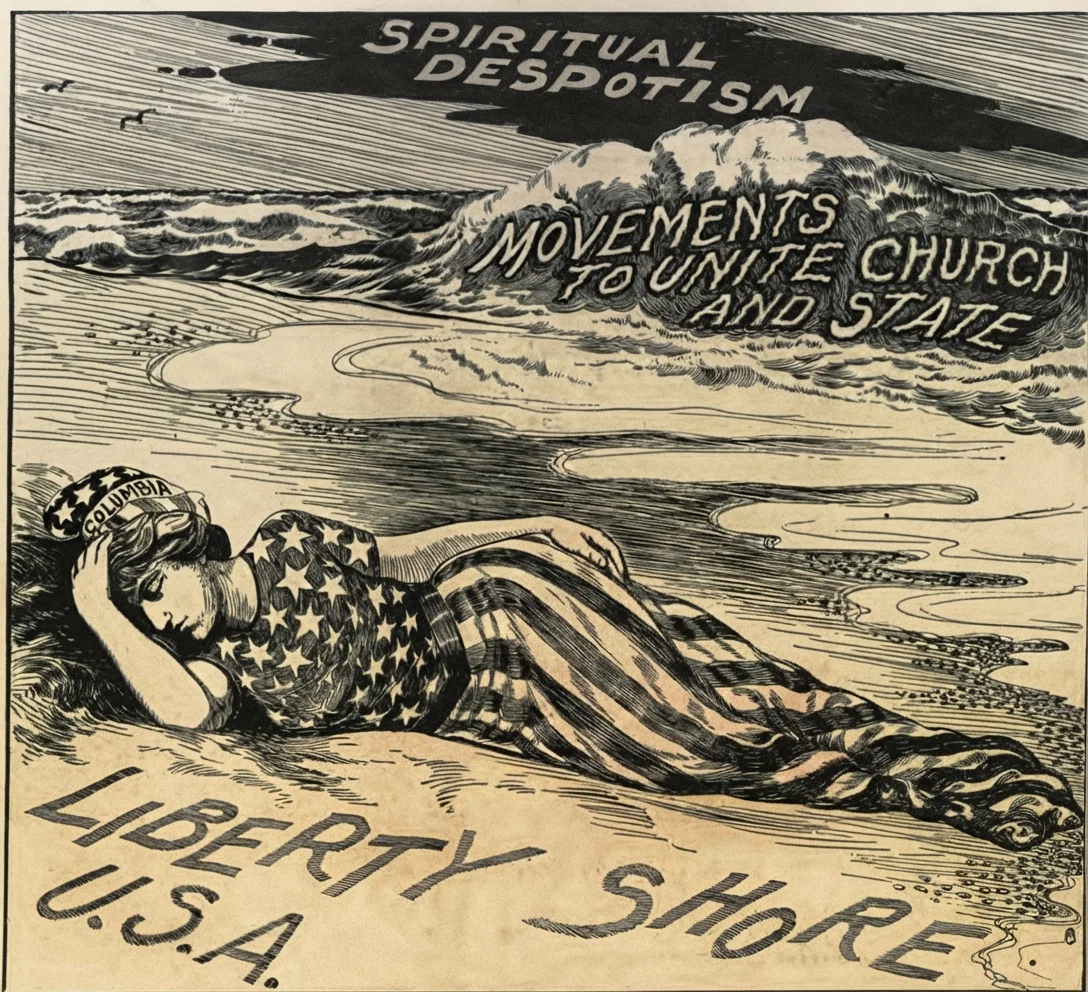
Columbia, trusting to a glorious past of Freedom, lies sleeping on the shore of liberty. She does not see the black cloud of spiritual despotism which is darkening the heavens. She does not hear the mighty roar of the on-coming billows. Awake, Columbia! Awake!
A Bid for Union with Catholics
Now with Protestantism definitely committed to that policy, it will be a matter of no small interest to know where that other great religious organization, the Roman Catholic Church, stands in reference to these un-American propositions espoused by the organizations previously named.
In 1884 the National Reform Association made a bid for the support of the Roman Catholic Church in carrying out its program. That bid was published in the Christian Statesman of December 11, and reads:
"Whenever they [the Roman Catholics] are willing to coöperate in resisting the progress of political atheism, we will gladly join hands with them."
What they meant by "political atheism" was nothing more nor less than the separation of religion from the functions of government—the separation of Church and State—and the nation's guaranty, to the individual, of the right to worship God according to the dictates of conscience. The right of the individual to worship God independent of the dominance of other men is "political atheism." The right to equality under the government without regard to our religious belief is "political atheism." The refusal of our Government to declare its preference for one religion above another is "political atheism." That ground being common to both the National Reform Association and the Roman Catholic Church, the latter took under favorable consideration the proposition of coöperation, and in the year 1889, at the Catholic Lay Congress held in Baltimore, Maryland, on November 12, issued the following pronunciamento:
Roman Catholic Response
"There are many Christian issues upon which Catholics could come together with non-Catholics and shape civil legislation for the public weal. In spite of rebuff and injustice, and overlooking zealotry, we should seek an alliance with non-Catholics for proper Sunday observance."—Quoted in "Religious Liberty Library," No. 6, page 62.
That was what the National Reformers were seeking, an alliance for the enforcement of "proper Sunday observance." And this action of the Catholic Lay Congress was taken, as announced by the National Reform Association, "after correspondence and conference with the American Sabbath Union." It was advocated by the editor of the Catholic Universe in these words:
"What we should seek is an en rapport with the Protestant Christians who desire to keep Sunday holy."—Paper read at the Lay Congress above mentioned, November 12, 1889.
The basis of union in both these proposals is the enforcement of a religious ordinance upon the people — the compulsory keeping of a sabbath. The pronunciamento issued as a result of the National Reform proposal and the “correspondence and conference with the American Sabbath Union,” declared in favor of such a union between Catholics and non-Catholics as would enable this combination to “shape civil legislation for the public weal;” and that “public weal” for which they were to unite in shaping legislation is principally comprehended in what they denominate “proper Sunday observance.” This attitude of the Catholic Lay Congress toward the enforcement of a religious ordinance upon the people, and toward general legislation of a religious character, had its basis in an encyclical of Pope Leo XIII issued four years earlier, in 1885, which reads:4
“All Catholics should do all in their power to cause the constitutions of States, and legislation, to be modeled on the principles of the true church.”
The principle of “the true church” in reference to the proper relation between Church and State is that the two institutions should be joined, controlled by one head, and that head the head of the Roman Catholic Church, and that all heresy should be punished by pains and penalties. The principles of National Reformism, carried to their ultimate, involve just such an arrangement, tho they refuse as yet to acknowledge the headship of the pope. Both organizations believe in the union of religion and the State, which is the same as a union of Church and State; both believe in the State’s legislating upon religious matters; both believe in the enforcement of the Sunday institution by law, backed by legal punishment; both believe in setting up a standard of religion for the nation, and laying the hand of the law upon religions that do not conform to the standard. Why should they not join hands?
A Federation of Protestant Churches
But as there are other religious organizations that have espoused the principles of National Reformism, the horizon of possible union with Rome upon these issues is correspondingly enlarged. As these other religious organizations have now banded themselves together into one great combination, claiming to speak for united Protestantism, we will speak of them in this collective capacity. That organization is the Federal Council of the Churches of Christ in America, which claims to represent 18,000,000 communicants and to speak for practically one half the population of the United States. In view of the consolidation of power and influence represented by that organization, the position which it assumes upon any question is a matter of no little consequence. The following resolution passed by that body at its session in Philadelphia in December, 1908, demonstrates its attitude toward religious legislation, and incidentally toward the previously mentioned organizations which stand for the same thing. The resolution reads:
“RESOLVED, That all encroachments upon the claims and sanctities of the Lord’s day should be stoutly resisted through the press, the Lord’s Day Associations and Alliances, and by SUCH LEGISLATION AS MAY BE SECURED to protect and preserve this bulwark of our American Christianity;
“That we rejoice in THE PROSPECT OF UNITY of action among the various ORGANIZATIONS striving in America for the preservation of the Lord’s day as a day for rest and worship.”
A Catholic Call
The first of these resolutions is a summons to Protestant organizations by an organization claiming to represent Protestantism. It summons them to the work of securing a sabbath, a religious ordinance, by compulsion of human law. In this connection it will be interesting to read a somewhat similar summons to Protestant organizations by a representative of Roman Catholicism:
“All W. C. T. U.’s and Y.’s, churches, pastors, young people’s societies, Law and Order Leagues, and individuals, are called upon to help maintain our sabbath as a day of the Lord for the people, without regard to race, sex, or condition, for a day of rest and worship. To this end let us make sabbath observance week in Minnesota marked by sermons, public meetings, Sunday-school exercises, distribution of literature, and prayer for the better enforcement of law against all infringement of the right of sabbath observance.”
This appeared in the Northwestern Chronicle of April 5, 1895, the official organ of Archbishop Ireland.
This summons is something unique in the history of Christendom — a Catholic archbishop calling Protestant organizations to the support of an institution established by the papal church. The summons has been heeded, and all these organizations, not only in Minnesota, but in all the country, are now having urged upon them, and are in turn urging upon legislators, the necessity of legislation for the enforcement of the Sunday institution.
It is a matter of no small significance that an archbishop of the Roman Catholic Church in America, and an organization representing so large a proportion of the Protestant church in America, should both be summoning Protestant organizations to rally to the defense of a certain religious institution by securing legislation in its behalf.
The second of the two resolutions quoted above from the proceedings of the Federal Council is broad in its scope. It does not specify either Protestant or Catholic organizations. It must be taken as including both, and as signifying the desire of that great organization to join with the Catholic hierarchy in America in the work of securing legislation enforcing upon the people the observance of a religious institution.
No Exceptions Allowed
During the discussion of the committee’s report at the above-mentioned council, a resolution was introduced to the effect that it was not the Federal Council’s intention that anything should be done to interfere with the convictions of their seventh-day brethren in the matter of the observance of the seventh-day Sabbath. The resolution raised a storm of protest, and was overwhelmingly defeated with a vigorous demonstration of satisfaction. The council thus put itself on record as opposed to religious liberty, and in favor of compulsion in religion, even for members of its own organization, the Seventh-day Baptists. In doing so, it took a position in harmony with the Church of Rome, so far as its attitude toward the fundamental principles of the Gospel and of the American nation are concerned.
Thus are these two great forces in America — Catholicism and federated Protestantism — united upon one great issue, the enforcement of the Sunday sabbath upon all the people, without regard to conscientious convictions. What God has separated, they have joined. What God has joined, they would separate, by thrusting in between man and his Maker a wall of human ceremony, human requirements, and human prohibitions. The religio-political unification of the whole country assumes the right to override conscience, lay an embargo upon its functions, and set itself in authority over men’s religious obligations and activities. When this unification has been fully accomplished, it will be found to be, for all practical purposes, the same machine that has operated to fill the earth with the graves of martyrs, and that Rome is leading the procession again toward that goal. On many matters, federated Protestantism stands opposed to Rome; but upon this one issue, the enforcement of the Sunday sabbath, forces will be joined, and “team work” will be done. Through a union thus effected, Rome expects to achieve her purpose in America, and through America to win back the world she has been losing, so that she may yet set her pontiffs over all the kings of the earth, and rule through them the people of every land, and dictate the religion of mankind. This is Rome’s declared intention; and Protestants who are helping her to override the religious rights of men by establishing and enforcing a sabbath of her making, are putting into her hands the machinery and the power with which to accomplish that hoary-headed purpose concerning both America and the world.