[Mr. Corliss has been engaged in religious liberty work for many years in three continents, Europe, Australia, and America. He has appeared repeatedly before committees in Congress and in State legislatures. For several years past he has led the religious liberty forces in California. He has in every way studied the question from every side.]
A Candid Appeal to Californians
WITHOUT any doubt whatever, Sunday rest law advocates will succeed in securing the necessary eight per cent of the voters' signatures necessary to insure the Sunday rest question a place on the ballots to be used at the next State election. The measures now being taken to this end must succeed, because there will be enough of the clergy of the State, who are at the head of the movement in California, to enroll easily the names of their church-members, after some impassioned appeal to their church loyalty.
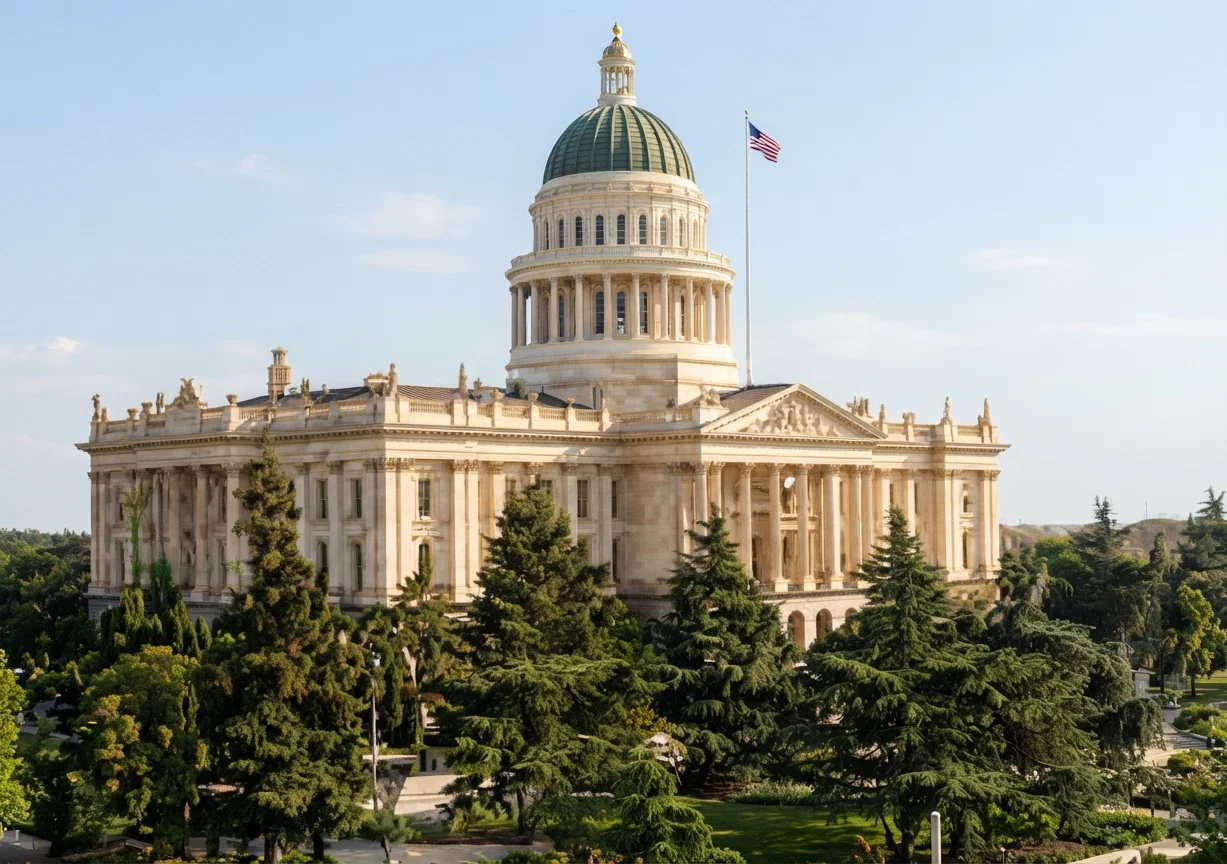
STATE CAPITOL IN SACRAMENTO, CALIFORNIA
This done, the final disposition of the proposition will rest with the voters of the State, who have, under the "Initiative and Referendum," the privilege of voting "Yes" or "No" upon the question. In meeting this issue at the polls, it will be well for every voter to have canvassed beforehand the whole topic, in order to cast his vote intelligently. It will be much better voluntarily to look squarely at possible results at the beginning, with a remedy at hand, than to gaze back with regret over a situation from which no relief is afforded.
One thing is certain,—that under present circumstances, when every individual is permitted to elect for himself whether he will rest, perform labor, or seek some form of recreation, peace and good will have been the rule throughout the State. But if a legal Sunday rest obtains, no certainty of this harmonious relation of society is assured, for the reason that it is a purely religious movement, born of a determination to have the church rule in matters of public religious ceremony. If the church wins in the contest through the aid of the "Initiative and Referendum," its members, especially those of narrow conception and illiberal sentiment, will feel in duty bound to act as spies on the conduct of their neighbors, to see that the law is reverenced.
A Generation of Hypocrisy and Deceit
This could but cause a repetition of medieval conditions, when, under a similar governmental arrangement, neighbors betrayed neighbors, friends violated sacred confidences, and near relatives delivered up each other to the civil courts, through frenzied fear of being counted comrades of those who overstepped the limits of the law. So far, indeed, was this régime carried that the milk of human kindness seemed frozen out of every breast, and the empty place filled with the icy coldness of distrust and deceit. The general rule of life was, in consequence, one of studied falsehood and hypocritical observances, until, with a mind degraded by habitual deception, the wrecked soul sank, hopeless and terror-stricken, into the grave.
A part of that early persecution, history affirms, was over the enforcement of Sunday as a day of rest, on the ground that the non-observance of that day was a sure sign of heresy. But this stigma of rebuke by the church would have counted for nothing, had not the church won the coöperation of the State to make her anathema effective. It was this, and this alone, that destroyed neighborhood unity, and made life a burden to all dissenters. Without State support the church could not have enforced her decrees on unwilling subjects; for of herself she was powerless to do more than that which she was divinely commissioned to do,—preach the Gospel.
An Unholy Ambition
But the church could not be, or at least was not, satisfied with the commission received, accompanied tho it was with the promise of divine power to win men through moral suasion. State power she was determined to have, by which to coerce halting souls; and she carried her point. State support secured, her path was unobstructed and smooth. From that time on, her skirts would be untainted with the blood of heretics, since they would be punished by State authority. Church-members, however, in the rôle of citizens, were not barred from making complaints in civil courts, against the transgressors of a rigid church rule sustained by State law, and thus it happened that the church received power to harass and persecute dissenters by means of civil law.
It may be said that that system was one of church-and-state union. True enough; but should the church now enlist the support of the State to enforce a religious ordinance upon the people, that would be exactly what was done to unite Church and State in medieval days, which resulted in so much sectarian strife and mortal hatred. There is nothing to prevent the same state of affairs now, if a like opportunity ripens by the use of the "Initiative and Referendum."
Like Causes, Like Results
The objection may be raised that people are more enlightened now than before, and this would act as preventive against such work as history records of past ages. But human nature is much the same now as it ever has been, and bigotry operates in the same way. Even now Sunday law agitators are scenting their prey, and are becoming bold in their declarations of attitude toward those who oppose their demands. At a National Reform convention held at Winona Lake, Indiana, August 8-19, 1910, the Rev. J. S. Martin, general superintendent of that association, is reported to have said when referring to seventh-day observers:
"This is not a Jewish country. If the people who come to this country do not like its Christian features, the doors that swung in, and permitted them to enter, will swing the other way, and they will have to hunt a country where they will find what they want. . . . The State will not allow those who want to keep the seventh day to do work on the first day of the week. It will not allow them to do this in the name of conscience, because the conscience of the American people is Christian."
"It is up to us to say what the religion of this country shall be. If the State accepts the religion of Jesus Christ as its religion, and seeks to be governed by the will of God, you can safely trust that State. . . . I am not afraid of persecution or infringement upon the rights of individual citizens under a Christian administration."
What Will the Ripened Fruit Be?
But all men know that it was just this kind of government in past ages that brought millions to martyrs' graves. Given the same conditions and opportunity of that time, its history will be repeated. Yet the sentiment uttered by Mr. Martin is the growing sentiment of this movement everywhere.7While in an attempt to have the people vote in favor of a Sunday rest law, with the promise that the measure will be a mild one, and not too exacting upon any one, yet in a speech by the California State superintendent of the Sunday rest proposition delivered in San Jose, the evening of February 14, 1912, he said that “those who were not loyal enough to the American Government to observe its American sabbath [meaning Sunday] should find a spot in some other part of the world where they can go and spend their time as they wish.”
Such statements surely ought to open the eyes of voters as to the ultimate design of these would-be Sunday reformers. If they mean anything, they show that the aim of these churchmen is to enslave, by civil enactment, the general conscience if possible, by chaining it to their Sunday-keeping creed. The immortal statement of Lincoln is to the point in considering this issue: “But we can not be free men if this is, by our national choice, to be a land of slavery. Those who deny freedom to others, deserve it not for themselves; and under the rule of a just God, can not long retain it.”
Court Decisions
One is told, by way of assurance, that the measure is correct, that it is sustained by supreme court decisions in many States. But in every case, without exception, where this has been done, it has been upon the basis that Christianity is the common law of the land, and this clearly shows that religion is the basis upon which all Sunday laws rest. If, however, Sunday rest laws have a rightful place in the statutes, on the ground of their constitutionality, why is it designed to contravene the Constitution by exempting some from a constitutional requirement, on the ground of their counteracting religion?
To know that seventh-day observers are counted such, one has only to hear the Sunday rest law advocates reiterate, in each public talk, that these are the worst opponents of Sunday laws in the country, and that they are doing more than all others combined, to destroy respect for Sunday observance. Yet these are the very people to be especially exempted from the operation of the proposed law, which is to be enacted for the express purpose of enforcing Sunday rest.
Why is this? Is it out of respect for them, or because of a desire to help them further to destroy respect for Sunday?—Hardly either of these. No, indeed; it is hoped by this course to check their opposition, and cover up from honest souls the real intent of the movement, until the State is committed to the desired legislation.
But have not seventh-day observers a perfect right to teach people that “the seventh day is the Sabbath of the Lord,” just as the Bible states it, and that it is the only Sabbath known to the Bible? Prominent Sunday law advocates are obliged to admit that there is no explicit command in the New Testament for Sunday observance. Why should Seventh-day Adventists be arraigned before the public for saying the same thing? Suppose even that they affirm Sunday is the Sabbath. Have not Adventists as good right to disagree with them as they have to disagree with Adventists?
Speaking to this point, an editorial in the Western Christian Union, as far back as March 22, 1889, said:
“Instead of thankfully making use of concessions granted them, and then going off quietly and attending to their own business AS THEY OUGHT, they [the Adventists] start out making unholy alliances, that they may defeat the purposes of their benefactors[?]. None of the bills are aimed at them; but if they fail to appreciate the fact, they may call down upon themselves such a measure of public disfavor as that legislation embarrassing to them may result.”
All this because the Adventists fail to see religious duty as do these Sunday law advocates. But if the church shall secure the legislation it craves, who will see to the enforcement of the law, if not the church itself? In order to do this, police courts must do her bidding. This will put the State in a subordinate position to the church, existing simply to formulate and to execute the will of the church.
Rest assured, voters of California, that to lend assistance to the enactment of a Sunday rest law will be to unsettle present satisfactory conditions, and not only bring dissatisfaction and unrest, but it will be an opening through which will enter more drastic religious demands. It is far better to wait for a sure light to guide in the way, than to take a leap in the dark, as will all who lend aid to the foisting of a legal Sunday rest upon all the people. Let those whose convictions lead them to the strictest observance of Sunday be faithful to their consciences, but let none attempt to be conscience for others in the matter of a weekly rest.