IN the scheme of the National Reformers, back of all the proposed religious legislation in this country, we have shown that all who oppose their ideal government are counted atheists, and in this class fall seventh-day Christians. It is intimated that those who oppose Sunday laws are not loyal Americans, that they should leave this country and go to some other land or submit. But those who thus talk are either themselves ignorant, or believe that the people are ignorant, of the devotion and loyalty that have been manifested by seventh-day observers and opposers of Sunday law, to this Government, from the very beginning. Here are some facts which clearly show the prominent part which they acted in the foundation of this Government:
One of the leading men in the First Continental Congress, to which he was duly elected, which convened September 5, 1774, was Governor Samuel Ward, of Newport, Rhode Island. In 1775 he became a prominent figure, acted as chairman upon some of the most important committees, and when Congress did business as a committee of the whole, Mr. Ward occupied the position as chairman almost continually during the sessions of 1775 and 1776. In fact, he so acted at the time that George Washington was made commander-in-chief of the Continental army. He had much to do with the organizing of the Continental army, and directing the movements of the colonies. He would have been one of the signers of the Declaration of Independence, if he had not been taken during the sessions of that Congress with virulent smallpox, of which he died when Congress was in session, in March, 1776. (See "Seventh-day Baptists in Europe and America," by Randolph, pages 637, 638, also pages 937, 1163-6.)
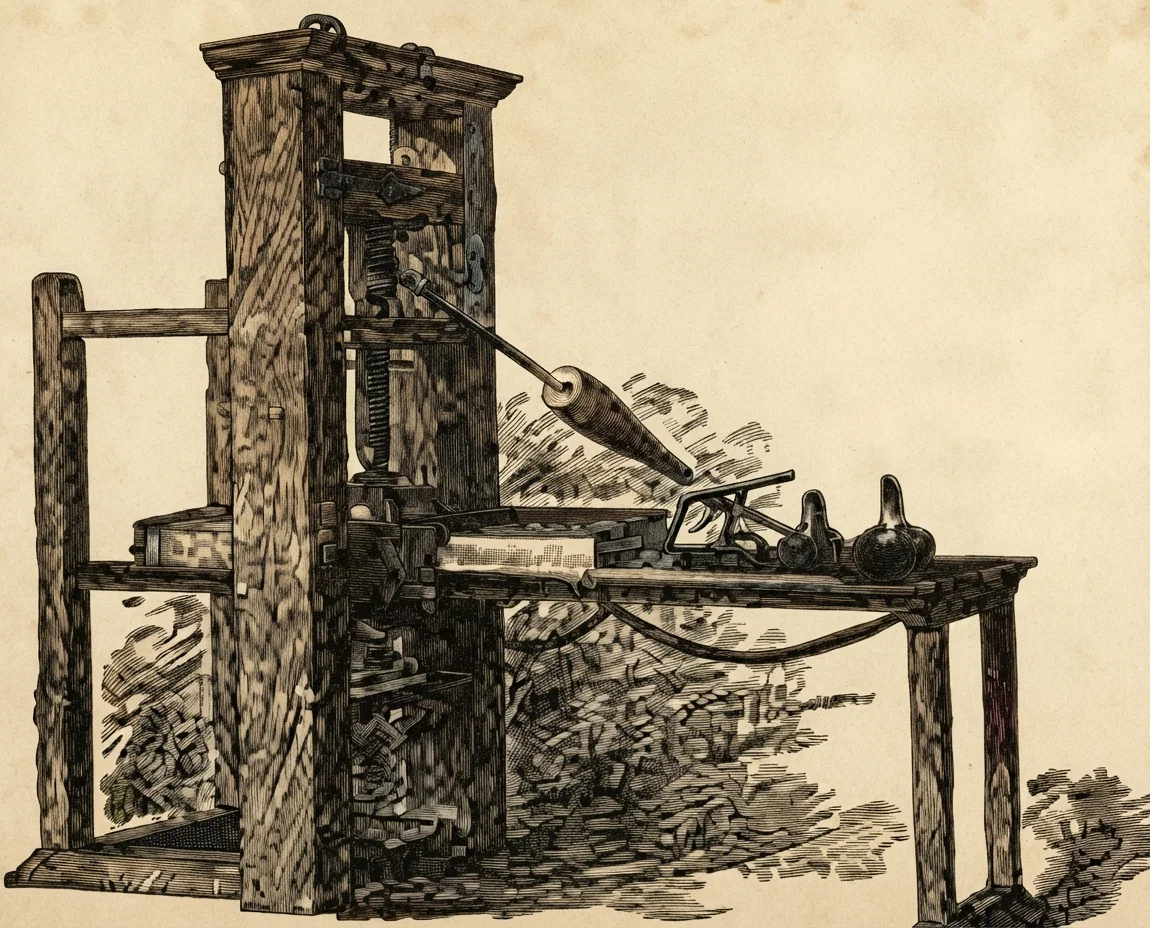
The old Ephrata Seventh-day Baptist press on which the Declaration of Independence was first printed.
His published correspondence with Washington and others contains important documents touching the work of the Continental Congress. Mr. Ward's son Samuel was captain of the Twelfth Rhode Island Regiment, and of him George Washington speaks very highly as a competent officer. Governor Ward was a Seventh-day Baptist.
The German Seventh-day Baptists of Pennsylvania—the little town of Ephrata, near Philadelphia, being the center of their work—rendered also faithful service during the times of the Revolutionary War. Altho themselves not believing in war or bloodshed, their whole sympathy was thrown with the ardent struggle of the patriots, and their homes and church and hospital became hospitals for the care of the wounded soldiers. Some of them died in nursing the soldiers sick of typhus fever. Not less than five hundred sick and wounded soldiers became the guests of the Seventh-day Baptists during this dreary winter, and were buried in the Seventh-day Baptist cemetery. Their hospital was burned to destroy the infection. The Rev. Dr. Peter Miller, of Ephrata, was chosen by the Continental Congress to conduct diplomatic correspondence—a most laborious and responsible position. He accepted it with the clear understanding that he should perform the service for his country without money and without price, and Congress gratefully accepted the patriotic service. He translated the Declaration of Independence into as many as seven different languages for the imperial courts of continental Europe. He pleaded with Washington, and secured the pardon of a traitor condemned to die, when the condemned man was Miller's "worst enemy." Washington was moved to tears by this, and thanked Miller for his Christian act.
The old Ephrata presses were the first to use English and German type; and on one of these, which is now in the museum of the Historical Society in Philadelphia, it is said that the Declaration of Independence was first printed. And from that day to this we know that no unpatriotic act of any kind can be brought against the Seventh-day Baptists, or other Sabbath-keeping Christians. Surely they have a right to the liberty granted by the Constitution of the United States.
And yet they feared, knowing the religious prejudice of men, as did the Baptists, the Quakers, and others, that the religious liberty which they hoped for might not be granted them, and in the little Ephrata community there is still cherished a letter written by Washington in behalf of religious freedom, August 4, 1789. The "father of his country" says:
"If I had had the least idea of any difficulty resulting from the Constitution adopted by the convention of which I had the honor to be president when it was formed, so as to endanger the rights of any religious denomination, then I never should have attached my name to that instrument. If I had any idea that the general Government was so administered that liberty of conscience was endangered, I pray you be assured that no man would be more willing than myself to revise and alter that part of it, so as to avoid religious persecution. You can, without any doubt, remember that I have often expressed as my opinion, that every man who conducts himself as a good citizen is accountable alone to God for his religious faith, and should be protected in worshiping God according to the dictates of his conscience." (Quoted from Hinds's "American Communities," page 21. See also "American State Papers," page 171.)
Fifty-two days later came the proposal of the first amendment to the Constitution of the United States, forbidding Congress to make any law respecting an establishment of religion or prohibiting its free exercise; guarding the right of freedom in speech and of the press, and the people peaceably to assemble and petition the Government for redress of grievances. This must have been with direct reference to Seventh-day Baptists, Baptists, Quakers, and Presbyterians.
And yet when Dr. Wayland Hoyt, a Sunday-keeping Baptist, wished the Federal Council of the Churches of Christ, meeting in Philadelphia, December 2-8, 1908, to exempt Seventh-day Baptists,—a member of that federation, having delegates present,—Dr. Hoyt's earnest plea was set aside, and his amendment to exempt Seventh-day Baptists rejected. Valley Forge was a long time ago, and National Reformers have been diligent seed sowers since that day. Philadelphia of 1776 and 1908 were farther apart than 132 years. That act of the Federal Council belonged to the Dark Ages.11Would that every lover of liberty could see, with Garrison, that religious liberty is equally important with civil liberty, and even more. The seventh-day people have seen this.