OUR CHILDREN

5%

Pacific Press Publishing Company · Oakland, California · Nov 18, 1897

FromSigns of the Times, Vol. 23, No. 45.

Read the full edition

OUR CHILDREN.

WHO are so dear to us as our children?—Not our husbands; for we can talk over their faults, and laugh at their foibles with others. We can hear some adverse criticism of them, and, tho somewhat ruffled, can soothe their ire, and calm our own, by saying: 'Never mind, dear. It is all in a lifetime. No one will know it is true of you if you do not make a fuss over it.' But, O, touch the child, and you have touched a spot as tender as that of the apple of the eye! Flesh of our flesh, heart of our heart, memory of our memory, dream of our dream, blossom of our bosom, sent us by Heaven to call forth the most tender reserve of womanhood,—that being, ripened by the warmth of our heart, fed by the tides of our nature, surrounded by every tender dream, planned for by our brain, worked for by our hands, brought forth by our death-like agony, nourished from our bosom, protected, loved, guided, comforted by us. Ah, we need not to go to any philosopher to solve the passion of our tenderness to our child! Rather, how strange it would be if every element of our natures did not surge when some adverse wind touched the flower that God caused to take root in our hearts for time and eternity! To scarcely a less extent is a father touched by what touches his child. In the child, we hope life's best ideal is embodied.
The place of supremacy given to the child by individual affection, results in placing him on the throne of the wide world's interest. Some one has said: 'Unravel from industry, commerce, literature, art, and domestic life, all that pertains to the child, and the whole fabric of society falls into shreds. That baby's stocking growing under your needle is the warp and woof of all human designs.' He who lay in Bethlehem's manger as a child, chose divinely well in not choosing a throne and the crown of a monarch. What attitude could have drawn the world so mightily as that of helpless infancy, before which bowed the shepherds of the hills and the kings of the east?
Longfellow well expresses what children are to the world, when he says:— 'What the leaves are to the forest, With light and air for food, Ere their sweet and tender juices Have been hardened into wood,— That to the world are children; Through them it feels the glow Of a brighter and sunnier climate Than reaches the trunks below.'
Is it then because of their supreme value to ourselves—for what were lifeless trunks without leaves?—that the world is now turning its attention to child culture? This movement has swept like a tide, and, indeed, from the evils that menace society on every hand, it seems the only movement that promises us a check on the disintegrating forces of corruption. Every argument, every sermon, every treatise for social betterment in this age, begins and ends with our children, and through the child-culture movement thousands have found life spring into new significance. Mothers' clubs, kindergarten schools, training colleges, new schemes for study in scientific and religious lines, have made the world hum with new industries, the mails heavy with new magazines, society buzz with new themes of conversation, designers originate new styles of costume, cooks find a new cuisine. That which has been left aside from this movement, can be readily estimated as of little importance, and more often, as actually hazardous to the world.
We can see that indeed 'the child is in the midst.' This is by no arbitrary ordering, but is the divine plan. When the disciples of old were questioning as to who should be greatest, Jesus took a child and set him in the midst, and called upon them to behold in the little child a type of the greatest in the spiritual kingdom.
The child in the midst has found his true place as the center of human interests, the symbol of the divine Majesty. Angels and men rejoiced at the birth of the divine stranger, for which no preparation had been made. And round the birth of every child something of gladness clusters. How lost, how sad, how despairing must be the heart to which a child's coming brings no hope, no joy! For months the interest of a household have centered around the dainty cradle and delicate robes. Satin and lace, down and perfume, wool and linen, weaving and embroidery, are only outward symbols of the heart's dreams of love.
In spite of all treatises on the results of a beautiful environment, the practical effects are disappointing. Ah, the environment of all the past is too wide, too deep, too penetrating, to leave room for the scanty environment of the passing moment to leave its impress! Some one has said to be well born one must be assured of a good ancestry for at least a hundred years. The parent begins too late at the conception to bring forth the ideal child. Every child comes into the world as his parents did before him, only with added passengers, 'an omnibus in which all his ancestors ride.' The mother who has thought to implant a mild and sunny nature in her babe is horrified at its passionate temper, and she who in her maidenhood boasted that she would order her children aright, finds herself helpless before some unexpected, uninvited ancestor, who steps from her child's omnibus, and confronts her with horrifying manifestations. That which makes her most helpless is the sudden mortifying realization that she is face to face with a part of herself, both in the evil temper, and in thestruggling soul-nature that yearns for good, and makes the child come sobbing to her bosom for forgiveness. Ah, she knows, understands, pities, loves her child, better than if the fair ideal were there, to which she would have but a meager kinship! Is it this knowledge of her child's soul that makes her fly like an enraged hen, to shield that little one from a neighbor's adverse judgement?
It is as true in a good sense as in a bad that our children are omnibuses, in which ride all our ancestors from Adam to John and Jane Smith. The beautiful thoughts, words, ways,—the artist's hand, the poet's insight, the philosopher's reasoning, the singer's song,—are all as much a revelation of some latent longing in ourselves, or unveiling of ancestry, as the forbidding qualities. How dear they make our children to us! How heavily they lie on our hearts as we realize what we are, and may be, to their unfolding souls!
Yet would we shrink from the responsibility?—O, no! With all its burden come great privileges,—the opening out of fields for thought and love. From the child's conception to its death it is a living messenger, an experimental sermon of God's nature in us. Has not a mother a better chance than others to understand the love divine, when life is brought forth by death, love nourished through loss, her child's salvation purchased somewhat by her cross of sacrifice? She of all others can come to Calvary and say, 'I know thee, thou Man of love and sorrow.'
Through our children our hearts are opened in sympathy to the hearts of the world. One young mother said, 'Children were nothing to me before I had one of my own, but now I see that the world is full of them.' Motherhood links the soul with mothers, fathers, and friends. All society finds its unity in the love awakened through the lisping tongue and velvety touch of the helpless babe. Not earth only, but heaven is opened, and a way is cloven to the throne of the Infinite, opening up through the cross of Him who says, 'As one whom his mother comforteth, so will I comfort you,' and asks, 'Can a woman forget her sucking child, that she should not have compassion on the son of her womb?' and answers, 'Yea, they may forget, yet will I not forget thee.'
Can a mother, then, do without God?—Not successfully. Many a mother thinks she does and can; but she is like Cyrus, of whom the Lord said, 'I have girded thee, tho thou hast not known me.' That mother-love is God's girding for the long work of a life discipline.
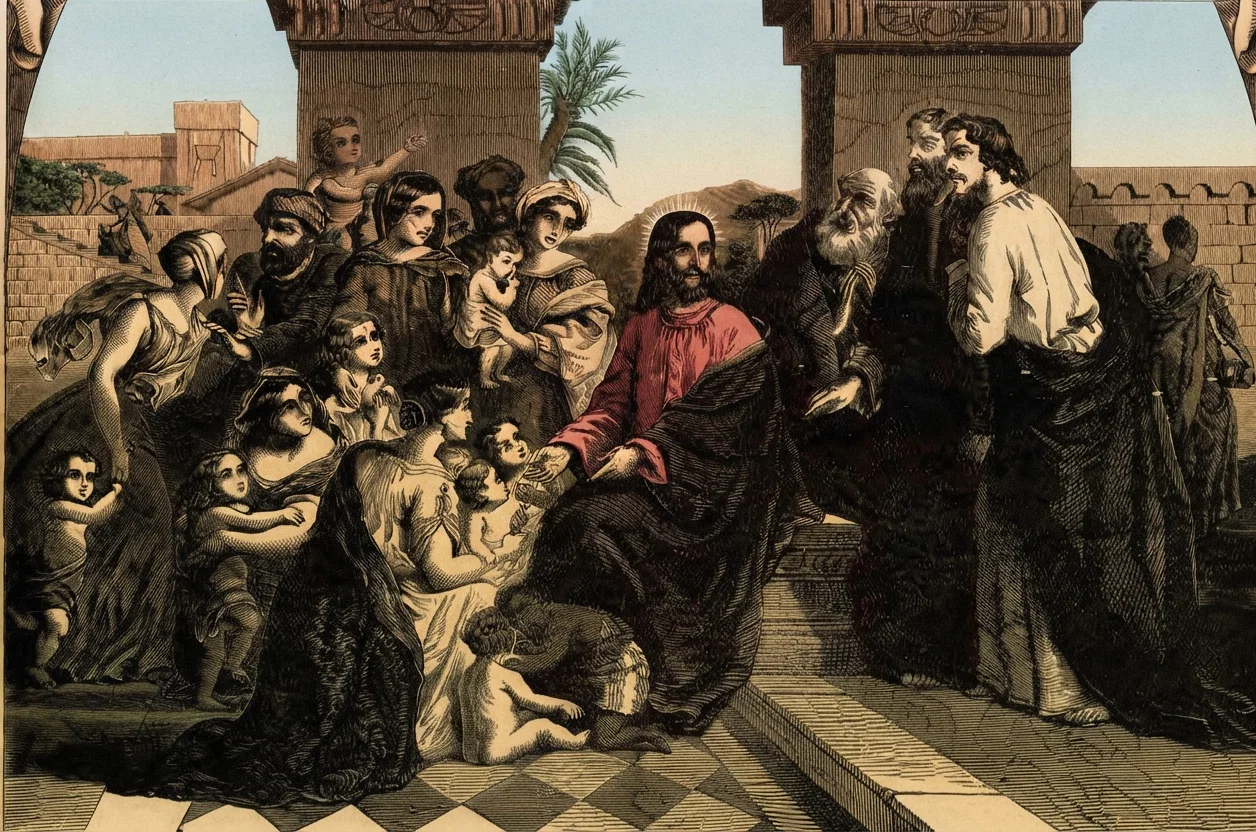
What strikes a mother with more pathos than that story of the Judean women, who sought Jesus with their little ones? or what endears the divine Man more to their hearts than that tenderness which corrected the disciples, made a place for mothers by his side, and a refuge for their children—in his arms and on his bosom? Did not his attitude then show where the mother and the children will find blessing, peace, and rest?
Whatever ancestry has done, and it no doubt has given some godlike traces, there is a place where the divine image may be restored, the ideal beauty regained. It is at Jesus' feet. In that gentle Presence works an almighty love that creates anew. Beholding Love's face, older than that of ancestry, waiting under the beams of that heavenly Dove that of old moved the face of chaos into order and beauty, our souls, and the souls of our children, take on a divine brightness.
How frequently we hear this testimony from efficient men and women in the world, 'If there's anything good in my life, it is due to my mother's influence'! A queen's crown and scepter are not so potent as a mother's influence, nor is a throne so honorable as a home sanctified by a mother's prayer and devotion. That beautiful path trodden by the Judean women is open to all weary-footed mothers. Its gateways open at the child's first question about the world and God. Enter therein, and lead your children to the breast of Him who bids them come and find rest unto their souls.
Gradually we change places. The child becomes father or mother; we sit in the chimney corner, in the dotage of a second childhood; the harvest ripens, and as we have sown in the child's heart, we reap in the years of our infirmity. By and by we lie down amid flowers, tenderly placed in our caskets and over our quiet resting-places by their hands, and dewed with tears of love and sorrow, leaving to them the sweetest or saddest memory that life can have.
By and by the great gates of God will open. Happy then will be the mother who can stand before the Master, and say with joyful smiles, 'Here am I and the children which thou hast given me.' The Master's hand will crown her with a crown gemmed with stars, representing the children saved unto eternal love and life.
This is the vast meaning of the joys, tears, prayers that come to live with us with our children. HOPE ONSLOW.