Our London Letter

3%

Pacific Press Publishing Association · Mountain View, Cal. · Sep 17, 1912

FromSigns of the Times, Vol. 39, No. 36.

Read the full edition

Our London Letter

By Our Own Correspondent

Europe in General

A S one looks out over the surface of European politics to-day, he sees little but unrest and confusion. It is almost a marvel that month after month goes by without witnessing an outbreak of war. The sullen struggle between Turkey and Italy continues, but the Porte has a far more serious problem on its hands in the tumults raging at home. The Albanians are up in armed insurrection; and on the frontiers, Montenegro and Bulgaria have been on the verge of war with Turkey. The Turks themselves are divided into two hostile parties, and the Parliament has been dissolved in consequence, for a new general election.
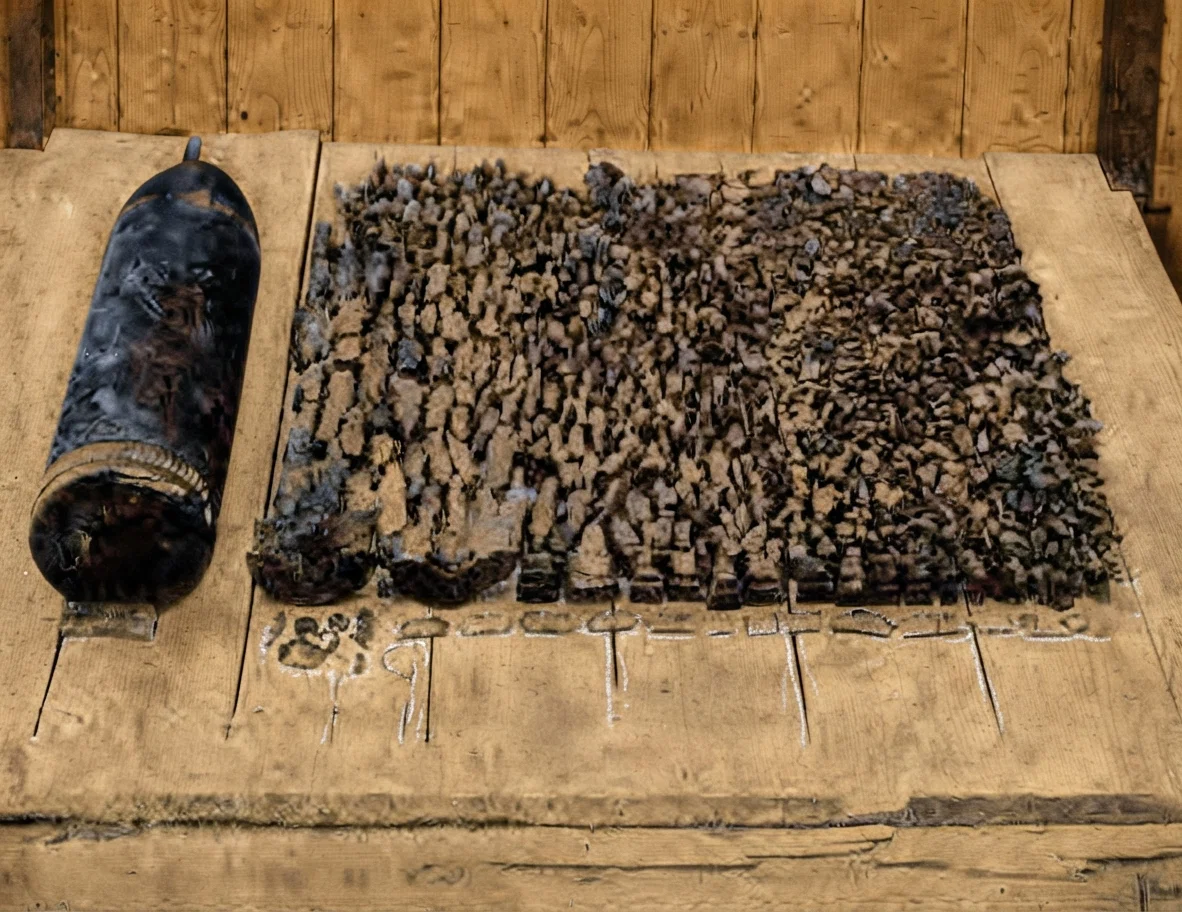
From the "Illustrated London News"
Italy is furious because her friends in Europe have not done more in bringing pressure to bear on Turkey to terminate the war. She is declaring that when they themselves get into trouble they need not look to her for help. She is discovering the hollowness of their friendship. England seems to be the principal offender in her eyes.

Russian Naval Expansion

Russia is again entering upon a naval career, and is planning to spend $650,000,000 for a new fleet. As a part of her plan, she has entered into a naval convention with France. Germany is further strengthening her navy as a fighting unit, and England feels bound to respond with a still further expenditure of $20,000,000.
Public opinion in England is perplexed as to whether it is getting from its friendship with France and Russia advantages sufficient to recompense it for the enormous expenditure which German rivalry is forcing upon it. The cabinet claims that the events of recent years have justified the policy followed by them; but the "Daily News," one of the journals which support the government, views the situation otherwise. It writes:
"The last six years have been the most anxious and agitated period within the memory of man. Crisis has followed crisis; we have been within an ace of war at least twice, and under the terror of war constantly; the rivalry in armaments has grown in costly intensity; and there is no prospect of future relief. International law has lost all respect, and treaties have become a byword. Meanwhile France has absorbed Morocco; the Turkish revolution, owing to the mischievous policy of the Young Turks and international intrigues, has been almost undone; the Russian Liberal movement has been stamped out; the Persian constitution has been destroyed; Northern Persia has been occupied by Russia; we are being blackmailed into opening the gates of India to Russia; and China is on the point of being partitioned. That is the harvest which our policy of special friendships has brought us in eight years, and he must be an optimist who is content with it."
No one in public life now pretends to regard Germany otherwise than as our inveterate rival and destined enemy, with whom it would be puerile to think of making any real or lasting peace. The country has now been thoroly educated into this view of our kinsmen across the North Sea.
Everybody is keenly alive to the details of the competition in ship-building and armaments. The man in the street can tell how many war-ships England has, and when they will be ready for service; and on the other hand, what new march Germany has stolen or is preparing to steal upon us. If anything could be relied upon to make the talked-of war inevitable, it would surely be this frame of mind. All diplomatic disguise has been abandoned.
Underwood and Underwood, London. Cardinal Bourne, from his latest portrait

A Great Change Has Come

Mr. Harold Spender, one of our most prominent journalists, says:
"Less than five years ago it would have been regarded as outrageous that the head of the admiralty should refer so openly to a foreign power, and should develop all these comparisons of size and number which are so admirably calculated to stimulate a fighting spirit between the two nations. The effect has certainly been deplorable. It was started just when the German naval program of 1906 was coming to its natural conclusion. It has led directly to a renewal of the program on both sides of the North Sea. There seems every reason to suppose that this system, if continued, will go on having its effect with increasing power until it ultimately produces war."
The tone of the speeches made by Mr. Churchill, the first lord of the admiralty, is hailed with delight by the Conservative Party, but they have been a bitter disappointment to his own party, the Liberals, some of whom regard him as a traitor to the principles which he espoused only a few years ago on leaving the Conservative Party, and it is rumored that erelong he will return to his original allegiance. The new editor of the "Review of Reviews," Mr. W. T. Stead's old paper, suggests, however, that Mr. Churchill is the very man for the place he occupies, and advocates his holding it permanently, irrespective of any change of government, as a trustee of the national defense. Mr. Churchill is a master of vigorous and graphic speech, and his vivid representations of the powerful force that is being steadily created by Germany have laid hold of the public imagination.

Canada and the Naval Program

Mr. Borden, the Canadian premier, and his colleagues in the cabinet, have been here in conference with the Liberal government, and one matter under discussion has been the contribution which Canada should make to the naval forces of the empire. Details are not to be made public until the Canadian Parliament approves them; but it is assumed that the dominion will make an important addition to the existing naval armaments, for use wherever it may be most needed. Thus the area of the struggle widens and its gravity deepens.

Canada and the Catholic Church

Canada, by reason of its remarkable growth, is not only claiming more attention from the British Empire; it is also becoming an object of special interest to the Church of Rome. In the annual congress of that body, which has just been held at Norwich, Cardinal Bourne gave expression to his firm and unchangeable conviction that it would be through Canada, with its forty per cent of Roman Catholics, that the British Empire was to be won back to the papal see. He said:
"A new population with amazing growth has come into existence in Canada, the whole situation has changed, and the church in Canada has to face a responsibility which a few years ago could not have been foreseen. . . .
"It consists of nothing less than welding together into one people, by means of one religion, those who, coming from many different races, are, by the forceof circumstances, quickly becoming members of the far-spread English-speaking world.
"It is religion alone which can make of the Canadian nation one absolutely united people. It is the Catholic religion alone which has this unifying force. Other religious bodies may enter in and gain adherents to their various forms of worship and belief; but which of them would dare to hope to join to itself even a minute fraction of the Catholics of Canada? It is they, and they alone, with their existing forty souls in every hundred of the population, that can essay to weld a whole people into something approaching religious unity."
This is interesting language to the student of prophecy. The book of Revelation indicates that it would be in the New World that Rome would regain for a while the power and influence she had forfeited in the Old World; that there an image would be set up to the beast that had received the deadly wound; and it is surely significant that to-day, when that restoration of the Papacy is in process of fulfilment, the Church of Rome should be basing her hopes for the future on the United States and Canada.

Women's Suffrage

Turning from international to home affairs, England's domestic relations are hardly more peaceful than her foreign. The women's suffrage movement is still with us in its most militant form. Two suffragettes have just been sentenced to five years' penal servitude for attempting to set fire to a theater in Dublin, where Mr. Asquith spoke on his recent visit to Ireland. Recently several members of the cabinet have been personally assaulted. When the pending reform bill is dealt with in Parliament, the House of Commons will be invited to decide for itself whether it wishes to confer the vote on women as well as upon the male adult population. Mr. Asquith has publicly stated that he does not believe, in view of recent developments, that the House will show itself prepared to take such a step; and if his forecast is verified, there will doubtless be a still further outbreak of violence on the part of the militant suffragettes.
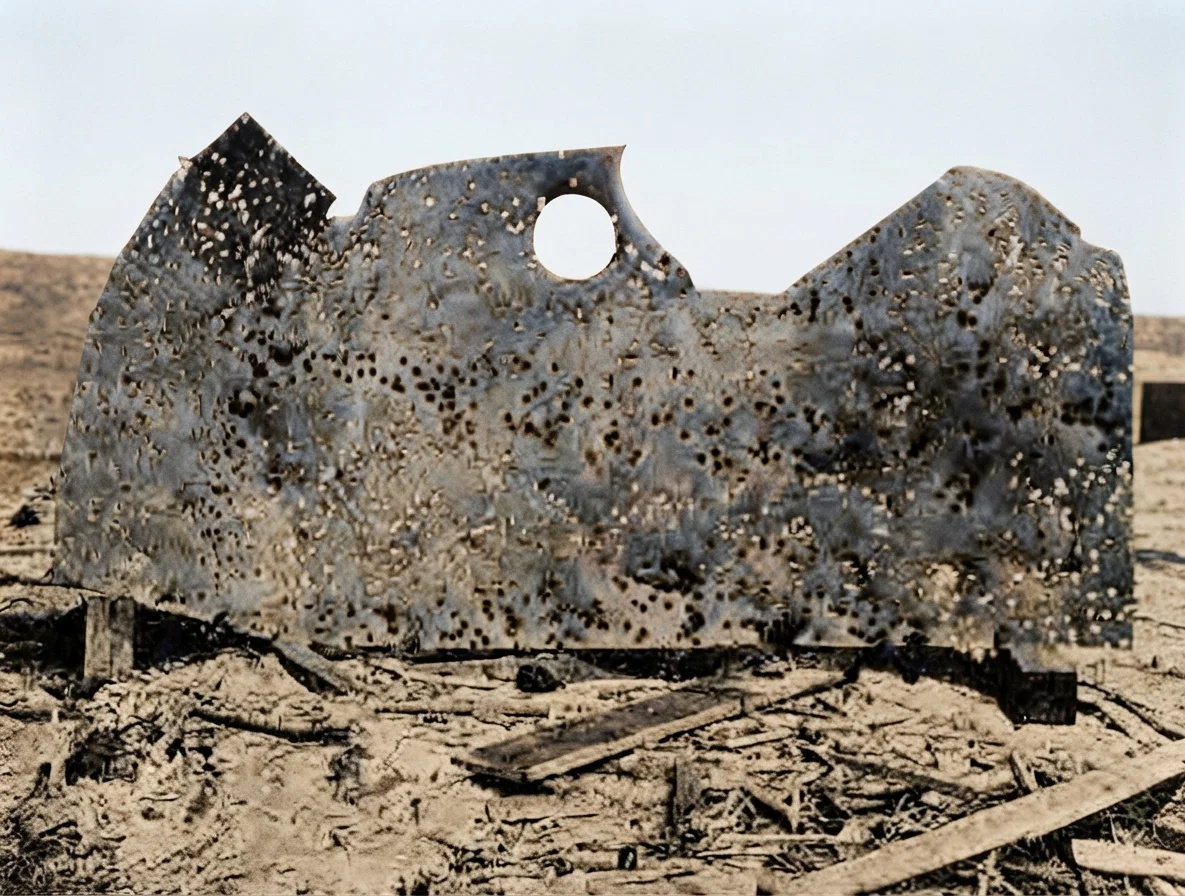
From the "Illustrated London News" A steel plate riddled by the bullets from a 12-inch shrapnel-shell, otherwise spoken of as the "man killer." See illustration on opposite page.

Home Rule in Ireland

In Ireland the agitation over the home rule question has produced something like a reign of terror for the unfortunate Catholics employed in the Belfast shipyards. Bands of Orangemen have hunted Catholic workmen out of the shops where they were at work, and pursued them through the streets, hurling iron rivets and brickbats at them. A large number have been injured so seriously that they had to be taken to hospitals. One man was thrown into a barrel of melted pitch; another was stripped and singed before an open furnace until some of his comrades armed themselves with sledge-hammers and threatened to smash the skulls of his assailants if he were not released. The cause of those who protest against home rule for any reason has been sadly disgraced by this outbreak of murderous violence, for it is apparent that the Orange faction have no room to talk of Romish bigotry and persecution as an argument against giving the Catholic majority of the country self-government. The state of affairs in Belfast simply shows that one may be a persecutor of the worst type, a thorogoing representative of its most diabolical principles, and yet bear the name of being a fierce opponent of Romanism. It is the spirit of Rome that is to be feared, rather than the name.
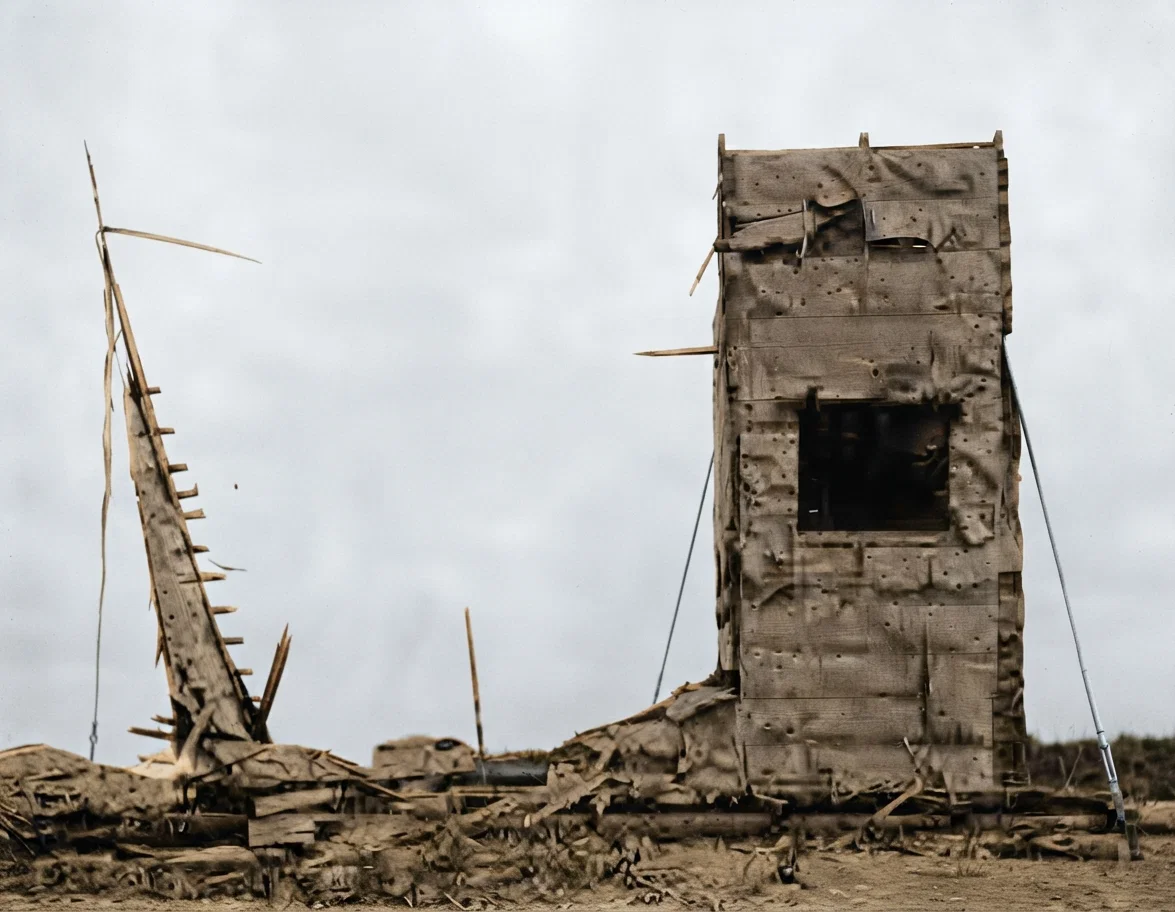
From the "Illustrated London News" "A target used for testing the effect of shell fire,—a frame of scantling sheathed with wood, which originally carried three plates of steel"
Meanwhile the government is pressing on with its measure for conferring self-government on Ireland, altho, when the bill is passed, there will doubtless be many grave difficulties to face in Ulster.

National Insurance Act

The government is not finding the path of reform a smooth one. The National Insurance Act became law on the 15th of July, but up to the present the doctors have almost unanimously refused to accept the scale of remuneration provided for them under the act. It remains to be seen how Mr. Lloyd-George will surmount this difficulty. Now that some twelve millions are compulsorily insured against sickness, doctors will have to be provided somehow to treat them, or the government will be compelled to admit defeat. Naturally it will do its utmost before it surrenders to the opposition, and this may mean that a radical change will soon take place in the system by which medical skill is made available.

The Dock Strike

For over two months the trade of the port of London has been crippled by a dock strike, which has finally ended in the men's going back to work on the masters' terms. The organizers of the strike declared it in despotic fashion in order to compel the masters to employ only such laborers as belonged to the Trade Union Federation. The masters stood out together against this demand, and in an early stage of the struggle Mr. Ben Tillett and his colleagues declared a national strike of dock workers. The response, however, was only partial, and before long the other ports in the country were again in full operation.
In London the strike dragged wearily on for more than another month, accomplishing nothing except to plunge the dock workers and their families into grievous distress. The whole body of strikers, between thirty and forty thousand stalwart men, marched through the principal thorofares of the city of London one day, carrying banners announcing their determination to hold out till their end was gained. The sight of such an army, fully equal in physique to a body of military, brought home to one the remarkable power that labor agitators have acquired over vast masses of toilers. These men were not striking for more pay or fewer hours—their work is altogether too uncertain as it is—but for the right to deny all who did not join their federation the privilege of earning a living at the docks. There was plenty of work waiting to be done if the men would do it, but for ten weeks they stood out, until their leaders were brought to swallow the bitter pill of acknowledged defeat, and ordered them back again.
Something is obviously wrong with our civilization. The bonds that hold society together are visibly weakening. Not only is the old antipathy between capital and labor and between nation and nation stronger than ever; the same spirit of hostility is making itself apparent in almost every section of the internal life of the country. The popular preachers of the day are predicting an era of brotherhood, but the real tendency seems to be in the opposite direction. Federation is the prevailing sentiment, if we are to judge by mere words; but antagonism, mutual suspicion, and class hatred are permeating society more and more. Many express a fear that we may soon find ourselves plunged into a wide-spread reign of violence.
W. T. BARTLETT.